The Internet's Broken Promise
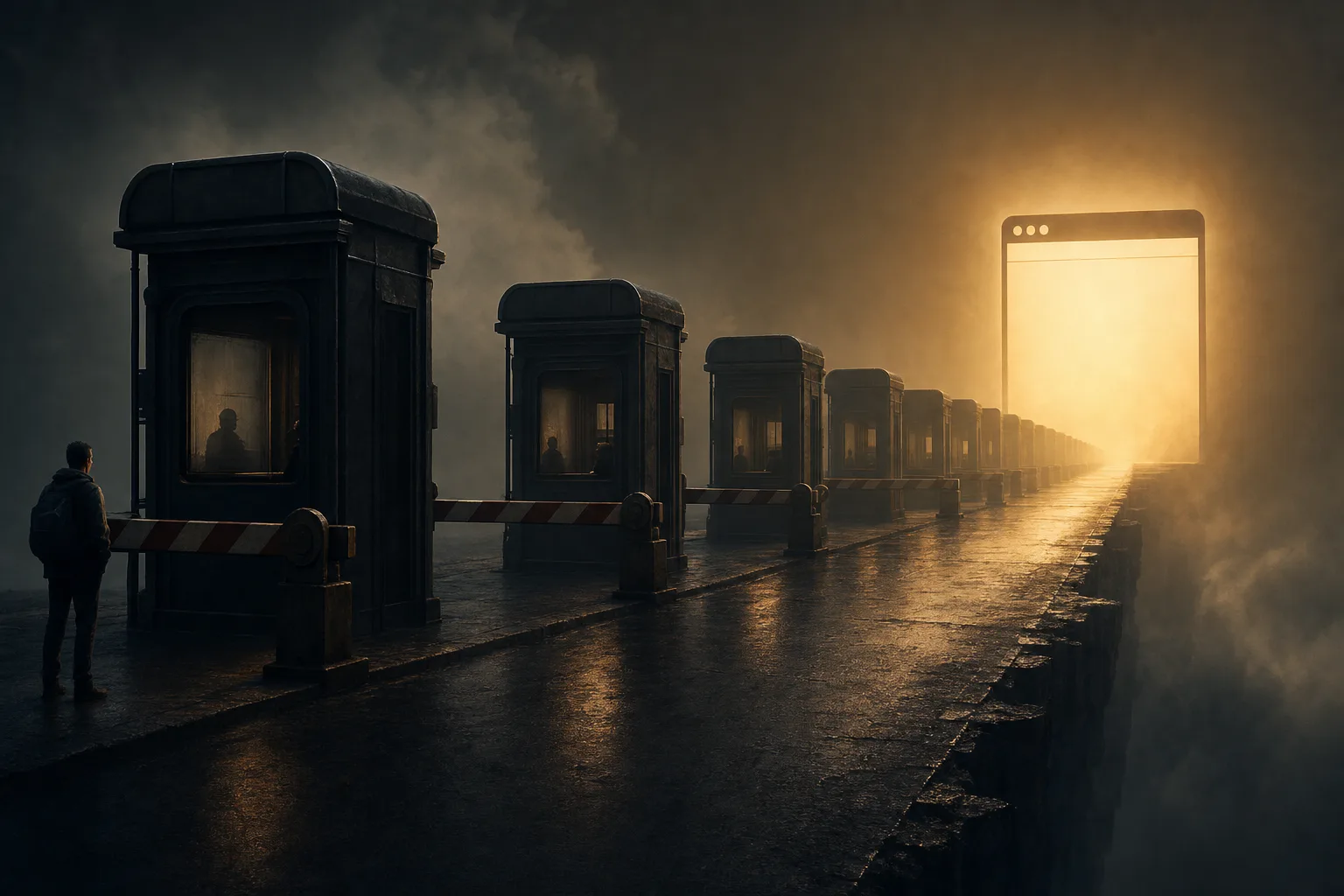
The internet was supposed to kill the middleman. It built the biggest middlemen in history instead.
In 2004, I typed a question into Google and got ten blue links. Ten doors. I picked one, walked through it, and landed on someone's website. A real website, made by a real person, with information they wrote and published and owned.
That's over.
The ten blue links are gone. And almost nobody noticed.
- 59% of Google searches now end without a single click to any website. Google went from doorway to destination.
- Amazon takes roughly 50% of seller revenue in combined fees (up from 19% in 2014). Booking.com takes 15-25%. Apple takes 30%. The middleman tax is accelerating.
- AI search is the newest intermediary layer. ChatGPT now handles checkout. Perplexity's browser shops for you. Google AI Overviews cut organic clicks by 58%. The visits are disappearing.
- Every major platform followed the same playbook: attract users with a good deal, then squeeze suppliers, then extract everything for themselves.
- The escape is owning the relationship directly. Your website, your data, your audience. Renting access to your own customers is a losing game.
The promise nobody kept
In 1995, Bill Gates wrote that the internet would create "friction-free capitalism." The pitch was simple: connect buyers straight to sellers. No brokers. No agents. No distributors. Just people finding each other across a wire.
Nicholas Negroponte at MIT argued that the shift from atoms to bits would reshape whole industries. The Cluetrain Manifesto in 1999 declared that "markets are conversations." Direct ones. No translators needed.
For a while it looked like they were right.
Craigslist destroyed newspaper classifieds. A multi-billion dollar industry, gone. Wikipedia killed off the encyclopedia salesman. Amazon let you skip the bookstore. eBay let you sell your stuff to strangers without a dealer.
The middlemen were dying. The future was direct.
Except it wasn't. The old middlemen died and new ones took their seats. Bigger ones. Smarter ones. With better data, stronger lock-in, and a global reach the old ones never had.
The internet didn't kill the middleman.
It made the middleman invisible.
Google became the answer
Google started as a librarian. You asked a question, it pointed you to the right shelf. It never tried to answer the question itself. That wasn't the job. The job was the pointing.
Then the librarian started reading the books out loud.
Google Shopping launched in 2002 as a free product search tool, then went pay-to-play in 2012. Google Flights arrived in 2011 after Google bought ITA Software for $700 million. Then came Google Hotels. Google Jobs. Google Recipes. Knowledge Panels started answering questions right on the page in 2012. Featured Snippets took the best paragraph off someone's website and put it at the top of the results. So you didn't have to visit that website at all.
The EU noticed. In 2017, the European Commission fined Google EUR 2.42 billion for promoting its own shopping service and pushing everyone else's down. Google appealed. It lost. Twice. The fine stuck.
The strategy didn't.
I want you to read that chart again. Fifty-nine out of every hundred people who type something into Google never click on anything at all. They read the answer on Google's page. That answer was scraped from content on someone else's website.
The librarian stopped pointing to the shelf. The librarian reads you the book now. And the author doesn't get paid.
In August 2024, a US federal judge ruled Google a monopolist. Not a competitor. Not a market participant. A monopolist. The company that promised to organize the world's information captured it instead. The doorway became the destination.
The tollbooth economy
Google is just the most visible example. The pattern is everywhere. Every industry on the internet has grown its own tollbooth. Sometimes two. Sometimes five.
I'll walk you through what it takes to book a hotel room in 2026.
The hotel keeps $19. The middlemen keep $61. Nobody in that stack owns a bed. Nobody launders a sheet. Nobody checks you in at midnight.
And this is the normal case.
Amazon tells the same story. In 2014, Amazon's total take from third-party sellers was roughly 19% of their revenue. By 2023, it reached 50%. That means half of every sale. That's referral fees, fulfillment fees, and the advertising you now have to buy just to be seen on the platform you already pay to sell on. Amazon's advertising business alone made $56.2 billion in 2024. None of that came from selling products. All of it came from charging sellers for the right to be found.
DoorDash takes 15-30% from restaurants that run on 3-9% margins. In plain English: the toll can be ten times the restaurant's own margin. Apple takes up to 30% from app developers. Airbnb charges both the host and the guest. Etsy raised its seller fees to 6.5% and then made offsite advertising mandatory for anyone earning over $10,000.
The specifics vary. The direction never does.
Every platform runs the same three-step playbook. Be generous to attract users. Squeeze suppliers once they depend on you. Take as much as you can for yourself.
Cory Doctorow calls this enshittification. The American Dialect Society named it their 2023 Word of the Year. That tells you how normal it has become.
The middleman's middleman
Stack the layers and the absurdity shows itself.
A guest searches for a hotel on Google. Google shows its own hotel results first. The guest clicks through to Booking.com, and Booking.com paid Google for that click. The guest books a room, and the hotel pays Booking.com 20%. The payment is processed by Stripe, which takes 2.9% plus $0.30. The charge then runs through Visa's network, with interchange fees to the issuing bank and assessment fees to Visa.
Four middlemen. Five, if you count the guest's bank. Not one of them owns a hotel.
The same stack sits under everything. A musician on Spotify pays the streaming platform, the label, the distributor, the payment processor, and the card network. An author on Amazon pays the marketplace, the fulfillment system, the advertising auction, the payment processor, and the card network.
Programmatic advertising is where the stack turns into a joke. The industry drew a chart called the LUMAscape just to map all the middlemen between an advertiser and a publisher. It started with 49 categories. It now lists nearly 5,000 companies. A 2023 ANA study found that only 36 cents of every programmatic ad dollar reaches a person as a viewable ad. Which means 64 cents vanish along the way: 29 in ad-tech fees and 35 in pure waste, the ads nobody sees, the fake traffic, the junk sites built to soak up spend. The original chart looked like a subway map. Now it looks like a conspiracy wall.
Visa and Mastercard sit under almost all of it. In 2024, US merchants paid a record $187.2 billion in combined credit and debit card swipe fees. That means the toll has tripled since 2009. Visa alone moved $16 trillion in payments and earned $35.9 billion in revenue at a 55% profit margin. They carry no credit risk. They lend no money. They just charge rent on the wire.
The internet didn't get rid of the middleman. It piled middlemen on top of middlemen. Then it hid the pile from view.
Now the robots want a cut
You'd think AI would fix this. A smart assistant that searches the whole internet for you should cut through the layers. That's the pitch, anyway.
It's not what's happening.
What's happening is a new middleman built on top of all the old ones. And it moves faster than any middleman before it.
In September 2025, OpenAI launched "Buy it in ChatGPT". You ask ChatGPT about a product. It shows you a card. You buy it without leaving the chat. The store never sees you. Shopify, Etsy, and Walmart are already plugged in, with over a million merchants coming online. OpenAI takes a fee from every sale.
Perplexity went further. In October 2025, they made Comet free and available everywhere. It's an AI browser that shops for you. It reads product pages, compares prices, logs into your accounts, and buys on its own. You don't even pick the store. The AI picks, clicks, and buys.
Amazon sued them. A federal judge blocked Comet from reaching Amazon on March 9, 2026. Perplexity appealed. The Ninth Circuit granted an administrative stay a week later. The middlemen are now fighting each other over who gets to stand between you and the store.
Amazon then launched its own AI agent, "Buy for Me", which shops other retailers without leaving the Amazon app. Shopify launched Agentic Storefronts so merchants can sell inside AI conversations. Google announced a Universal Commerce Protocol for checkout inside AI search. Everyone is racing to be the agent that stands between you and the purchase.
The damage to traffic is real. Google's AI Overviews now cut organic click-through rates by 58%. Google search referrals to publishers fell 33% globally in 2025. Small publishers lost 60% of their search traffic over two years. Which means the people who wrote the information get none of the visitors. The AI ate their work and read it back to the reader. For free.
The old search engine was a middleman that at least pointed you somewhere. The AI search engine is a middleman that keeps you right where you are. It's not a doorway. It's not even a hallway. It's a room with no exits.
And the ads showed up right on schedule. In February 2026, OpenAI started showing ads in ChatGPT to free-tier users. Microsoft put ads inside Copilot. Google put ads inside AI Overviews. Every AI company that launched with "no ads, just answers" now sells ads. Every single one.
New technology. Same playbook.
The walled garden ate the open web
Search isn't the only place this happens. Every big platform walked the same road: start open, end closed.
Facebook used to show your posts to 16% of your followers. Today the average is roughly 2%. In practice, to reach the audience you've spent years building, you pay. Meta's ad revenue in 2023 was $131.9 billion. None of that came from building connections. It came from charging you to use the connections you already built.
LinkedIn gives posts with external links 6x less reach. Instagram never allowed clickable links in posts. TikTok keeps you in an in-app browser so you never really leave. Twitter, now X, openly buries posts that link elsewhere.
Every one of these platforms started by welcoming outside content. Links were currency. Sharing was the whole point. Then the audience got locked in, and the rules changed. Native content only. Stay inside the walls. Stop linking out. The open web became a threat to the walled garden.
Google Reader, the most popular RSS reader with over 30 million users, was shut down in 2013. RSS was the purest direct subscription there's. You chose what to follow, you got every update, and no algorithm decided what reached you. Google killed it. The reason isn't complicated. A direct link between a reader and a publisher is a link Google can't tax.
A 2024 Pew Research study found that 38% of the webpages that existed in 2013 are gone today. In plain English: more than a third of the web, erased in eleven years. I find that number harder to shake than any of the fee tables. The open web is shrinking. Not because people stopped making websites. Because the platforms took the attention, and without attention there's no reason to keep the lights on.
The question nobody asks
Here's the part I keep turning over in my head.
The internet runs on a protocol called TCP/IP. Any computer can talk to any other computer. No central authority needed. The whole thing was designed for direct connection. No gatekeepers. No tollbooths.
The technology still works that way. You can still put up a website, write something, and anyone with a browser can read it. The protocol never changed. It hasn't needed to.
What changed is the money.
When the cost of distribution fell to zero, the old middlemen lost their edge. The bookstore, the travel agent, the classified ad desk all had less reason to exist. But a new problem exploded in their place. With a billion websites out there, how do you find the right one? Whoever answers that becomes the new middleman. The old ones were stuck inside geography and competed street by street. The new ones run at global scale, and the winner takes nearly all of it.
Ben Thompson calls this Aggregation Theory. Free distribution handed all the power to whoever aggregates demand. Google aggregates search intent. Amazon aggregates shopping intent. Facebook aggregates attention. The aggregator owns the customer. The supplier becomes a swappable part.
The internet killed the middlemen of distribution.
It built the middlemen of discovery.
And the second kind holds far more power than the first ever did.
The only escape
I won't pretend there's a clever hack here. No trick. No plugin.
The only way out of the middleman economy is to own the relationship directly.
Own your website. Not a Facebook page. Not an Instagram profile. Not a storefront on someone else's marketplace. A website you control, on a domain you own, with content you publish and data you keep.
Own your audience. An email list is yours. Social media followers aren't yours; they're rented. If the platform flips an algorithm tomorrow, or goes bankrupt, or decides your category isn't worth showing, your rented audience vanishes. Your email list doesn't.
Own your data. This is the fight I picked, so discount me accordingly: when your analytics live on Google's servers, Google decides what you're allowed to see. Google decides how long the data sticks around, what gets sampled, what gets blended into a number too vague to use. And it feeds your visitor data into its own ad targeting. You handed over how your customers behave, for free, and it sold ads to your competitors with it.
That's why the answer isn't another platform. It's plain, unfashionable independence. Your own website. Your own analytics. Your own email list. Tools where you're the customer, not the product.
Full disclosure: I build one of those tools, a cookieless analytics product, so I'm not a neutral bystander here. And if you're thinking this through for your own site, email me what you're weighing.
The internet's first promise wasn't wrong. It was early. Direct connections between people still work. They're still worth more than the ones routed through a tollbooth. They're just not the default anymore.
Every platform wants to stand between you and your customer. Every algorithm wants to decide what your audience sees. Every new AI tool wants to summarize your work and keep the traffic for itself.
The only question left is whether you let them.

Comments
Loading comments...
Leave a comment