What Using Cookie-Banner-Free Analytics Actually Means for Your Site

With a cookie banner, your analytics see 25-40% of actual traffic. Without one, they see nearly all of it. That's not a rounding error. It's the difference between deciding on a biased sample and deciding on the real thing, and I've watched teams plan whole quarters off the biased one.
- The UK's privacy regulator lost 90.8% of tracked traffic after implementing a proper consent banner. 60-70% of European visitors reject analytics cookies.
- Cookie consent banners add 50-150KB of JavaScript and 2-6 extra network requests, measurably increasing Largest Contentful Paint and layout shift.
- Removing the consent banner eliminates a full-screen interstitial on mobile, the single biggest UX friction for first-time visitors.
- Cookie-banner-free analytics capture the visitors a banner would have turned away, from day one, giving you near-complete data instead of a consented subset.
- Tools that qualify as 'strictly necessary' under GDPR (no cookies, no personal data, EU-hosted) don't require consent and can legally run without a banner.
The consent banner is costing you more than you think
You probably think of your cookie banner as a minor annoyance. A popup your visitors click through. A compliance checkbox. Something you set up once and forgot about. I did too, until I ran the numbers.
It's none of those things. A cookie consent banner is an active drain on five separate fronts, and I'd bet you've never added up the bill on yours.
Every one of these problems disappears the moment your analytics tool stops needing cookies. Not reduced. Eliminated. That means five separate drains gone with one switch. Let me take them one at a time.
You're making decisions with a fraction of your data
This is the biggest one, and I think it's worse than it sounds. You aren't losing a slice of your traffic, you're losing the visitors most likely to buy.
Show a visitor a GDPR-compliant cookie banner with an equally visible "Reject All" button, and the research is consistent: 50 to 66% of them will reject. That means half your traffic or more opts straight out of your data. Germany is worse. Fewer than 25% of German users accept analytics cookies. France, the same. That means in those markets three of every four visitors never enter your data. In a 2023 study covering 1.2 million users, only 25.4% accepted all cookies at the first banner level.
The rest reject, close the banner, or ignore it. And every one of those people vanishes from your cookie-based analytics, so your reports are already missing them before you open a single chart. They didn't leave your site. They're reading your content, clicking your links, buying your products. You just can't see them.
The eTracker benchmark study found that with a legally compliant banner, an average of 60% of visit data is lost. Not a worst case. An average. That means the typical site is reading well under half its real traffic. More than half your visitors, gone. The UK's own privacy regulator, the ICO, lost 90.8% of tracked traffic after putting a compliant banner on its own site. In plain English: the body that writes the rules lost nine in ten visitors to its own popup.
The data you lose isn't random. This is the part that should worry you. A study by Exactag covering 25+ advertisers found that non-consented users have 5% higher basket values, convert 33% faster, and need 20% fewer touchpoints to buy. That means the banner hides exactly the customers you most want to see. The visitors you can't see are your best ones.
Researchers call it "non-consent bias." Your sample isn't just smaller. It's bent. Consent rates vary by over 36% by traffic source, so your channel mix is distorted too. That means the channels you think are winning might just be the ones people consent to. Social and display get underreported because those visitors consent less. Direct looks inflated. Your conversion rate reads high because the non-converting, non-consenting visitors never enter the denominator.
You're not seeing most of your traffic with a few gaps. You're seeing a biased minority and treating it as the whole, and I think that's the most expensive mistake in analytics. I'd want the real number.
Switch to cookie-free analytics and the consent gate is gone. You count every visitor. No modeling, no estimation, no guesswork. Your traffic numbers are real, your sources reflect reality, and your conversion rate tells you the truth. It's not more data. I'd call it accurate data instead of distorted data.
575 million hours of wasted clicks
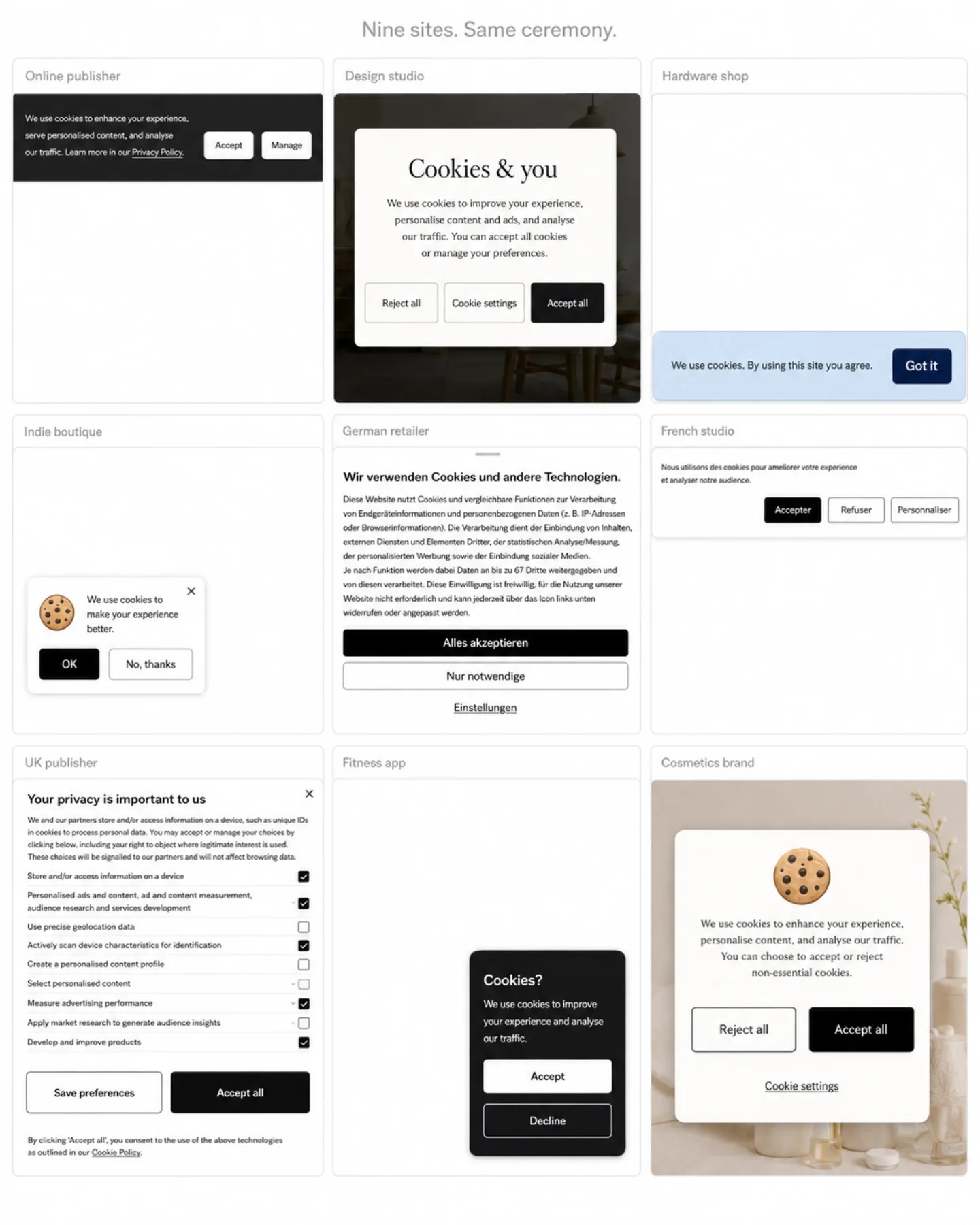
The data problem is the big one. But there's a simpler one sitting right next to it: cookie banners are a bad experience for the person on the other side of the screen.
Europeans spend an estimated 575 million hours per year clicking through cookie consent popups. Put that in money and it comes to roughly 14.375 billion euros in lost productivity at average European wages. Every single year. That means Europe burns a small country's economic output clicking these away. Spent on a system that 76% of users find annoying and almost nobody understands.
And almost nobody is reading them. A 2023 study of 1.2 million users found that 68.9% just close or ignore the banner. Nearly seven in ten people aren't weighing up their privacy. They're swatting away an obstacle. In a field study, 44 of the 61 people who clicked a cookie notice clicked it because it annoyed them. That means most clicks on your banner are reflexes, not consent. Not because they read it. Not because they agreed. Because it was in the way.
Your cookie banner is the first thing a visitor touches on your site. Not your headline. Not your product. A legal popup. That means you spend your best first impression on a consent form. And plenty of people will close the tab rather than wrestle with it. They never get as far as your content.
The average internet user runs into over 1,000 cookie banners per year. More than a thousand. In plain English: everyone is numb to them well before the hundredth. That's where consent fatigue comes from. After a few hundred of these, nobody is reading anything. People just build the muscle memory to make the popup go away. A Harvard Business School study put a price on it: the average US worker loses about $4 a week to time spent staring at cookie banners. In plain English: the ceremony costs everyone something and buys almost no one anything.
Take the banner away and the first thing your visitor meets is your content. Your headline, your product, the reason they came to you. Those three seconds they'd have burned on a legal popup go to what you built instead.
The hidden performance tax
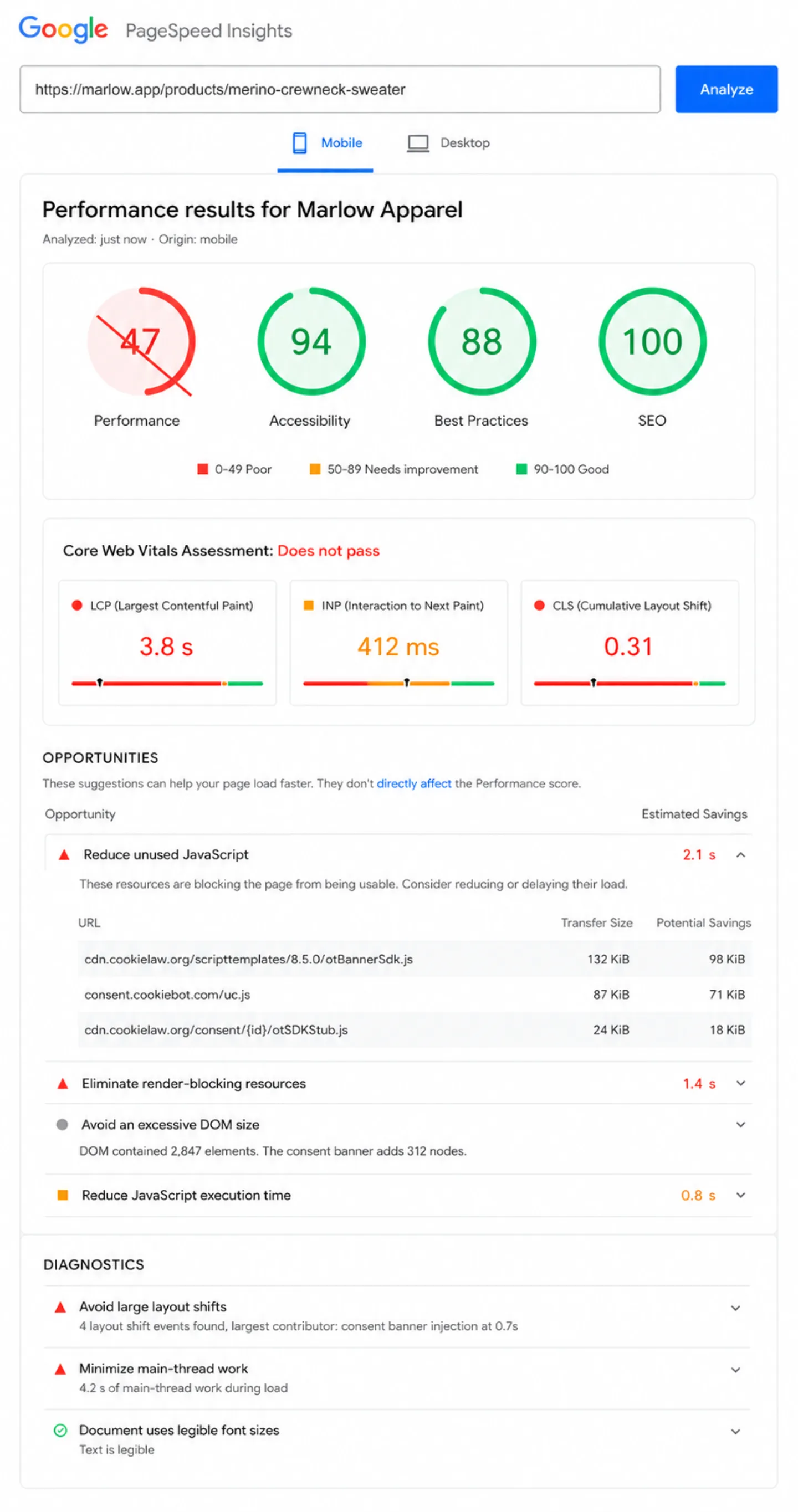
A cookie banner doesn't only annoy people. It slows down your whole page, and I can show you the byte counts.
Consent Management Platforms are big, heavy JavaScript apps. OneTrust loads approximately 124 KB of compressed JavaScript. UserCentrics comes in at 206 KB. That means your consent tool alone can outweigh your entire page. Even one of the lighter ones, CookieBot, drops 34 KB of synchronous JavaScript and 209 DOM nodes onto your page. That means the lightest banner still outweighs a whole privacy-first tracker before it does a thing.
And all of that lands before your analytics script even shows up, which is the part I find backwards: the compliance tool is slower than the thing it is policing.
The numbers on what this does to your load time aren't subtle. DebugBear tested it and found that adding a cookie consent banner pushed Largest Contentful Paint from 1.43 seconds to 3.61 seconds. That means the banner alone fails the speed test Google grades you on. The banner's wall of text was bigger than the page's hero image, so the banner itself became the thing Google measures as the main content. That means your slowest element is the popup. Google calls anything under 2.5 seconds "good." The banner on its own blew past that.
RUMvision documented a client case where the cookie banner was the slowest-loading element on 50% of mobile pageviews, with new visitors hitting 4,721ms. That means on half of mobile loads, the slowest thing on the page is the consent popup. That's nearly double what Google considers acceptable.
Load time is only the start of it. Per Google's own documentation, cookie banners are one of the most common sources of Cumulative Layout Shift, the metric for content jumping around as the page loads. A banner slides in from the top or bottom, shoves everything else down, and your layout score tanks. Anything over 0.10 is no longer "good," and a single banner shift can push you past it, so you fail a Core Web Vital you'd otherwise pass.
Then there's the click. The moment a user taps "Accept," the CMP runs more JavaScript to record the choice and then fires off every third-party script that was waiting on consent. The Agence Web Performance comparison measured how long the page takes to respond after that tap, at the 75th percentile: Cookiebot hit 241ms, and Google's own Funding Choices CMP scored 200ms. The line for "good" is 200ms or under. That means most consent tools fail the responsiveness bar the moment your visitor taps accept. Most of them sit right on it or worse.
The most thorough real-world measurement comes from Simon Hearne's research. He compared the opted-out and opted-in versions of the same site. Visual complete time went up 35%, from 5.4s to 7.3s. CPU busy time went up 2.5x, from 4.9s to 12s. The number of requests jumped from 60 to 144. On a repeat visit, your page load more than doubled. His conclusion was blunt: "Opted out experiences are roughly 35% faster." That means turning off the tracking makes the page a third quicker for everyone.
When your analytics don't need a banner, and I made sure Clickport's doesn't, all of that goes away. No CMP script. No DOM injection. No layout shift from a banner sliding in. No flood of scripts after the click. You get one small tracking script, loaded in the background, with nothing to show on your Core Web Vitals.
Mobile visitors get the worst of it
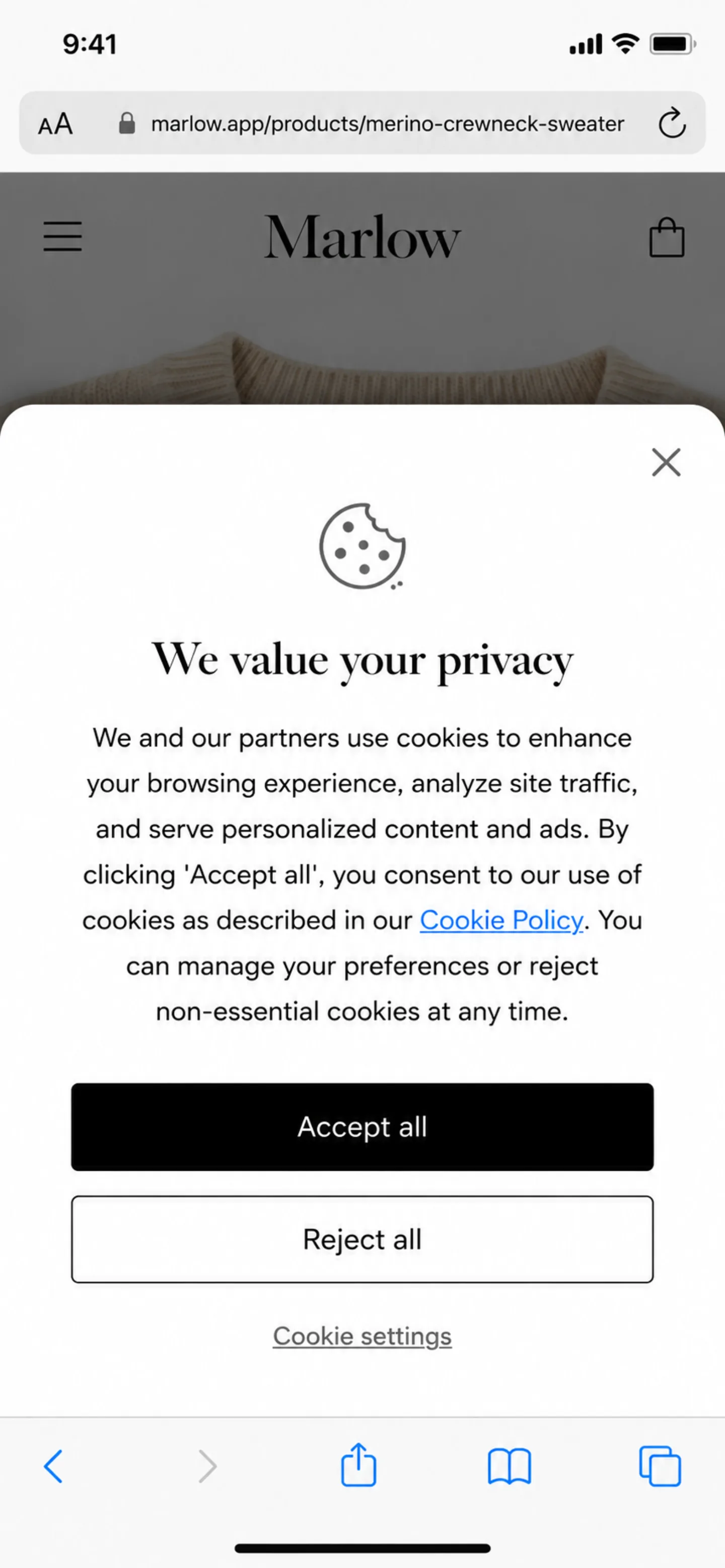
Everything I just described gets worse on mobile. A lot worse. And mobile is where 60 to 64% of your traffic lives. That means most of your visitors get the worst version of this, and I'd want to fix the version most people see first.
On a phone, your cookie banner eats 30 to 50% of the screen your visitor came to see. Picture a 375-pixel-wide display with stacked accept and reject buttons and a paragraph of legal text. There's barely any room left for the page. Some banners go further and switch off scrolling until you tap, so you can't even peek at the content underneath. That means you're blocked from your own page until you answer a legal question.
The buttons are a problem too. WCAG 2.1, the accessibility standard, asks for a minimum 44x44 pixel interactive target. Plenty of banners shrink buttons built for a desktop down to a size your visitor can barely hit on a phone. A "Manage preferences" link in 11px text might as well not be there for your visitor. And here's the irony: if someone taps "Accept" by mistake because the button was too small or placed to trick them, that's not valid consent under GDPR anyway. The friction buys you nothing, and I mean nothing you can use.
The speed hit compounds on mobile. On a 3G connection, still common in plenty of markets, a CMP that loads synchronously can add 1 to 2 seconds of blank screen before a single thing appears. You've lost them already. Then consent fires the rest of the third-party scripts all at once, and the page can freeze for several more seconds, and you've lost the visitor I'd have most wanted you to keep. Research shows that 53% of mobile users leave a site that takes more than 3 seconds to load. That means a slow banner can cost you half your phone visitors before they read a word. So more than half of your visitors walk away at the three-second mark, and a cookie banner can spend that whole budget by itself.
Mobile already bounces harder than desktop: roughly 60% versus about 50%. That's a 10-point gap before a banner is anywhere in sight. That means you're widening a gap that already runs against you. Now you're dropping an overlay that covers half the screen, slows the load, and demands a tap before the content shows. You're widening a gap that was already against you.
Cookie-free analytics give your mobile visitors the same clean, fast page your desktop visitors get, and getting mobile right is the whole game for me. No overlay. No waiting for content. No tap targets you need good aim to hit. Just the page, loading fast, content there from the start.
The compliance theater nobody talks about
Now for the part I find hardest to defend: most cookie banners don't even follow the rules they exist to enforce.
A 2025 study by Aarhus University looked at 254,148 websites across 31 EU countries. Only 15% met the minimum GDPR bar for their cookie consent. In plain English: the compliance tool is usually the compliance problem. Read that the other way and it's worse: 85% of cookie banners break the law in one way or another. In other words, the cure you installed is sicker than the disease. You took on the risk and the slowdown, and you still aren't compliant.
The specific failures are well documented, and every one of them points the same way:
- 43% of websites set tracking cookies without valid consent
- 57.5% don't delete cookies after users revoke consent
- 63% run pixel tracking without valid consent
- 79% of websites load trackers before consent is even given, with an average of 3 trackers active at page load
- 77% contain at least one dark pattern (asymmetric button design, pre-checked boxes, hidden reject options), which means most banners are quietly rigged toward accept
NOYB, the privacy group Max Schrems founded, has filed over 700 formal GDPR complaints against banners that don't comply. Look at what they found on the sites they checked. 81% had no "reject" option on the first screen. 73% used loaded colors and contrast to nudge you toward "accept." 90% gave you no easy way to take your consent back. About 56% of the sites cleaned up their act within 18 months. The other 44% are, I'd guess, still waiting for their fine to arrive.
And the fines keep climbing. The French CNIL handed out EUR 486.8 million in cookie-related fines in 2025 alone. That's nearly 9 times the EUR 55.2 million it issued in 2024. Google paid EUR 150 million for making "reject" harder to find than "accept." Amazon paid EUR 35 million for setting cookies without consent. The Belgian DPA went after Mediahuis with daily fines of EUR 25,000 per website over dark patterns on its newspapers. Every day.
The whole consent management industry is worth over $1 billion. Think about that for a second. More than a billion dollars a year, spent worldwide, to manage a problem that cookie-free analytics never creates in the first place.
Drop the cookies and you step out of the entire machine. Nothing to implement. Nothing to keep compliant. No dark patterns to second-guess. No audits. No CMP bill. No regulator one day deciding your banner falls short.
Privacy International summed it up: cookie banners are "annoying and deceptive. This isn't consent." A thing built to protect privacy turned into a ritual that protects nobody. The cleanest way to respect your visitors isn't a better banner. It's not having one to begin with.
How cookie-free analytics actually works
So if a tool sets no cookies, how does it know the person who read page A and then page B is the same person?
The trick is a hash that changes every day. I went through the technical details in depth in our privacy-friendly analytics guide, so here's the short version.
When someone lands on your site, the analytics server grabs a few inputs (the IP address, the User-Agent string, your domain), mixes them with a secret value that rotates daily, and turns the lot into a hash:
HMAC-SHA256(daily_salt, IP_address + User-Agent + date)
The hash is a short string of nonsense. It does one job: tell two pageviews from the same person apart from two pageviews from two people, within a single day. The raw IP never gets stored. It lives in memory for a moment, then it's gone. And the secret value rotates at midnight, with the old one deleted for good. So the person you saw yesterday produces a totally different hash today. There's no math that links the two. By design, you can't follow anyone past midnight.
Referrer / traffic source
UTM campaign parameters
Device type and browser
Screen size
Country and region (from IP, then discarded)
Language
Scroll depth
Time on page
Outbound link clicks
Form submissions
Custom events
Entry and exit pages
Bounce rate (per session)
Cookies or local storage
Cross-session user IDs
Cross-device linking
Persistent identifiers
Browser fingerprints
Personal data of any kind
This isn't fingerprinting, and the difference matters. Browser fingerprinting scrapes 100+ signals (canvas rendering, WebGL parameters, installed fonts, audio context) to build an identifier that follows you from site to site and sticks around. Hash-based analytics uses two signals, makes an identifier that dies at midnight and only works on your site, and makes following someone across the web mathematically impossible. Same word, opposite intent.
The trade-offs are real, and I'd rather name them than hide them. With no persistent identifier, every day starts from scratch. Someone who visits five days running counts as five unique visitors. You can't tell a new visitor from a returning one. You can't trace a conversion that took a week to happen. Those aren't bugs. They're choices, and I made them on purpose. For most sites, seeing 100% of your visitors a little less precisely beats seeing 25-40% of them in perfect detail. Real and a bit fuzzy wins over sharp and mostly missing.
Your visitors trust you more without one
Privacy stopped being an abstract worry a while ago. For a lot of people it's now part of the buying decision.
Cisco's 2024 Consumer Privacy Survey asked 2,600+ consumers across 12 countries, and 75% said they won't buy from a company they don't trust with their data. Not "would rather not." Won't. Three in four. And 49% of 25-to-34-year-olds have already walked away from a company over its data policies.
This isn't a handful of privacy obsessives. Deloitte's 2025 Connected Consumer Survey asked roughly 3,500 US consumers whether the benefits of online services outweigh the privacy cost, and fewer than half (48%) said yes. That's the lowest reading since Deloitte started asking in 2019, down sharply from 58% the year before. The trust is draining out, fast.
People are voting with their browsers too. Over 900 million people now run ad blockers. The Brave browser passed 100 million monthly active users in October 2025, with ad and tracker blocking switched on by default. Nobody installs a tracker blocker by accident. They're choosing to shut surveillance out.
The young ones are out in front. Cisco found that 18-to-24-year-olds are 7 times more likely to exercise their data rights than people over 75. 34% of Gen Z say they've quit a social network for good, with privacy near the top of the reasons. These are the people you'll be selling to for the next decade.
A site with no cookie banner says something loud without saying anything at all: we don't track you. No popup to swat away, no legal text to wade through, no dark pattern to dodge. Just your content, right away. It's a trust signal made of what isn't there.
And the money backs it up. Cisco's Data Privacy Benchmark Study found that 95% of businesses said their privacy spending paid for itself, at an average return of $160 for every $100 put in. Apple built a whole brand around it. Proton grew past 100 million accounts. Brave reached 100 million. Privacy isn't something you give up to compete. It's how you compete.
The legal case for going banner-free
Running a site without a cookie banner is on firmer legal ground than most people think. It comes down to two laws and how they fit together.
The ePrivacy Directive (Article 5(3)) covers storing or reading anything on a person's device. It demands consent for cookies unless they're strictly necessary. Set zero cookies and the main consent trigger never fires.
The GDPR covers processing personal data. Collect no IP addresses (or use them in memory and throw them away at once), build no persistent identifiers, store only anonymous aggregate numbers, and the data minimization principle (GDPR Article 5(1)(c)) leaves you with almost nothing to comply with.
Put the two together. No cookies, so ePrivacy doesn't ask for consent. No personal data, so GDPR has nothing to act on. No banner needed.
And several national regulators have said as much, on the record.
The CNIL's framework spells it out in the most detail. Analytics skip the consent requirement when the purpose is just audience measurement, no data goes to third parties, there's no cross-site tracking, and the output is anonymous statistics. Cookie lifetime caps at 13 months, data retention at 25 months, and IP addresses must be pseudonymized.
The Spanish AEPD's January 2024 guide lands in the same place. The Netherlands exempted first-party analytics from consent back in 2015. And the UK ICO, long the strictest of the bunch, drafted new guidance in 2025 that would let aggregate-only analytics run without consent.
No data protection authority has ever gone after a genuinely cookieless, privacy-focused analytics tool. Not once. Every big cookie fine, from Google's EUR 150 million to Amazon's EUR 35 million, hit broken consent mechanisms, dark patterns, or data sent abroad. None of them touched privacy-first analytics.
The whole regulatory drift points one way: not every kind of analytics needs consent. So if your tool sets no cookies, stores no personal data, and only spits out aggregate numbers, you're already standing where the law is heading, not chasing after it.
For a fuller breakdown of how GDPR applies to analytics and how Clickport handles privacy, see our compliance and privacy pages.
What this means for your site today
Let me pull it together. Dropping the cookie banner isn't a single win. It's a chain of them, each one feeding the next.
Every row in that table is tied to the next, and I keep coming back to that. Better data, better decisions. Faster pages, fewer bounces. No banner, so people start reading straight away. No CMP, so less to manage and less to pay. No compliance risk, so you'll sleep at night. And your visitors, whether or not they could explain a single line of this, land on a site that doesn't waste their first three seconds on a legal popup. Your visitors feel it even when they can't name it.
None of this is theory. It's what you get when a tool is built on privacy-by-design principles from day one, and it's the reason I built Clickport this way rather than bolting consent onto something built to watch people.
If the only reason you've got a cookie banner is your analytics tool, the fix is small, and it's the one I'd make first: switch to one that doesn't need it. Clickport was built from scratch to run without cookies, without personal data, and without a consent banner. You get one small script, all your data, and a clean page for the people who came to read it. (Weighing up options? Here's our rundown of the best Google Analytics alternatives in 2026. And if part of your motivation is GA4's own legal exposure in Europe, is Google Analytics legal keeps the current state of the rulings.)
Try it free for 30 days. No credit card. No cookie banner required.

Comments
Loading comments...
Leave a comment