Why You Should Stop Using Google Analytics in 2026
In my view, Google Analytics is the most popular analytics tool in the world. It's also, I'd argue, the most penalized. Eight countries have banned it, and I doubt that list shrinks. Over 2,000 US lawsuits target it. Google itself slows your site down with it, and I'll show you the byte counts.
That's the short version, and I've lived most of it. Below are 12 data-backed reasons I'd give anyone to stop using it, each one a problem GA4 either created or refuses to fix. If you want the full picture of what to switch to instead, our complete guide to privacy-friendly analytics covers cookieless tracking, the legal landscape, and how to migrate.
Quick disclosure before the list: I run Clickport, a cookieless analytics tool, so "stop using Google Analytics" is a conclusion I profit from. Every data point below is sourced and linked, so check my work rather than take my word.
- Google Analytics is ruled illegal in 8 EU countries. No data protection authority has ever declared GA4 compliant.
- Over 2,341 wiretapping lawsuits filed in the US, the majority under California's CIPA, with verdicts exceeding $425M.
- Ad blockers and browser privacy features block 25-45% of GA tracking. Your data is structurally incomplete.
- The 'free' tool costs $5,000-$18,000 in year one: setup, consent management, training, and compliance.
- GA4 adds ~134KB of JavaScript and 5-7 network requests per page, measurably hurting Core Web Vitals.
It's illegal in 8 European countries
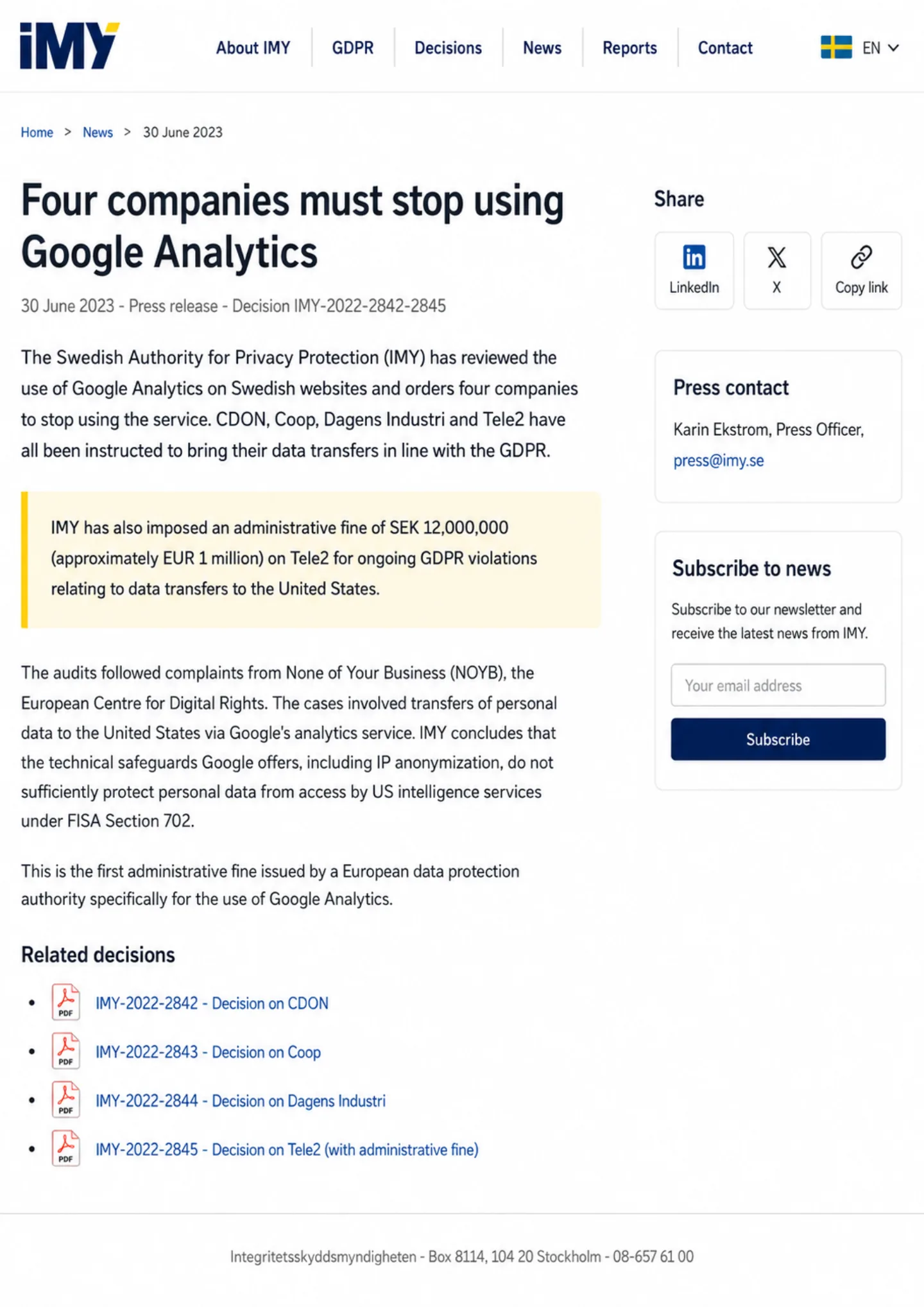
Between January 2022 and August 2024, eight European data protection authorities ruled that Google Analytics breaks the GDPR. Austria went first. France, Italy, Denmark, Norway, Finland, and Sweden followed. The Netherlands joined in August 2024 when it reprimanded Takeaway.com for using GA.
Sweden's IMY handed out the first fine: EUR 1 million against Tele2. In plain English: a million euros for running an analytics script. Plenty of people assumed GA4 would clean this up. Norway's Datatilsynet said the opposite in plain words: "GA4 will not necessarily correct those problems." And not one EU regulator has ever called GA4 compliant.
As I read them, the reasoning runs the same way through all eight rulings. Google LLC sits under US surveillance law (FISA Section 702). No setting fixes that, not even IP anonymization. The problem isn't your settings. It's where Google sits.
There was a brief reprieve in July 2023, when the European Commission adopted the EU-US Data Privacy Framework. But this is the third try at a transatlantic data bridge, and the first two collapsed. Safe Harbor fell in 2015. Privacy Shield fell in 2020. The third one is already under fire from every side (the full Schrems III story is here):
For the full timeline and legal analysis, see Is Google Analytics Legal in 2026?
It's classified as a wiretap under US law
Europe argues about data frameworks. The US has a different kind of trouble. A law written in 1967 to stop people tapping phone lines is now the biggest legal threat to any website running an analytics script.
California's Invasion of Privacy Act, or CIPA, makes it illegal for a third party to intercept your communications unless every party agrees. Courts have decided that an analytics script reading what a visitor browses counts as exactly that. Over 2,341 lawsuits have been filed, and the payouts keep climbing. That means more than two thousand websites already sued over a tracking script:
This isn't a Big Tech problem you can watch from the sidelines. It's landing on small businesses too. One LA firm filed 550+ CIPA lawsuits and mailed thousands of demand letters to small businesses. The floor is $5,000 per violation, and nobody has to prove they were harmed. In plain English: $5,000 a head, no injury required. Florida runs a similar law at $10,000 per violation. Twelve more states have all-party consent laws on the books.
Courts handed down twice as many CIPA decisions in January 2026 as in December 2025. The lawyers who track this all say the same thing: 2026 will beat 2025. The line is still going up.
For the complete legal analysis, see Is Your Analytics Script a Wiretap?
You're seeing a fraction of your real traffic
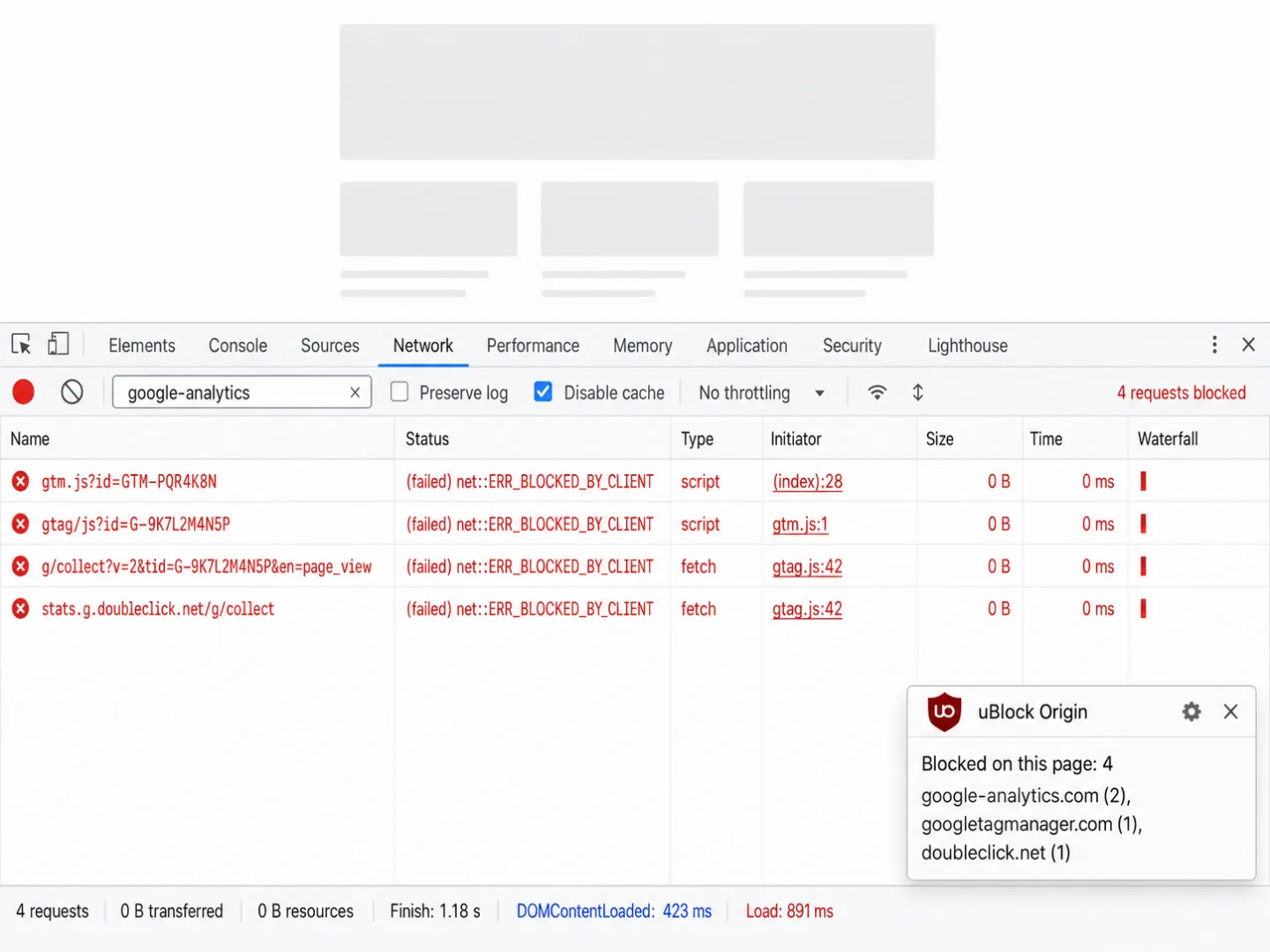
This is the one that keeps me up at night. Google Analytics doesn't tell you how many visitors you've. It tells you how many visitors didn't block it, didn't reject the cookies, and didn't show up in a privacy browser. And that pool gets smaller every single year.
Three layers eat into it, one after another.
Layer 1: Cookie consent. Give Europeans a fair choice, with the Accept and Reject buttons the same size, and 60-70% reject analytics cookies. In Germany and France, fewer than 25% accept. Even the UK's own privacy regulator, the ICO, lost 90.8% of its tracked traffic the day it put up a compliant banner. In plain English: nine in ten visitors, gone, at the body that writes the rules. Those visitors didn't disappear. They're just invisible to you now.
Layer 2: Ad blockers. 42.7% of internet users worldwide run an ad blocker. In Germany it's 49%. Among developers, 72%. Among cybersecurity people, 76%. That means to GA4, none of them exist. The script never even loads.
Layer 3: Privacy browsers. Safari caps GA cookies at 7 days, so a returning reader looks brand new. Firefox has blocked third-party tracking cookies by default since 2019. Brave blocks Google Analytics outright for its 100 million monthly users. Put together, those three browsers are roughly 20-25% of website visitors.
Want the number for your own audience? The GA4 Data Loss Estimator takes your industry and your region and puts a percentage on it.
So you're not really optimizing your website. You're optimizing for the minority who happened not to block you. The rest run the place too, and you'll never see them.
For a deeper look at the data accuracy problem, see What Cookie-Banner-Free Analytics Actually Means.
It slows your site down while Google penalizes you for it
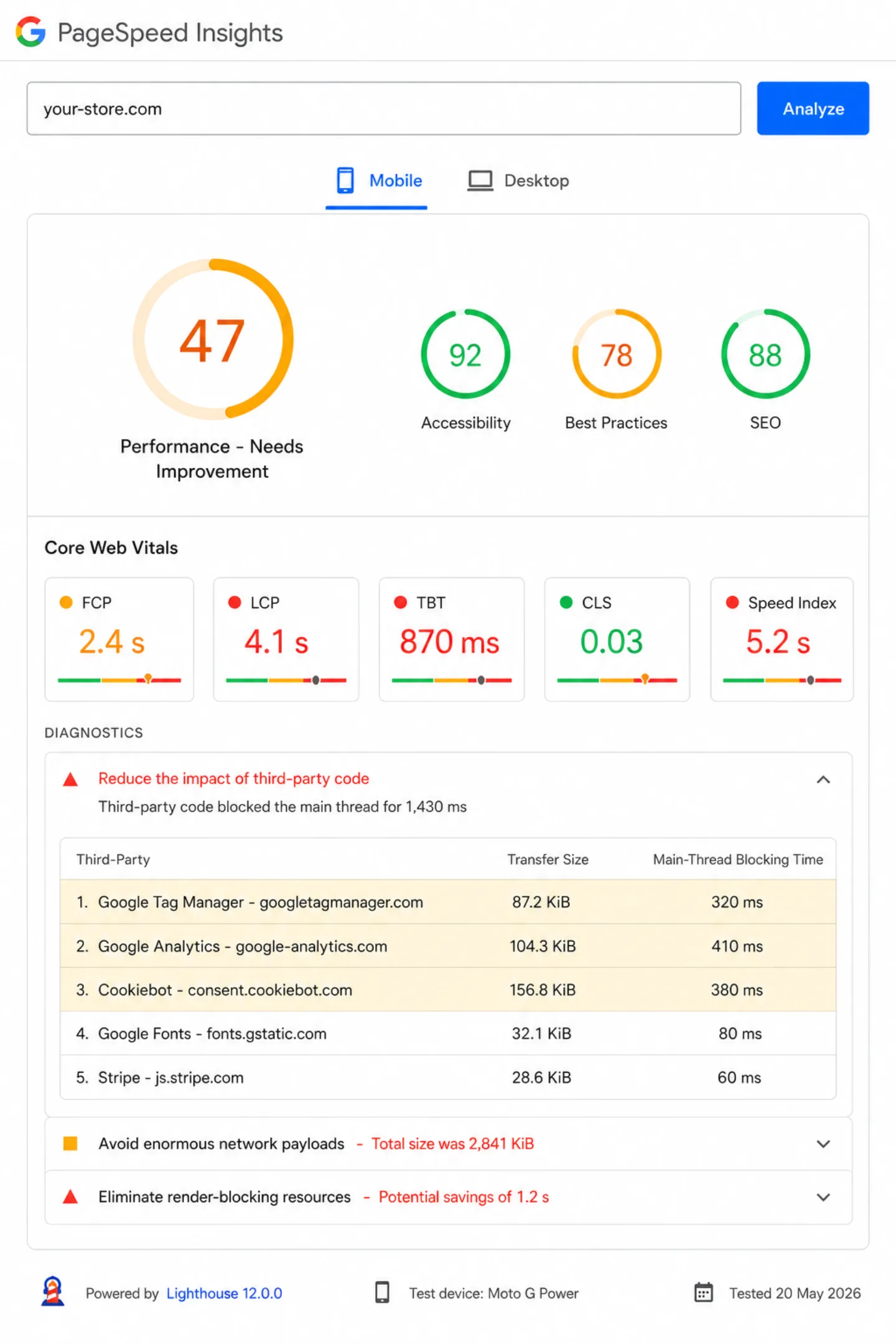
Google Analytics 4 loads 45-104 KB of JavaScript, depending on how you set it up. That means a heavy payload before your page says a word. That's the analytics alone. And because GA4 uses cookies, European law makes you bolt on a consent management platform too. The popular ones add another 82-206 KB.
Add it up: 130-310 KB of JavaScript before your page shows a single word of content.
You can measure what that does, and I did. DebugBear found cookie consent banners pushing Largest Contentful Paint from 1.43 seconds to 3.61 seconds. Google's own research says going from 1 second to 3 seconds of load time raises the odds of a bounce by 32%. At 5 seconds, it jumps 90%. The slower the page, the faster people leave.
I want you to sit with the irony for a second. Google uses Core Web Vitals as a ranking signal and demotes slow sites in search. And Google's own PageSpeed Insights tool flags Google Analytics as third-party code that blocks the main thread.
So Google is docking your ranking for a slowdown that Google's own product caused. The fix is lightweight web analytics that doesn't drop 130-310 KB of JavaScript in front of your first paragraph.
And it bites hardest on phones, where 62-64% of web traffic now lives. That means most of your audience feels it most. There GA4 can eat 10-50% of your entire performance budget, and sites with poor INP scores (above 300ms) see 31% traffic drops, mostly on mobile.
Seven million websites didn't switch to GA4
Universal Analytics ran on 21 million websites. Google forced everyone onto GA4 in July 2024. GA4 now sits at 14.2 million. That means a third of the old base never came along. In plain English: roughly seven million websites looked at GA4 and walked away rather than make the move.
You can see why, and I don't blame the seven million. Over 75% of SEOs said they were unhappy with GA4 in a 1,700-vote industry poll. Jobs that took two clicks in Universal Analytics now take six or more. Andy Crestodina at Orbit Media timed it: finding your lowest-traffic PPC landing page is 15 clicks.
The move also stripped out the things marketers used every day. Annotations, views, behavioral flow reports, recurring email reports, the old bounce rate, regex search in reports, and over 100 pre-built reports all went. A few came back years later after enough people complained. Bounce rate was gone at GA4's October 2020 launch, brought back in July 2022 under pressure, but with a different meaning. Others, like Views, never came back at all.
The learning curve grew its own little economy. GA4 courses run $279-$499. CXL Institute charges $133-289 per month. The enterprise tier, GA4 360, runs $50,000 per year. One founder got so fed up he built his own analytics service after months of fighting GA4.
Chris Fox put it best. He called GA4 a "free edition of the full product which was Universal Analytics."
It silently breaks and nobody tells you
The worst thing about GA4 isn't what it gets wrong, in my experience. It's that it breaks without a sound.
An audit of 200+ GA4 implementations found that 81% had errors hurting data accuracy. That means four setups in five were quietly wrong. One manufacturing client had been missing 47% of its lead form submissions for 14 months. That means nearly half its leads, invisible, for over a year. Nobody caught it, because GA4 never tells you when the data stops coming in.
The form problem runs deep. GA4's Enhanced Measurement only spots forms that fire the browser's native submit event. Modern frameworks like React, Vue, and Angular, plus WordPress plugins like Contact Form 7, Elementor, and WPForms, all submit through JavaScript instead. GA4 never sees them. Analytics Mania's own advice is to switch off Enhanced Measurement form tracking, because it causes more confusion than it's worth.
E-commerce is worse. GA4 wants a dataLayer built just so, with the exact field names. Send id instead of item_id, the field name Universal Analytics used, and GA4 quietly drops the product data while the tag fires like nothing's wrong. WooCommerce renewals run server-side, so GA4 misses every one after the first sale. Revenue can come out underreported by up to 91%. That means you'd see less than a tenth of the money.
GA4 also has hard ceilings it doesn't shout about. You get 25 parameters per event and 50 custom dimensions. Go past either and GA4 drops the rest. The 26th parameter just vanishes. No warning.
Then there are the bots. 51% of all web traffic in 2024 was automated, the first year in a decade that machines outnumbered humans. GA4 leans on a static IAB list to catch them. It has no referral spam filtering at all (Universal Analytics had it; GA4 dropped it). Ghost spam can shove pure fiction into your reports through the Measurement Protocol without anyone ever visiting your site. We break down how real bot detection in web analytics works, and why GA4 catches almost none of it, in a separate deep dive.
It redefined your metrics without asking
GA4 launched in October 2020 without bounce rate. The pushback got loud enough that Google brought it back in July 2022. But they changed what it means.
In Universal Analytics, a bounce was any single-page session. Simple. In GA4, bounce rate is just the flip side of engagement rate. A session counts as "engaged" if it runs 10 seconds, fires a key event, or racks up two pageviews. Everything else is a bounce. You can push the threshold up to 60 seconds, but almost nobody touches the default.
So a visitor can land on your page, read nothing, scroll nothing, click nothing, leave after 11 seconds, and GA4 files that under "engaged." That isn't engagement. It's a definition stretched until your numbers look good.
In September 2023, Google removed four attribution models: first-click, linear, time-decay, and position-based. Any conversions still using them got flipped over to data-driven attribution, like it or not. Google's reason was that fewer than 3% of conversions used them. The 3% who built their reporting on them got no vote.
Standard reports take 24-48 hours to process. Universal Analytics usually had your data inside four hours. So when a campaign is moving fast or your site is on fire, GA4 keeps showing you yesterday.
For a complete analysis of how bounce rate is measured across tools, see What Is Bounce Rate?
"Free" costs $5,000 to $18,000 in year one
Google Analytics is free. Everything it makes you buy, build, learn, and keep running isn't. I'll show you the bill.
Setting up GA4 the right way, GDPR and all, takes 15-25 hours. That means configuring events, standing up a consent platform, wiring in Consent Mode v2, signing the data processing agreement, rewriting your privacy policy, and testing that the whole thing works. At $50-100 an hour for your own staff, or $100-250 an hour for a consultant, setup alone runs $750 to $7,500.
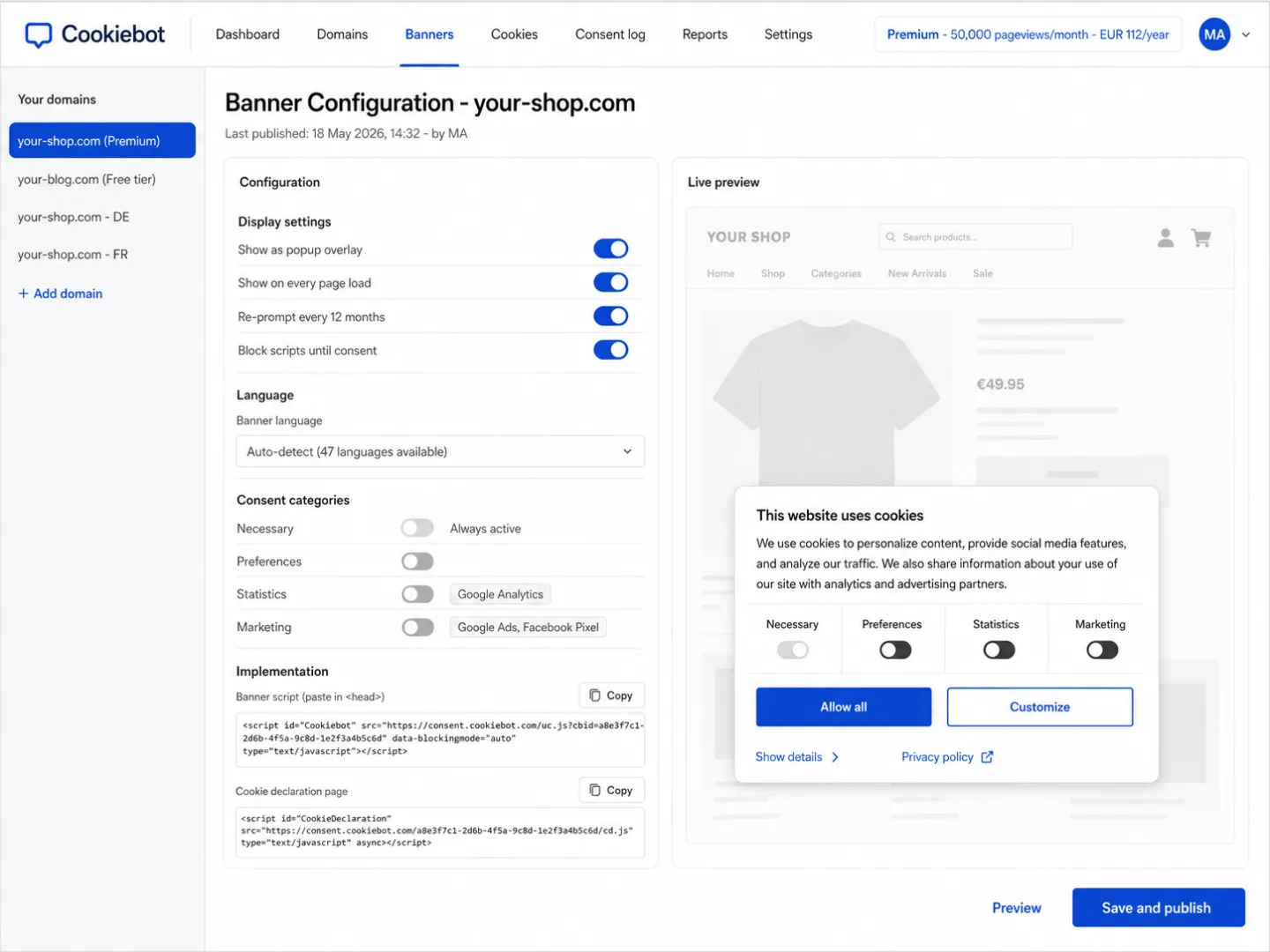
Then comes the consent platform. Cookiebot starts at $16/month. CookieYes starts at $10/month. OneTrust averages $11,500 a year. You need one of these because GA4 sets cookies, and GDPR says you must get consent first.
Training is its own line item. Google's free certification covers the basics and leaves you stranded on the real setup. The practical courses cost $279-$499. CXL Institute charges $133-289 per month.
A lawyer to review your privacy policy: $500-$1,500.
Then the upkeep. Checking reports, chasing down discrepancies, watching consent, verifying tags, relearning the UI every time Google reshuffles it: 8-12 hours a month. At $50 an hour, that's $4,800-$7,200 a year, every year.
Count the real costs and the "free" tool ends up 45-170 times more expensive than the paid one. That means "free" is the most expensive word on the pricing page.
And that's before the cost you can't invoice. If GA4 is only showing you 25-35% of your real traffic, then every call you make on content, channels, and conversion rests on a skewed sample. The people who reject cookies skew technical, privacy-conscious, and higher-income. That's the exact crowd you're probably trying to win.
It can't track the traffic that matters most
AI search traffic grew 357% year over year in 2025 and hit 1.13 billion referral visits in June 2025. That means your fastest-growing source is the one GA4 files under Direct. And it converts far better than anything else. Seer Interactive clocked 15.9% from ChatGPT and 10.5% from Perplexity, against 1.76% from Google organic. Ahrefs saw AI visitors drive 12.1% of signups from just 0.5% of traffic. Tiny slice of traffic, huge slice of the results.
GA4 has no channel for any of it. Visits from ChatGPT, Perplexity, Claude, and Gemini land in "Referral" by default. Worse, most ChatGPT mobile traffic shows up with no referrer at all and gets dumped into "Direct." To see AI search in GA4, you have to build a custom channel group with regex rules placed above the built-in Referral rule. Almost nobody does. So your best-converting source is hidden right out of the box, and you'd never know.
And the "Direct" mess goes well past AI. SparkToro tested link sharing across 16 social platforms and found that 100% of visits from TikTok, Slack, Discord, Mastodon, and WhatsApp land in "Direct" with no referral data at all. LinkedIn passes attribution only 14% of the time. So if your "Direct" bucket is over 30%, it's almost certainly full of paid and social visits wearing the wrong label.
At the same time, Google's own AI Overviews are quietly draining the traffic GA4 can still see. 58.5% of US searches now end without a click. Put an AI Overview on the page and that jumps to 83%. In plain English: most searches never reach a website at all. On queries with an Overview, the click-through rate for the number-one organic result fell 58%.
The traffic is moving faster than GA4 can keep up.
It feeds the largest ad company in the world
Google pulled in $265 billion in ad revenue in 2024. Google Analytics feeds that machine. It watches visitor behavior across 53% of all websites and pours what it learns into Google's ad targeting, audience modeling, and attribution across the whole network. In plain English: half the web feeds one ad company.
GA4 is built to walk you toward Google Ads. No other analytics-and-advertising pairing is wired this tightly: export your audiences in one click, spin up remarketing lists, run cross-device attribution. Nothing else can match it, and that's the point. It's lock-in.
This isn't a hypothetical. In April 2025, Blue Shield of California disclosed that a Google Analytics misconfiguration had been shipping the protected health information of 4.7 million patients straight to Google Ads. For three years. Names, insurance types, doctor names, dates of medical service. All of it flowing into Google's ad systems because of one setting. No hacker. The product doing exactly what it's built to do.
Google has already been fined EUR 50 million over weak transparency and consent for behavioral advertising. And in July 2025 it switched off conversion tracking for EU advertisers who hadn't set up Consent Mode v2, pulling the knot between analytics consent and ad money even tighter.
Every pageview you hand to Google Analytics sharpens Google's ad targeting. Not only on your site. On every site in the network. When the product's free, you're the product.
Your competitors can now sue you for using it
On March 27, 2025, Germany's Federal Court of Justice (BGH) ruled that GDPR violations can be chased under German competition law. Articles 12, 13, and 9 of the GDPR now count as "market conduct rules." That means any competitor can file an Abmahnung (a cease-and-desist) against your website over a privacy slip. So can consumer protection groups.
Eight days before that, a Hannover court ruled that Google Tag Manager needs explicit consent before it loads. The same ruling called Google Consent Mode v2 non-compliant, because it lets scripts run before anyone has agreed.
Put the two together. If your site runs Google Analytics behind a cookie banner, and that banner is even a little off, a competitor can take you to court under competition law.
And how often is a banner off? 85% of cookie banners miss the minimum GDPR bar, per a 2025 Aarhus University study. In plain English: the odds your banner is compliant are slim. 43% of websites set tracking cookies even after the visitor clicks Reject. The UK's ICO looked at 200 top websites and found 134 of them, 67%, non-compliant. The odds aren't in your favor.
Filing an Abmahnung costs the sender almost nothing. You'll pay to respond. For a German business, that turns Google Analytics from a reporting tool into a target on your back. Analytics with no cookies and no consent banner make that target disappear.
What to use instead
A whole class of simple web analytics tools has grown up without any of these problems, and I built one of them. They all work the same way: no cookies, no personal data sitting in storage, no consent banner, EU-hosted, and a script of just 1-4 KB. Built for GDPR compliance by design, not by spending a weekend on settings.
They count unique visitors using daily-rotating hashes and similar tricks, without keeping anything that points back to a person. IP addresses get used for a moment to work out the rough location, then thrown away. Nothing crosses the Atlantic.
I won't pretend the trade-offs aren't real. They are, and I think you should know them:
- No cross-device tracking. Someone on their phone and their laptop counts as two visitors. If you have to stitch one person's journey across devices, you need cookie-based tracking and all the consent machinery that rides along with it.
- No ad remarketing. You can't push audiences into Google Ads or build retargeting lists. If your business lives on retargeting, that's a real loss.
- No predictive audiences. No machine learning guessing which visitors will convert or churn.
- No BigQuery export. No raw event firehose for SQL work on enormous datasets.
But look at who really uses this stuff. 54% of GA users have never set up a single goal. The average local business pulls 414 visitors a month. For them, and for the content site or SaaS that just needs to know where its traffic comes from and which pages get read, I think the choice makes itself. You'll get all of your data, no legal exposure, faster pages, and nothing to maintain.
So the question was never whether Google Analytics is powerful. It is, and I'll grant it that. The question is whether you need that power enough to swallow everything that comes attached to it. For most sites, I don't think you do. I certainly don't.
And if you're weighing the switch for your own site and something here doesn't add up, email me.

Comments
Loading comments...
Leave a comment