The EU Digital Omnibus Act: What It Means for Your Analytics (and Whether GA4 Qualifies)
Europeans spend 575 million hours per year clicking cookie consent banners. That's EUR 14.375 billion in lost productivity, gone on a pop-up almost nobody reads. The EU's Digital Omnibus wants to end the banner for analytics that don't track individuals. Here's what it means for your site, and why Google Analytics won't make the cut.
Before the law talk, the disclosure: I build Clickport, a cookieless analytics tool that stands to benefit from exactly this exemption. So I have a horse in this race, and every legal claim below links to a source you can check, so you don't have to trust me.
- The EU Digital Omnibus Act (proposed November 2025) folds cookie rules into GDPR via Article 88a, replacing the failed ePrivacy Regulation.
- Article 88a creates a consent exemption for audience measurement tools that meet strict criteria: first-party only, no cross-site tracking, no data sharing with third parties.
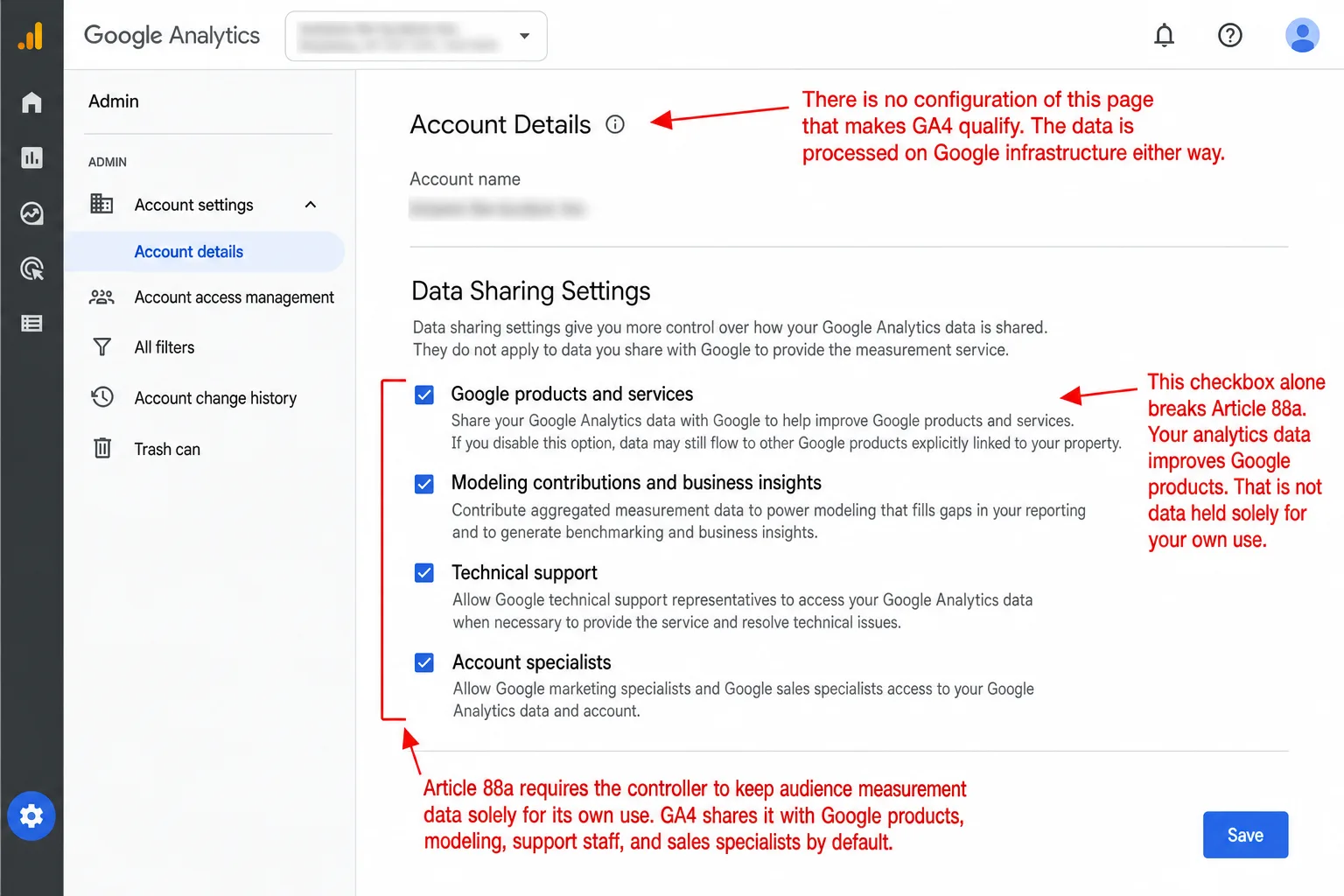
- Google Analytics doesn't qualify for the exemption. It transfers data to Google's US servers and uses it across Google's advertising products.
- Privacy-first, cookieless analytics tools (EU-hosted, no cookies, no personal data) are positioned to qualify for the exemption.
- The proposal must pass European Parliament and Council. Expected timeline: 2027-2028 at the earliest. But the direction of travel is clear.
The EU just rewrote the cookie rules
For over two decades, cookie consent has been governed by the ePrivacy Directive from 2002. Each EU member state wrote it into national law its own way. Germany has its TDDDG. France has CNIL's implementation. Belgium has its 2005 Act. Twenty-seven countries, twenty-seven different cookie laws. One website, twenty-seven ways to get it wrong.
The ePrivacy Regulation was supposed to fix that. Proposed in January 2017, it was meant to modernize the rules and give the EU a single framework. Nine Council presidencies took a turn at it. All nine failed. On February 11, 2025, the Commission withdrew the proposal for good. In plain English: eight years of drafts, amendments, and debates, and nothing to show for it.
So the Commission tried something else. Instead of writing a new regulation, the Digital Omnibus folds cookie rules straight into the GDPR through a new Article 88a. One regulation, directly applicable in all 27 member states, enforced by the GDPR machinery that already exists. No more twenty-seven versions.
The Digital Omnibus does more than shuffle the rules around. It goes after consent fatigue directly. Websites must offer a single-click refusal button, and once a user declines, the site can't re-ask for the same purpose for at least six months. One click to say no. They can't re-ask for half a year. A companion Article 88b says browsers must be able to send standardized privacy signals to websites, and websites must honor them. That's Global Privacy Control, only now it would be the law.
But the change that matters most for analytics sits in Article 88a, paragraph 3, subparagraph (c). In plain English: it's a consent exemption for audience measurement. Get it right, and the analytics banner disappears.
Article 88a: the consent exemption for analytics
Here's the exact wording of the proposed exemption. Consent isn't required for:
"Creating aggregated information about the usage of an online service to measure the audience of such a service, where it is carried out by the controller of that online service solely for its own use."
One sentence. Five conditions hide inside it. Here's each one, as I read it and as the legal analyses read it.
The EDPB and EDPS have asked for the exemptions to be "further specified" before adoption. The shape of it looks clear to me, though. First-party, aggregated analytics for your own website, with nothing leaking out to third parties. That's the lane you want to be in.
One nuance will trip you up, so I want to get it right. "Aggregated" describes the purpose of the measurement. It isn't a ban on ever touching granular data. Several legal analyses say so. One of them puts it well: a store can count its customers and see what each one buys to work out the totals, but it can't follow those people from one store to the next. Session-level collection is fine as long as it rolls up into aggregate reporting and nobody can be re-identified or tracked across sessions.
Does Google Analytics qualify?
No, and I'm not alone in saying so. Privacy lawyers, analytics vendors, and data protection authorities all land in the same place: GA4 doesn't meet the Article 88a criteria, and no realistic configuration can make it qualify, and it isn't for lack of trying. Several EU countries have already ruled Google Analytics illegal. The exemption criteria show you why.
I'll walk through it, one condition at a time. Here's how it falls apart.
GA4 sets persistent cookies. The _ga cookie has a 2-year expiry. The _ga_<container> cookie runs for 2 years too. Turn on Google Signals and it ties a person's activity across their devices through their Google account data. In other words, none of that is a temporary session identifier. It's a two-year leash.
Data flows to Google, a third party. Every event is sent to Google's servers and processed on Google's infrastructure. Google then uses aggregated customer data for its own product development and improvement. Wire that up with Google Ads, DV360, and the rest of the advertising machine, and your analytics data is no longer "solely for your own use." It's working for Google too.
Cross-site tracking is built in. Switch on Google Signals and cross-device tracking comes with it. Cross-domain tracking hands user identifiers from one domain to the next through URL parameters. You don't even need to run Google Ads. The data still feeds Google's wider infrastructure.
Can you configure GA4 into qualifying? No. I looked for a way, and so have better lawyers than me. Turn Google Signals off, turn the advertising features off, unlink Google Ads, and the core problem is still there. The data lands on Google's servers. Google is both the processor and a company with advertising interests in the very same data. CNIL has noted that getting GA4 to comply with GDPR transfer rules takes "proxyfication," meaning you route every hit through a reverse proxy to strip the identifiers before Google ever sees them. For most organizations that's out of reach.
Consent Mode v2 doesn't save it either. Google's Advanced Consent Mode sends anonymous "cookieless pings" when someone declines consent, then leans on machine learning to model the missing conversions. The data still goes to Google, a third party. The analytics provider still reuses it for product development. "Solely for its own use" and the way GA4 is built simply don't fit together.
Google has made no public statement on whether GA4 qualifies for the Article 88a exemption. I'd notice if it had.
The data you're already losing
The consent exemption isn't just a paperwork win. It fixes a real measurement problem I see constantly. If your analytics tool requires consent, you're losing most of your data in European markets right now.
Germany and France: 60 to 77% rejection rates. Put a compliant "Reject All" button up next to "Accept All," same size, same weight, and fewer than 25% of visitors accept cookies. The etracker Consent Benchmark 2025 measured an average 60% data loss from compliant banners. That means more than half your visitors are gone before you count them.
GA4 misses 55.6% of traffic. Orbit Media ran an independent study, GA4 against cookieless analytics on the same website. With consent banners showing, GA4 missed 55.6% of the traffic. In plain English: it saw fewer than half the people who came.
The ICO saw a 90.8% drop. The UK's own Information Commissioner's Office, the privacy regulator itself, had Google Analytics counting 119,417 users a day. Then they put up a best-practice cookie banner. The count fell to 10,967. That's a 90.8% drop. In other words, the visitors didn't go anywhere. They just stopped showing up in the numbers.
Consent Mode modeling has a catch most people miss. Google's machine learning model, the one that's supposed to fill in the gaps from people who decline, needs 1,000+ daily events from denying users across 7 days in a row, plus another 1,000+ daily events from consenting users. In practice, most sites under 30,000 monthly visitors never clear that bar. So the modeling never switches on, and the data from the people who said no is gone for good, no matter what you were promised.
Then there's the bill for the banner itself. Consent management platforms aren't free. CookieYes starts at $8.33 a month. Cookiebot starts at $8 a month for 50 subpages. Enterprise tools like OneTrust run a median of $11,500 a year. Which means you're paying real money to show a pop-up that makes 60 to 87% of your visitors disappear.
Tools that qualify for the Article 88a exemption make this whole mess go away. No consent banner for analytics. No CMP bill. No data lost to rejection. You measure everyone the banner was hiding, from day one. That's the tool I chose to build.
Which analytics tools actually qualify?
The exemption doesn't care which brand name is on your tool. It cares how the tool is built. I build one of these tools, so judge my scoring accordingly. Here's how the two ad-ecosystem incumbents and Clickport line up against Article 88a's five requirements.
| Tool | Cookieless | First-party | No cross-site | No data reuse | Qualifies? |
|---|---|---|---|---|---|
| Google Analytics 4 | ✗ | ✗ | ✗ | ✗ | No |
| Adobe Analytics | ✗ | ✗ | ○ | ○ | No |
| Clickport | ✓ | ✓ | ✓ | ✓ | Yes |
The pattern jumps out. Tools that were cookieless and first-party from day one qualify without you touching a setting. Tools built for advertising ecosystems can't get there no matter what you toggle. Article 88a doesn't invent a new category. It blesses what privacy-first analytics tools have been doing all along. If you want the mechanics of how this category works, see our privacy-friendly analytics guide.
The Audience Measurement Coalition has complained that the exemption is too narrow. Their gripe is that "solely for its own use" blocks independent audience measurement run by joint industry committees. When even the industry groups say the rule is too strict, you know the criteria are tight. And I like tight criteria.
The UK already did this
While the EU is still debating, the UK has already moved. The Data (Use and Access) Act got Royal Assent on June 19, 2025. Section 112 adds a statistical purposes exception: you don't need consent for analytics cookies that gather aggregate statistical information about how a website is used, as long as the data can't identify anyone and you offer an opt-out.
In plain English: the UK already has the thing the EU is still debating. The UK used to demand consent for every non-essential cookie under PECR. Now it carves out privacy-respecting analytics by name. And it's already law.
If you serve both UK and EU audiences, the message is hard to miss. The two jurisdictions are arriving at the same answer: first-party, aggregated analytics that don't track individuals shouldn't need consent.
Over in the US, the story rhymes. The California Privacy Protection Agency fined Todd Snyder $345,178 in May 2025 over CCPA violations tied to tracking pixels. More than 1,500 businesses have been sued under CIPA in the past 18 months, the claim being that their website tracking counts as "wiretapping." In practice: look at who's getting sued, and who isn't. Not one of those CIPA suits has gone after a cookieless, first-party analytics provider. Every case targets tools that ship data to third parties.
The political battle you should understand
The analytics exemption doesn't float free of everything around it. It rides inside a much bigger Digital Omnibus package, and that package has turned into one of the most fought-over pieces of EU legislation in years.
127 civil society organizations signed an open letter calling the Omnibus "the biggest rollback of digital fundamental rights in EU history." Max Schrems' organization noyb put out three versions of a detailed legal analysis and called it "the biggest attack on Europeans' digital rights in years." EDRi called it "a major rollback of EU digital protections." The EFF called it "full of bad and confusing ideas that will significantly weaken privacy protections."
Corporate Europe Observatory found that 7 of the 8 major changes in the Omnibus "align closely with the positions of major tech corporations." Meaning: the wishlist came from the lobby. The digital industry spends EUR 151 million a year lobbying the EU, up 33.6% since 2023. Read those two numbers together and the shape of the thing gets clearer.
Here's the part I care about, though. The consent exemption for audience measurement is the least controversial piece of the whole package. Even the EDPB and EDPS "strongly support the objective of providing for a regulatory solution to address consent fatigue and the proliferation of cookie banners." The fight is over the other parts: narrowing what counts as personal data, stretching "legitimate interest" to cover AI training, and trimming back data subject rights.
The analytics exemption is just doing what CNIL has been doing in France since 2020. It isn't a new idea. It's an EU-wide version of an approach that already works.
All of this shapes the timeline, and I don't pretend to know the ending. The analytics exemption has broad support, even from the privacy advocates fighting the rest of the package. Whether it makes it through comes down to one procedural question: does Parliament split the provisions apart and vote on them one by one, or does it vote on the package as a single block?
The CNIL already proved this works
France didn't wait for the Digital Omnibus. The CNIL has run a consent exemption for audience measurement tools since 2020. And it has policed the edges of that exemption hard.
In 2025 the CNIL handed out EUR 486.8 million in fines, nearly 9 times the EUR 55 million it issued in 2024. In plain English: cookies were front and center. Google was fined EUR 325 million. Shein was fined EUR 150 million for loading 10 cookies before a visitor had even touched the consent banner. American Express was fined EUR 1.5 million for dropping cookies on people who had explicitly said no.
In other words, the message isn't subtle. The CNIL isn't easing off. It's running two lanes. First-party analytics that meet the strict criteria run without consent. Everything else risks record fines.
On July 4, 2025, the CNIL swapped its formal certification program for a self-assessment model. The public list of CNIL-validated tools was retired on January 1, 2026. Now providers assess their own compliance against the CNIL's published criteria. The old list carried a handful of European vendors. Google Analytics never made the list at all.
The CNIL exemption sets out what counts: first-party cookies only, no cross-site tracking, no combining the data with other systems, no sending identifiable information to third parties, a cookie lifespan capped at 13 months, data retention capped at 25 months, and an opt-out. That means Article 88a is the same set of principles the CNIL already runs, written up at the EU level.
This isn't a thought experiment. If you sell in France, you've been living under it already. It has been running for five years in the EU's second-largest market. The Digital Omnibus just takes that and makes it the law everywhere.
When this takes effect: the timeline
The Digital Omnibus isn't law yet. Here's where it stands, and what I think a realistic timeline looks like.
One more thing could speed all of this up, no matter what the Omnibus does. I keep one eye on the EU-US Data Privacy Framework, because it's wobbling. President Trump dismissed three Democratic members of the Privacy and Civil Liberties Oversight Board (PCLOB) in January 2025, which left it without a quorum. That board's annual report was one of the framework's safeguards. Norway's DPA has warned that if the framework is revoked, "there will most likely not be a transition period." Should a "Schrems III" scenario materialize, every EU business running US-based analytics would be in breach of GDPR overnight. No warning, no grace period.
What you should do today
I wouldn't wait for the Digital Omnibus, and neither should you. The consent rejection rates on their own already mean GA4 is broken for EU businesses today. The Omnibus just makes it official.
So here's how I'd decide, depending on where you are. Four situations, four moves.
If you're in France, Spain, Italy, or the Netherlands: You can already run qualifying analytics without consent under the national exemptions you have today. Switch to a cookieless analytics tool and you can take the analytics part out of your consent banner today.
If you're in the UK: The DUAA Section 112 exemption is in force. You don't even need to wait. You can run aggregate analytics without consent, as long as you offer an opt-out.
If you're anywhere else in the EU: The Omnibus hasn't passed, so in a country like Germany you still need consent for analytics today. But the direction is set. Move to a cookieless GA alternative now and the visitors the banner was hiding come back into your numbers right away, because tools that don't use cookies or collect personal data don't need consent. You're also ready for Article 88a the day it lands.
If you're in the US: The aggregate data exemption under CCPA/CPRA already puts de-identified and aggregate consumer information out of scope. Cookieless analytics that only ever produce aggregate statistics sit right in that lane. On top of that, you clear your CIPA wiretapping exposure entirely.
The math isn't complicated. A consent-dependent tool shows you 13 to 40% of your EU traffic. A cookieless analytics tool shows you 90 to 100%. In plain English: that gap isn't a rounding error. It's the difference between you deciding on half a picture and deciding on the whole one.
The way I read it, the regulators are quietly building a moat around privacy-first analytics. Every new enforcement action, every consent rate study, every CIPA lawsuit makes the case stronger. The trend line doesn't wobble. The EU Digital Omnibus doesn't create the trend. It validates it.
If you want the broader case against GA4, read Why You Should Stop Using Google Analytics in 2026. For the full legal picture, read Is Google Analytics Legal in 2026?. And for a deep dive into how cookieless tracking works under the hood, read What Cookie-Banner-Free Analytics Actually Means.

Comments
Loading comments...
Leave a comment