50+ European Alternatives to US Tech: The Privacy-First Business Stack
Should European businesses run on US tech? I stopped hearing that question a while ago. The real one is which European tools to run on instead, and that's what this guide answers. "Europe doesn't want to be a vassal," Emmanuel Macron said at the Berlin Digital Sovereignty Summit in November 2025, where European tech leaders pledged EUR 12 billion toward digital independence. Add EUR 7.1 billion in GDPR fines on top of that, and the debate is over. In plain English: the bill for staying on US tech keeps growing. Analytics is one of the easiest categories to switch first, and my guide to privacy-friendly analytics explains why.
Quick disclosure: I run Clickport, the analytics tool in the analytics slot below, and I host it on Hetzner, the first tool on the list. I'm in this stack up to my neck. I'd still recommend every pick here if I weren't.
- EUR 7.1 billion in GDPR fines have been issued since 2018. Eight of the ten largest targeted US Big Tech, five targeted Meta alone. The regulatory pressure is accelerating.
- 61% of European CIOs plan to shift workloads to local providers. 53% plan to restrict US hyperscaler use. This is mainstream risk management, not ideology.
- A full European business stack costs 30-60% less than the US equivalent. Hetzner alone saves most teams 60-70% vs AWS once egress fees enter the math.
- Every tool in this guide is European-headquartered (EU, EEA, Switzerland, or the UK) with European data centers. No US parent companies pulling the strings.
- We cover what no other guide does: real pricing on every tool, re-verified against live vendor pages in July 2026, clear trade-offs, migration difficulty ratings, and complete stack recommendations by company size.
Why European tools, why now
The conflict at the heart of this is simple. The US CLOUD Act, passed in 2018, lets American authorities demand data from US-headquartered companies no matter where that data physically sits. Run your European business on AWS, Google Cloud, or Azure, and US law enforcement can request your data without telling you and without your consent. That collides head-on with GDPR, which demands a legal basis for any processing and limits transfers to countries without adequate protection. Two laws, pulling in opposite directions, and your data sits in the middle. You didn't pick that fight, but you're in it.
This isn't theory. The enforcement has been building for seven years (is Google Analytics legal tracks the rulings in detail):
The decision-makers are already moving. 61% of European CIOs plan to shift more workloads to local or regional providers over geopolitical concerns. 53% plan to restrict use of US hyperscalers, and 44% have already started. That means half the buying side is already moving. 78% of German companies say they're too dependent on US cloud providers. That isn't a survey of activists. That's the people who sign the cloud contracts.
And some have gone all the way. Germany's state of Schleswig-Holstein migrated 40,000 email accounts off Microsoft, is rolling LibreOffice out across its 30,000 workstations, and is planning a full Windows-to-Linux switch. The estimated saving is EUR 15 million a year in licensing alone. In plain English: sovereignty came with a discount. So the move is cheaper, not just safer.
This isn't a niche concern. It's a structural shift in how European businesses think about their tech stack.
What follows is what I found: every category of business software, with a genuinely European alternative for each one. Real pricing, real trade-offs, and a clear read on what you gain and what you give up.
Three rules decided who made the list. The company is headquartered in Europe, the data can stay in Europe, and the tool is something a real business can run today. I dropped every price I couldn't verify on a public page in July 2026 rather than guess. You'll notice the list skews toward bootstrapped companies, and that isn't an accident. A company that doesn't need a growth story doesn't need your data to tell it. For analytics specifically, my deep comparison of GA alternatives goes further than the analytics section below.
Cloud hosting and infrastructure
This is the foundation. Everything else runs on top of it. And it's the one category where the European option doesn't ask you to give anything up.
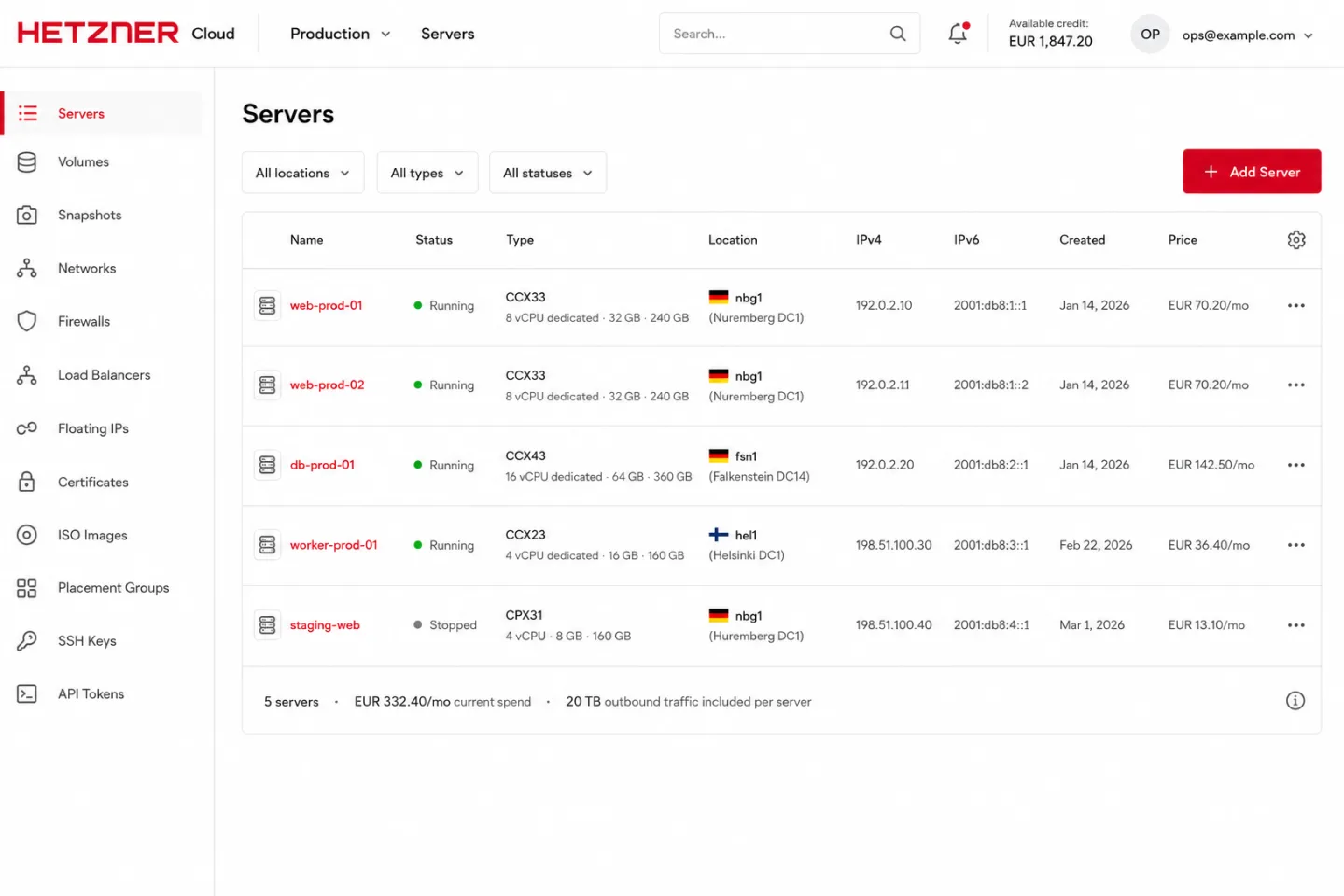
Hetzner is what I run Clickport on, and I've yet to see a surprise bill. The pricing makes the case on its own. A VPS with 2 vCPUs, 4GB RAM, and 40GB SSD costs EUR 5.49 a month. The same spec on AWS costs roughly three times that, before egress. Which means 1 AWS server buys you 3 at Hetzner. And Hetzner throws in 20TB of outbound traffic, with overage at EUR 1/TB. So no surprise bill at the end of the month. They are ISO 27001 certified across every location, and the data centers sit only in Nuremberg, Falkenstein, and Helsinki. No US parent company. No venture capital. No reason to make money off your data instead of your subscription.
There's a real trade-off. Hetzner gives you almost no managed services next to AWS. No managed Kubernetes, no proprietary database services, no 200-product catalog. What you get is excellent compute, storage, and networking. The rest you build yourself, or with self-hosted tools. For most startups and small businesses, that's plenty.
Need more managed services? Then OVHcloud 🇫🇷 is the one to look at. It's the biggest cloud provider in Europe: EUR 1.08 billion in revenue, more than 1.6 million clients, roughly 450,000 servers across 43 data centers. They build their own servers in-house, run managed Kubernetes, and hold France's SecNumCloud 3.2 security qualification. This is the closest Europe gets to a hyperscaler.
Scaleway 🇫🇷 is the one developers tend to like. It's part of Xavier Niel's Iliad Group, with data centers in Paris, Amsterdam, and Warsaw. You get strong GPU infrastructure for AI work (H100, L40S), clean APIs, and 20-40% savings against AWS. Want managed Kubernetes or GPU compute that stays on EU soil? This is the pick.
UpCloud 🇫🇮 fills out the list. Finnish-headquartered, 15 data centers in 12 countries, and pricing that holds no surprises.
CDN, DNS, and storage
bunny.net 🇸🇮 is the one I'd point most people to first. Slovenian-built, and it grew without the usual VC firehose. It runs 119 points of presence across 77-plus countries, and it has an EU-only routing option so your data never leaves a GDPR-compliant region. CDN pricing starts at $0.005 per GB. That means a terabyte of traffic costs about $5. On top of that you get Bunny DNS, edge storage, video streaming, and a Google Fonts replacement that doesn't break GDPR. For most European businesses, this one swap retires Cloudflare. You flip the DNS and you're done.
Gcore 🇱🇺 is the heavier, enterprise end of the same shelf. Luxembourg-headquartered, $140M in revenue, 210-plus points of presence, and a CDN business growing fast. It's building AI cloud infrastructure alongside the CDN, and the client list runs to Microsoft, DAZN, and Orange.
For DNS, deSEC 🇩🇪 is a German non-profit that hands you privacy-first DNS hosting with automatic DNSSEC, for free. No tracking. No commercial angle. No CLOUD Act exposure. Need domains too? Gandi 🇫🇷 has carried the European-values flag for registrars since 1999: 2.5 million domains under management, 800-plus extensions, and 2 mailboxes free for the first year with every domain.
Object storage is where the price gap gets almost funny. Impossible Cloud 🇩🇪 is S3-compatible at a flat EUR 7.99/TB a month, and here's the part that matters: zero egress fees. No charge per API call. No minimum storage duration. They claim 60-80% savings against AWS S3, and with 3,000-plus companies already on board, that reads less like a pitch and more like a fact. Which means the S3 line on your bill roughly drops by two-thirds. Cubbit 🇮🇹 does it differently, splitting your data across several EU data centers, and Hetzner's own object storage starts at EUR 4.99 a month with the first terabyte included.
Email and marketing
Private email
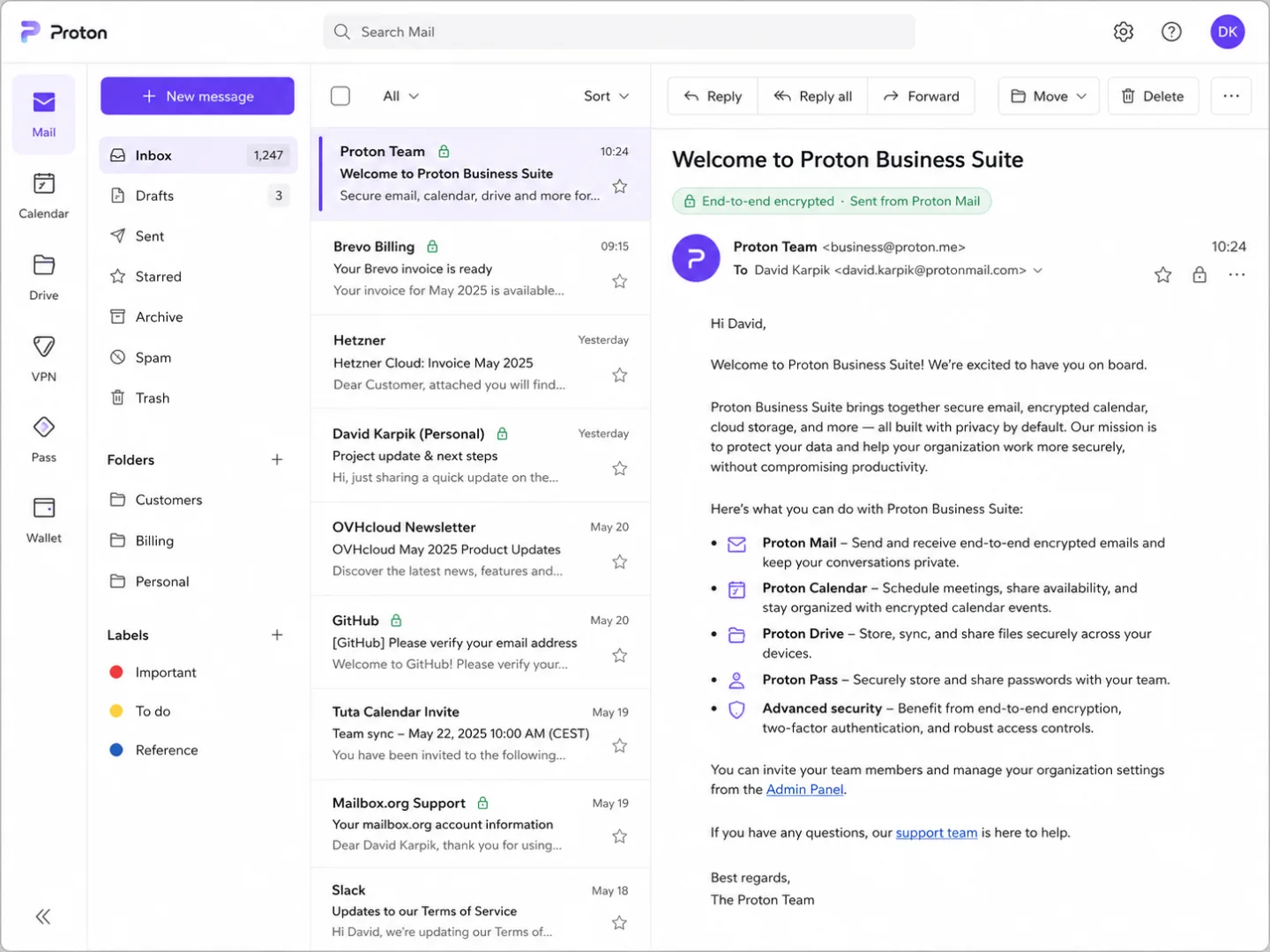
Proton stopped being just email a while ago. They've stitched Mail, VPN, Drive, Calendar, Pass, and now Standard Notes into one suite, all under Swiss jurisdiction. The top business tier, now sold as Workspace Standard, is $12.99 per user a month and covers most of what Google Workspace does, except the encryption is zero-knowledge and there's no US legal exposure hanging over it. That means 1 bill for mail, files, VPN, and passwords. More than 100 million Proton accounts now, and still climbing.
Tuta 🇩🇪 is the German answer. It encrypts end-to-end including the subject lines, which Proton leaves in the clear. Every byte sits on ISO 27001 certified German servers. They're also building post-quantum encryption on the back of a EUR 1.5M German government grant. Business plans start at EUR 6 per user a month.
Mailbox.org 🇩🇪 is the quiet workhorse of the bunch. EUR 4 a month buys email, calendar, contacts, cloud storage, an online office suite, and video conferencing. The servers live only in Berlin. Want a full Google Workspace replacement without Proton's premium tag? This is it.
Email marketing and transactional
Brevo 🇫🇷, which you may remember as Sendinblue, is the European Mailchimp. Paris-based, more than 600,000 customers including Carrefour and H&M, around $232M in revenue, and a fresh unicorn after a $583M raise. The free plan gives you 300 emails a day and room for 100,000 contacts. In plain English: 9,000 free sends a month before you pay a cent. Paid starts at $9 a month. It also ships a transactional email API, so one European provider replaces both Mailchimp and SendGrid in a single move.
MailerLite 🇱🇹 is the Lithuanian underdog people genuinely love. 1.4 million-plus users, a clean interface, and a free plan up to 250 subscribers since a June 2026 trim. They built MailerSend for transactional email too. Polish company Vercom bought them for $90M in 2022.
GetResponse 🇵🇱 is one of the most durable SaaS stories Europe has. Founded in Gdansk in 1998, fully bootstrapped, $150M in revenue, more than 400,000 customers across 180-plus countries. It's an all-in-one platform: email campaigns, automation, landing pages, webinars. Free for 500 contacts, paid from $19 a month. Which means 28 years of growth without a single term sheet.
Two hidden gems are worth knowing. Laposta 🇳🇱 runs the email for over half of all Dutch municipalities and most Dutch hospitals, and it's free up to 2,000 subscribers. Keila 🇩🇪 is a German newsletter tool you can self-host, built in Elixir, with cloud plans from EUR 8 a month.
For transactional email on its own, Scaleway TEM 🇫🇷 is the purest European play of the lot. The whole infrastructure stays inside the EU, no US data transfers, a free tier of 300 emails a month, and EUR 0.25 per 1,000 emails after that.
Team chat and video conferencing
Element 🇬🇧 is the strongest Slack alternative Europe has. It's built on the open Matrix protocol, encrypted end-to-end by default, and you can host the whole thing yourself. Look at who already runs on it: the French government, whose Tchap messenger is built on it and open to all 5.5 million public servants. Germany's Bundeswehr, 100,000-plus military personnel. The European Commission. NATO ACT. Governments in more than 25 countries. In plain English: the people with the strictest security rules picked it. Pricing moved to quote-only enterprise tiers in 2026, but the Community edition stays free to self-host. Total funding sits at $48M.
The trade-off is real, so I'll say it plainly. Element's interface is more functional than pretty. If your team is used to Slack's polish, you'll need a settling-in period. And the self-hosted path means running a Matrix Synapse server, which isn't a weekend job.
Wire 🇨🇭 is the Swiss pick. Every message, call, and file is encrypted end-to-end. It's ISO 27001 and ISO/IEC 27701 certified. Video conferencing scales to 2,000 participants, all encrypted. More than 1,800 organizations use it, on $55M in total funding.
Threema 🇨🇭 is the one for mobile-first teams. 12 million users, every server in Switzerland, and no phone number or email needed to sign up. Threema Work starts at CHF 3 per user a month on the annual plan. More than 8,000 companies use it, including government agencies and schools across the DACH region.
On to video. Whereby 🇳🇴 is the gentlest move off Zoom: a Norwegian company, ISO 27001 certified, all user data held in Ireland, and no download for your guests. Pro is $10.99 a month. Tixeo 🇫🇷 is the security-first one, the only video tool France's national cybersecurity agency ANSSI has certified for seven years running, used by French defense agencies and CNRS. OpenTalk 🇩🇪 is the self-hostable option, published on Germany's OpenCoDE government platform and free for up to 5 participants.
Office and collaboration
Nextcloud 🇩🇪 is the closest you'll get to a full Google Workspace replacement. File sharing, collaborative editing through Collabora Online, calendar, contacts, video calls, and more on top. More than 300,000 server installations, tens of millions of users. It's fully self-hosted, employee-owned, and took no venture capital. The German state of Schleswig-Holstein picked Nextcloud over Microsoft SharePoint. And customer interest tripled since the beginning of 2025 as US tariffs and geopolitics made people nervous about where their files live.
CryptPad 🇫🇷 is for the teams that can't bend on confidentiality. Every document is encrypted end-to-end with zero-knowledge architecture, which means the server can't read your files. It can't. It's backed by French and EU research grants, and the United Nations picked CryptPad Forms over its usual Microsoft Forms for a 2025 endorsement round. Free for 1GB, paid from EUR 5 a month, self-hostable under AGPL3.
LibreOffice 🇩🇪 hardly needs an introduction: an estimated 200 million-plus users, free, and no telemetry, because there isn't any code phoning home. For the same thing in a browser, Collabora Online 🇬🇧 puts LibreOffice on the web and plugs into Nextcloud. If your team trades .docx and .xlsx files all day, ONLYOFFICE 🇱🇻 has the best Microsoft Office compatibility, self-hostable, with a free community edition for up to 20 users.
For notes, Anytype 🇩🇪 is a local-first take on Notion. Your data sits on your device, syncs peer-to-peer, and is encrypted end-to-end. $29M in total funding, Series A led by Balderton Capital. Joplin 🇫🇷 is the open Evernote killer: end-to-end encryption, Joplin Cloud servers in Paris, and self-hostable if you'd rather.
CRM, ERP, and business software
Odoo 🇧🇪 is the European ERP heavyweight. Belgian-built, EUR 650M in revenue, valued north of EUR 7B, with more than 15 million users across 170,000-plus enterprise customers. The Community Edition is open source under LGPLv3 and self-hostable. Paid plans start at €24.90 per user a month and bundle a CRM, accounting, inventory, manufacturing, HR, and dozens more modules. That means 1 subscription where 5 tools used to be. Want one platform to run the whole business on? Odoo is the European answer to SAP and Oracle. The catch is that all-in-one means all-in: you're committing to their world. Moving over from Salesforce or SAP takes weeks, not hours, and you'll want to run both side by side for a while.
Twenty 🇫🇷 is the open-source CRM turning heads right now. French-founded by ex-Airbnb engineers, backed by Y Combinator, more than 50,000 GitHub stars. Picture Salesforce rebuilt in 2024 with a modern interface and full data sovereignty baked in. Self-hosted it's free, cloud is from $9 per user a month. That price alone is reason enough to try it.
SuperOffice 🇳🇴 is the established hand. Norwegian-built since 1990, more than 12,000 European companies on it, and a EUR 266M fund from Danish firm Axcel behind its European push. On-premise is on the table. Efficy 🇧🇪 is the Belgian CRM with 13,500 customers and 330,000 users spread across 8 European countries.
For lighter ERP needs, Dolibarr 🇫🇷 is a French open-source ERP/CRM that's free to self-host. Freelancers and micro-businesses love it, and the French government has handed it out to new businesses.
Invoicing and accounting
Germany owns this space. Lexware Office 🇩🇪, which you'll still see written as lexoffice, leads with more than 350,000 customers, TUV Rheinland certification, and German data center hosting, from EUR 7.90 a month. sevDesk 🇩🇪 looks after freelancers and startups from EUR 11.90 a month. Both keep you in line with German GoBD bookkeeping standards and the ZUGFeRD/XRechnung e-invoicing mandates coming down the pipe.
Customer support and incident management
Crisp 🇫🇷 stands out for one reason above the rest: it's bootstrapped, all the way, which I respect more the longer I run my own bootstrapped company. No venture capital, no investors, no quiet pressure to make money off your data. Hundreds of thousands of businesses use it, with all data held in the EU, messaging in the Netherlands and plugin data in Germany. And the pricing is per workspace, not per agent: EUR 95 a month for 10 seats. In plain English: EUR 9.50 a seat. That's a sliver of what Intercom asks.
Zammad 🇩🇪 is the open-source helpdesk from the person who built OTRS. German data centers, self-hostable under AGPLv3. Version 7.0 runs local LLMs through Ollama, so you get AI help in your helpdesk without shipping customer data off to OpenAI. Hosted it's from EUR 7 per agent a month, self-hosted from EUR 2,999 a year.
ilert 🇩🇪 takes over from PagerDuty for incident management. German-built, ISO 27001 certified, bootstrapped, around 20 people. The client list runs to IKEA, Lufthansa Systems, and Adesso. Free for up to 5 users, the Pro tier at $24 per user a month. It matters more now that Atlassian is winding down Opsgenie and its replacement offers no EU data residency.
LiveChat 🇵🇱 is that rare European SaaS company: publicly traded, profitable, and entirely self-funded. Built in Wroclaw, listed on the Warsaw Stock Exchange, $90M in annual recurring revenue, more than 35,000 businesses on it. The suite covers LiveChat, ChatBot, HelpDesk, and KnowledgeBase, with the single-seat Starter plan at $19 a month billed annually. It's a real alternative to Intercom and Zendesk, and nobody's leaning on it to monetize your data.
Developer tools and monitoring
This is the category most "European alternatives" articles skip altogether. So here's what's out there:
Codeberg 🇩🇪 is a non-profit GitHub alternative run by a German association, Codeberg e.V. More than 380,000 registered users, 640,000-plus projects, and free for every open-source project. It runs on Forgejo, a community fork of Gitea. IP logs are kept for 7 days and no longer. Its privacy policy is one of the shortest of any code host.
For CI/CD, Woodpecker CI is the self-hosted option Codeberg runs itself. Forked from Drone, Apache 2.0 licensed, container-based, and beholden to no SaaS service.
AppSignal 🇳🇱 stands in for Datadog and New Relic. Dutch company, data processed in the EU, no US transfers. More than 2,000 organizations, a $22M Series A behind it. The free plan covers 50K requests, and paid starts at EUR 18.25 a month billed yearly, with unlimited apps and hosts. The price is predictable. No surprise bills.
Bugsink is the Sentry replacement you can run yourself on a EUR 5 a month VPS while it handles 1M-plus events a day. That means Sentry-scale error tracking for pocket change. It speaks the Sentry SDKs, so all you change is the DSN. The free hosted tier covers 15K events a month, and the data lives on Hetzner servers in Finland and Germany.
For uptime, Oh Dear 🇧🇪 is the Belgian all-rounder: uptime, SSL, broken links, performance, DNS, cron jobs, domain expiration, and status pages, from $15 a month for 5 sites, with every feature on every plan. Phare 🇪🇪 has a free unlimited plan with 30-second checks from 12 regions, runs on 100% European infrastructure, and writes AI incident digests with Mistral's open-source model. Hyperping 🇫🇷 rolls monitoring, status pages, and on-call scheduling into one, free for 20 monitors and from $29 a month after that. Bootstrapped, no VC.
Security and privacy
Mullvad 🇸🇪 is, I think, in a class by itself. Founder-owned, no outside investors, no marketing department, no affiliate program. Just a flat EUR 5 a month, the same since 2009. That means 17 years without a price rise. They don't even know who you're: creating an account spits out a random number, and that's it. No email. No name. Nothing. Around 580 servers in 50 countries, every one running on RAM alone with nothing written to disk. Quantum-resistant WireGuard has been on by default on desktop since January 2025. When Mozilla needed infrastructure for Mozilla VPN, it picked Mullvad. And Cure53 audited it with zero critical or high findings.
For encrypted file sharing, Tresorit 🇨🇭 is the Swiss-headquartered Dropbox replacement: end-to-end encrypted, zero-knowledge, and owned by Swiss Post, a government entity. More than 11,000 organizations use it, with business plans from around EUR 15 per user a month. Cryptomator 🇩🇪 takes a lighter line. It encrypts your files before they ever reach a cloud provider, so you keep your existing Dropbox or Google Drive and wrap a zero-knowledge layer around it. Free and open source, with a team Hub from $6 per seat a month.
For passwords, Passbolt 🇱🇺 is the open-source option out of Luxembourg. Self-hostable, end-to-end encrypted, and built for teams. More than 40,000 organizations, an $8M Series A behind it, and a Community Edition that's free for unlimited users. Already living in the Proton world? Proton Pass at $1.99 per user a month adds zero-knowledge password storage under Swiss law.
For authentication, ZITADEL 🇨🇭 is a Swiss-built Auth0 replacement: open source, multi-tenant by design, with Passkeys, OIDC, SAML, and SCIM. $15.5M in total funding, a free cloud tier, and pay-as-you-go from there. If you're shipping a B2B SaaS product that needs multi-tenant auth on EU soil, this is the one.
AI, translation, and productivity
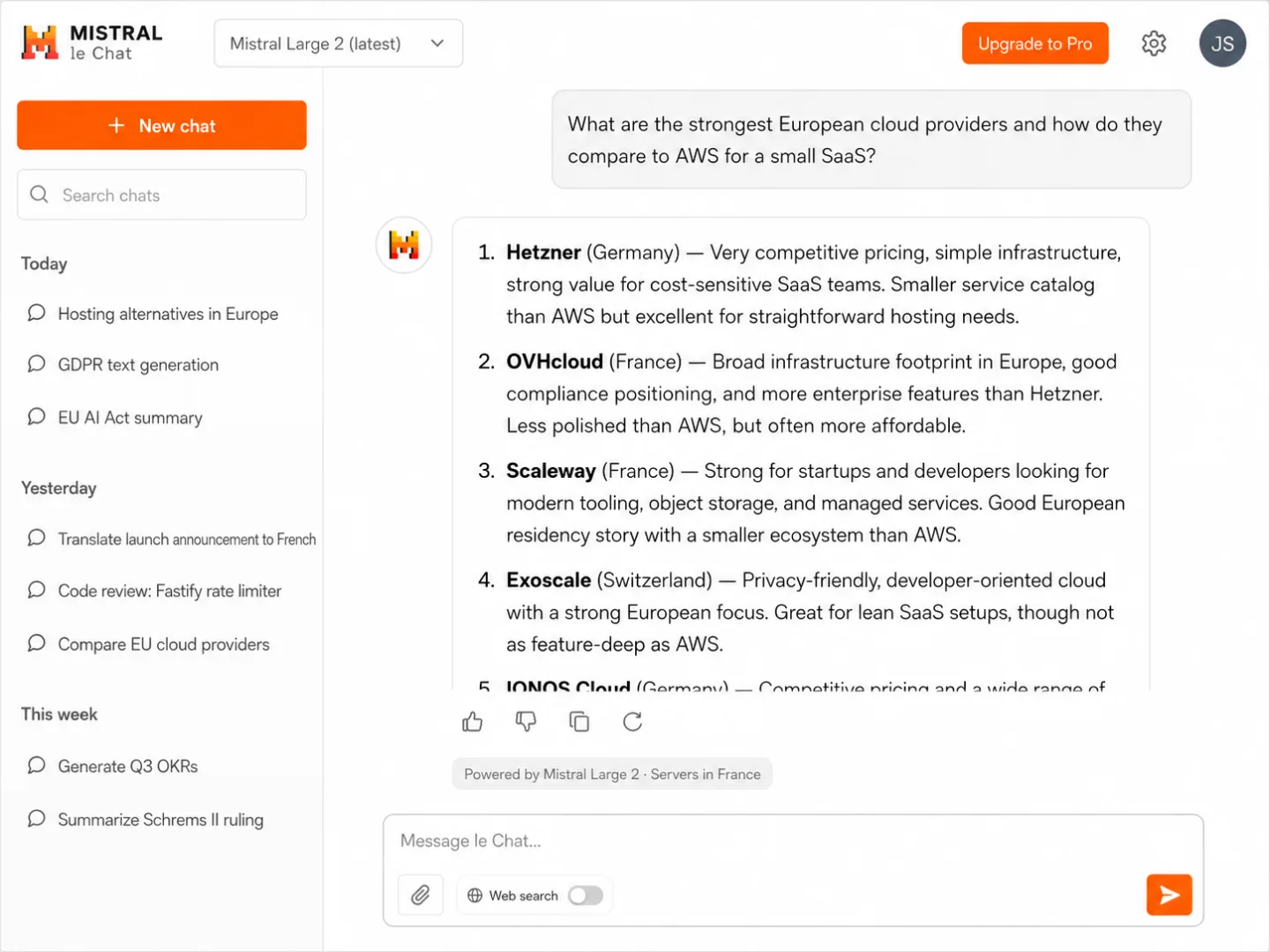
AI is the next place European businesses have to make a sovereignty call, and the time to make it's now, before the lock-in sets. Italy fined OpenAI EUR 15 million in December 2024 over GDPR violations with ChatGPT. Pump sensitive business data through a US AI API and you carry the same CLOUD Act risk as any other US service.
Mistral AI 🇫🇷 is the European answer. Founded in 2023, already valued at $13.8B on more than $3B raised. The enterprise tier gives you zero data retention and full on-premise deployment. On the API, Mistral Medium 3 runs $0.40 per million input tokens, which puts it shoulder to shoulder with GPT-4 on price. Aleph Alpha 🇩🇪 goes after the heavily regulated end: defense, government, healthcare. Heidelberg-based, with SAP and the Schwarz Group among its backers, and all data processing kept inside the EU. One honest caveat: in 2026 Canada's Cohere moved to take it over, so watch where the ownership lands before you bet a regulated workload on it.
DeepL 🇩🇪 has quietly grown into one of Germany's most valuable tech companies. More than 200,000 business customers, half the Fortune 500 among them. Around $185M in 2024 revenue, weighing a $5B IPO. In plain English: the quiet one grew into a giant. ISO 27001 and SOC 2 Type II certified, and Pro users' data never trains the model. In blind tests it beats Google Translate again and again, especially on European languages. Starter from $10.49 a month.
LanguageTool 🇩🇪 is what I'd run instead of Grammarly. German-built, open source, self-hostable, and it doesn't store your text. Premium runs about EUR 5 a month on the annual plan, roughly half what Grammarly charges.
Surfer SEO 🇵🇱 is a content optimization platform out of Wroclaw that bootstrapped its way to $16M in revenue before the Positive Group acquired it. It reads the top-ranking pages and tells you, in real time, what to do with keywords, structure, and length. Plans start at EUR 49 a month. It stands in for Clearscope and MarketMuse, and it got there without a cent of Silicon Valley money.
For forms and surveys, Tally 🇧🇪 is the Belgian Typeform alternative I see recommended most, with a free plan that's genuinely free: unlimited forms, unlimited submissions, no paywall on the core features. Pro is $29 a month if you want custom domains and branding. LimeSurvey 🇩🇪 is the world's leading open-source survey tool: self-hostable, 80-plus languages, and trusted by governments and universities since 2003.
Build your European stack
Every tool above is real, priced, and available today. But nobody swaps 15 tools in one weekend, and I wouldn't try. Here's how I'd sequence it:
Start with the easy wins
Don't try to move everything at once. If it were my stack, and it is, I'd sequence it like this: you swap analytics this week, you point DNS at Europe next week, and you leave the CRM for a quarter when you've got slack. You won't feel the switch day to day. That's the point. Start where the risk is low and the compliance payoff is high:
Analytics and monitoring are the easiest first move. Nothing to migrate, nobody to retrain. Install the new tool, check it works, pull the old one. You're done before lunch. Scan your current tracking setup to see what you're replacing, then try Clickport free for 30 days: no cookies, no consent banners, no US data transfers, hosted on Hetzner in Germany.
DNS and CDN come next. Point your domain at deSEC or Bunny DNS and put bunny.net in front as your CDN. Your users won't notice a thing, and your sovereignty jumps.
Email is a middle-effort move. Export your contacts, set up forwarding, update the MX records. For most teams you're done in a weekend.
CRM and ERP are the hard ones. They reach into every corner of the business. Plan the parallel run, migrate in stages, and give it 2-8 weeks.
FAQ
Do you have to move everything at once? No, and you shouldn't try. I didn't. Start with analytics or DNS, where nothing breaks if you get it wrong. You'll have your first win in an afternoon, and the momentum does the rest.
Is the European stack cheaper across the board? Not everywhere, but the big lines fall. Hosting drops 60-70% against AWS once egress enters the math. In plain English: you won't switch for the savings alone, but you won't pay a premium either.
What about the UK tools on this list? Element and Collabora are UK companies. The UK isn't in the EU anymore, but it isn't under the US CLOUD Act either, and both tools are open source. If your compliance bar is strict EU-only, you can self-host them on Hetzner or OVHcloud and the question disappears.
Which swap gives the biggest payoff for the least work? Analytics, and it isn't close. You don't migrate anything, you don't retrain anyone, and you don't touch production. You add one script line, watch it work, and delete the old tag. If you're in the EU, you also lose the consent banner that was eating half your data.
How current are these prices? I re-checked every price in this guide against the vendors' live pricing pages in July 2026 and corrected the ones that had moved. Prices rot. If you spot one that's drifted again, email me and I'll fix the entry.
The European stack stopped being a compromise. The tools are mature, the pricing is competitive and often cheaper, and the regulation is only heading one way. The real question is whether you switch on your own terms or wait until a DPA switches for you. You don't need a big-bang migration, you don't need a consultant, and you don't need permission. You need one afternoon and the first tool on this list.
So pick one category. Make one switch. Then work outward from there.
And if you're mid-migration and something in this list doesn't hold up anymore, email me and I'll fix the entry.

Comments
Loading comments...
Leave a comment