How to Track AI Search Traffic (ChatGPT, Perplexity, Claude) in 2026
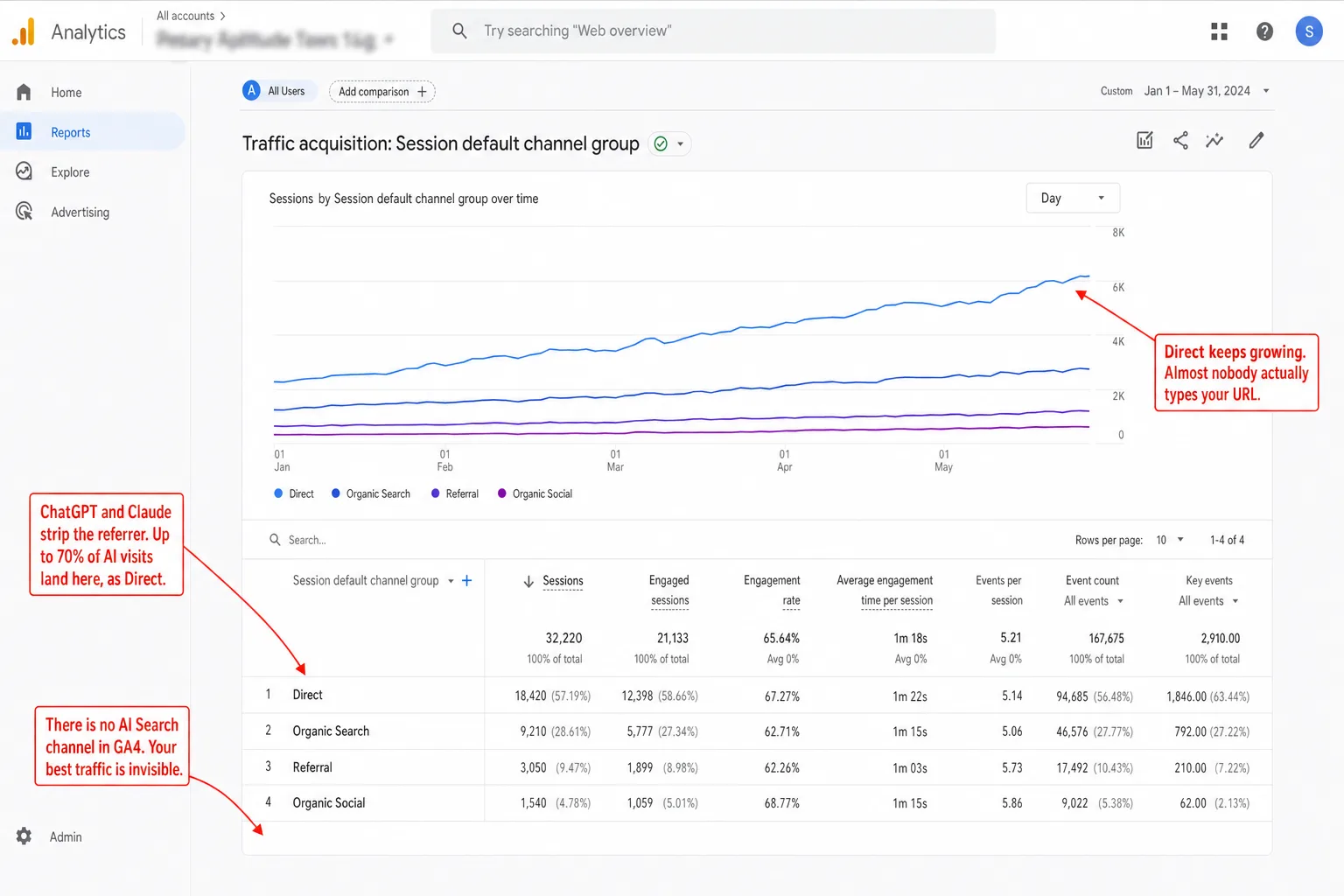
Everyone's chasing AI search visibility right now. The trouble is, the traffic it sends back lands in your analytics as a ghost. AI visitors convert at up to 5x the rate of organic search, and the channel grew 527% in five months on one agency's client base, January to May 2025. But 70.6% of that traffic shows up as "Direct" because AI platforms strip the referrer header. Your best new channel is also the one you can barely see.
- AI visitors are worth the effort: in our own study they converted at 3.4x the rate of every other channel, and third-party studies put the premium as high as 5x organic. But 70.6% of AI traffic lands in 'Direct' because AI apps strip the referrer.
- GA4 added a native AI Assistants channel in May 2026. It's a real improvement, but it only fires when a recognized referrer arrives: no-referrer AI visits still land in Direct, Perplexity lands in Referral, and Google's own AI Overviews stay inside Organic Search.
- A dedicated AI Search channel fixes the referrer-bearing side. Clickport classifies 16 AI platforms out of the box, no regex, and pairs it with server-side, IP-verified AI crawler tracking, so bots and humans never mix.
- AI crawlers are not AI traffic. Cloudflare measured Anthropic crawling 38,000 pages for every visit it referred in July 2025. Block training crawlers, allow search crawlers, and track the two separately.
- No tool can recover a stripped referrer, and on EU sites the consent wall stacks on top. A cookieless tool sees roughly 2x more AI referrals simply because there's no banner to reject.
Your best traffic source is invisible
I've measured this on our own servers: 8,280 verified AI citations produced 83 visits in 14 days, and the AI visitors who did land converted at 3.4x the rate of everything else. A later re-run put the citation gap closer to 150 to 1.
The third-party numbers point the same way. SE Ranking analyzed 101,574 websites and found AI visitors spend 67.7% longer on site than organic search visitors. Seer Interactive's case study showed ChatGPT visitors viewing 2.3 pages per session versus 1.2 for organic. Adobe measured retail shoppers arriving from AI assistants as 33% less likely to leave immediately. And Superprompt's analysis of 12.3 million visits found 73% of AI visitors convert on their first session, compared to 23% from Google. In plain English: three in four AI visitors who convert do it on the first visit.
The gaps aren't small. AI visitors arrive pre-qualified. The AI already answered their basic question, so they click through wanting one specific thing: to buy, to sign up, to verify a recommendation. The research happened inside the chat, before they ever reached you.
So you'd think this is the channel you want to watch most closely. You can't.
Put another way: for every seven or eight AI visitors who arrive, your dashboard admits to one. The rest are either misfiled as Direct or gone entirely. So your dashboard shows one thing: a "Direct" number that creeps up a little each month. A missing source also leaves revenue from AI visits unattributed.
What AI traffic looks like when you can see it
Clickport sorts every visit into one of 16 channels, and one of them is a dedicated AI Search channel. The classifier recognizes 16 AI platforms: ChatGPT, Perplexity, Claude, Gemini, Copilot, Phind, Kagi, You.com, Meta AI, DeepSeek, Grok, Duck.ai, Mistral, Liner, Poe, and Tencent's Yuanbao. A visitor who arrives from any of them with a referrer header or a matching utm_source parameter lands in AI Search on its own. You write no regex. You build no custom channel group. You do nothing when a new platform shows up, because I keep the list current centrally.
Here's the whole AI picture on one screen: what the engines read, what they cite, who clicks through, and who converts, per engine.
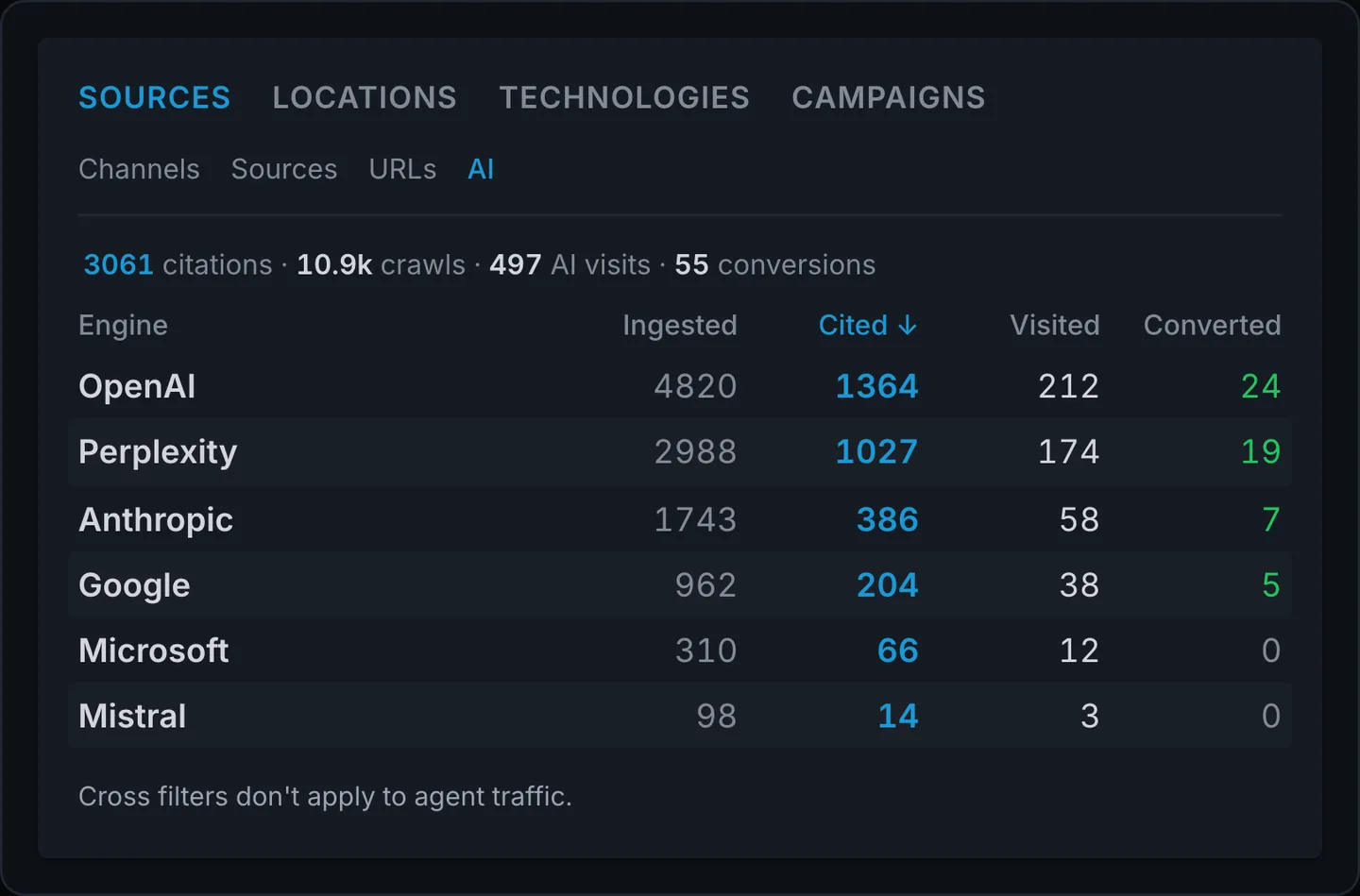
Where should you put your attention? Look at the split. ChatGPT drives 87.4% of all AI referral traffic, says Conductor, so nearly nine in ten AI clicks come from one product. It's also the fastest-growing platform, at roughly 200% year over year. Perplexity sends roughly 18-22%. Gemini sits at 10-14%. Claude sends the least, but Superprompt's data gives its visitors the highest session value of any AI platform, at $4.56. Small channel, sharp buyers.
With the AI Search channel you see which platform sent the visit, which page it landed on, how the person engaged (scroll depth, time on page, clicks), and whether they converted. It's the same reporting you already get for organic search or social. The only difference: it covers a channel most tools toss into "Referral" or "Direct" and forget about. That's the whole trick, and it's the part I'm proudest of: nothing to configure, nothing to maintain.
What about GA4? In May 2026, Google added a native AI Assistants channel that auto-tags visits from recognized AI tools. That's a real improvement, and credit where due. But it only fires when a referrer Google recognizes arrives. No-referrer AI traffic still lands in Direct. Perplexity passes a perplexity.ai referrer and still files under Referral. And Google's own AI Overviews stay inside Organic Search. In practice the new channel catches the easy visits, the ones that were nearly visible anyway. The invisibility problem it was supposed to fix mostly doesn't move.
Why most of it is hiding in your Direct bucket
AI platforms don't all behave the same way when they send you a click. Some pass a clean referrer header every time. Others strip it before the visit ever reaches you. If you don't know which is which, you can't read your own numbers.
Claude used to be the extreme case, stripping everything. That's changed: Claude web clicks now carry a claude.ai referrer. I checked our own referrer data across the sites we measure, and they're there. The native apps still send nothing. Cloudflare notes the same caveat in its own referral data. So Claude went from invisible to partially visible. The mobile-app problem, though, is everyone's problem: ChatGPT's apps alone account for roughly 68 million monthly downloads, and every click out of their embedded browsers lands on your site with no referrer at all. To your analytics, that person typed your URL by hand.
Google AI Overviews is the biggest blind spot of all. Those overviews now sit on just over 25% of Google searches. Click a citation link inside one and the referrer is plain old google.com, the same string a normal organic click sends. No analytics tool can tell an AI Overview click from a blue-link click, mine included. The data that would let us doesn't exist. Google Search Console did add AI Mode data, but it's folded into the "Web" search type with no way to break it out. Even Google won't show you Google.
AI crawlers are not AI traffic
Most articles on this topic muddle two different things, so let me draw the line. An AI crawler is a bot: GPTBot, ClaudeBot, or PerplexityBot fetching your pages for training data or to answer a question. AI referral traffic is a human: a real person in a real browser, clicking a link an AI gave them. The bot carries a bot user-agent and never runs your JavaScript. The human looks like any other visitor. You handle them in opposite ways: bots stay out of your visitor counts, humans are the traffic you want to measure.
Clickport splits the two for you, and verifies the bots while it's at it. Crawler hits are checked server-side against each operator's published IP ranges, so a scraper pretending to be GPTBot doesn't pollute your AI numbers.
That split matters more now that Google is testing payments for content used in AI answers. If you get an offer, you need to know what those visits were worth before you judge it, and our guide to Google's AI contribution payments works through the calculation.
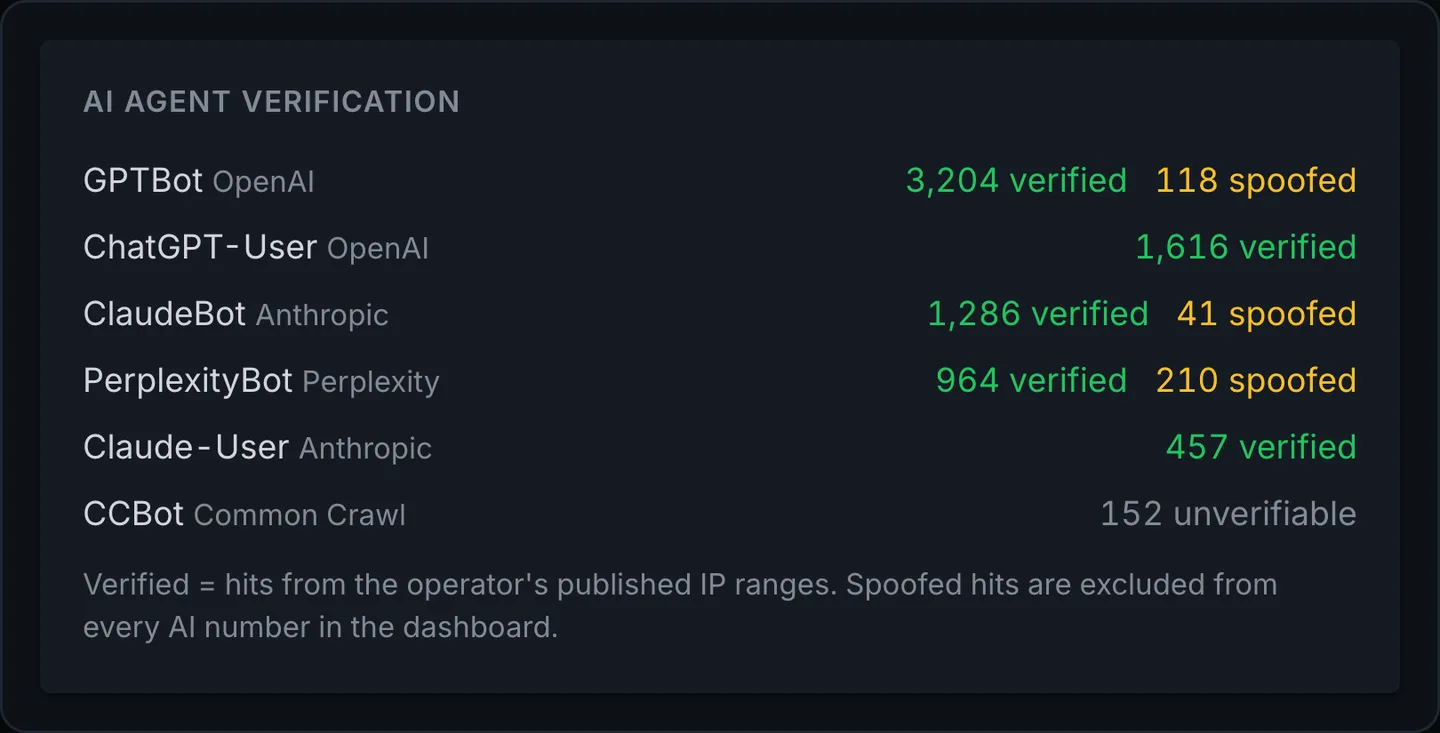
The scale of the crawling is hard to overstate. Cloudflare's CEO expects bot traffic to pass human traffic online by 2027. And the exchange rate is brutal: Cloudflare's July 2025 data has Anthropic crawling 38,000 pages for every visit it referred back. OpenAI: 1,091 to 1. Perplexity: about 195 to 1. In other words: they read a library and send back a postcard. Most of that reading turns into nothing you can count, and it eats bandwidth while it happens.
So how should you set up robots.txt? Block the training crawlers (GPTBot, ClaudeBot, CCBot, Bytespider) to keep your content and cut your server bill. Allow the search and retrieval crawlers (OAI-SearchBot, ChatGPT-User, PerplexityBot) so you still turn up in AI answers. Block them all and you vanish from AI search. Allow them all and you hand AI companies your content for training and get nothing back. The middle path is the only sane one.
Humans coming from AI platforms carry normal browser user agents, so they sail through bot detection and the classifier files them as AI Search. The two paths never cross. And as of July 2026 the crawler side goes much deeper: you can watch which AI bots are reading your website server-side, IP-verified, engine by engine, joined to visits and conversions.
Clickport now shows both halves of your AI traffic
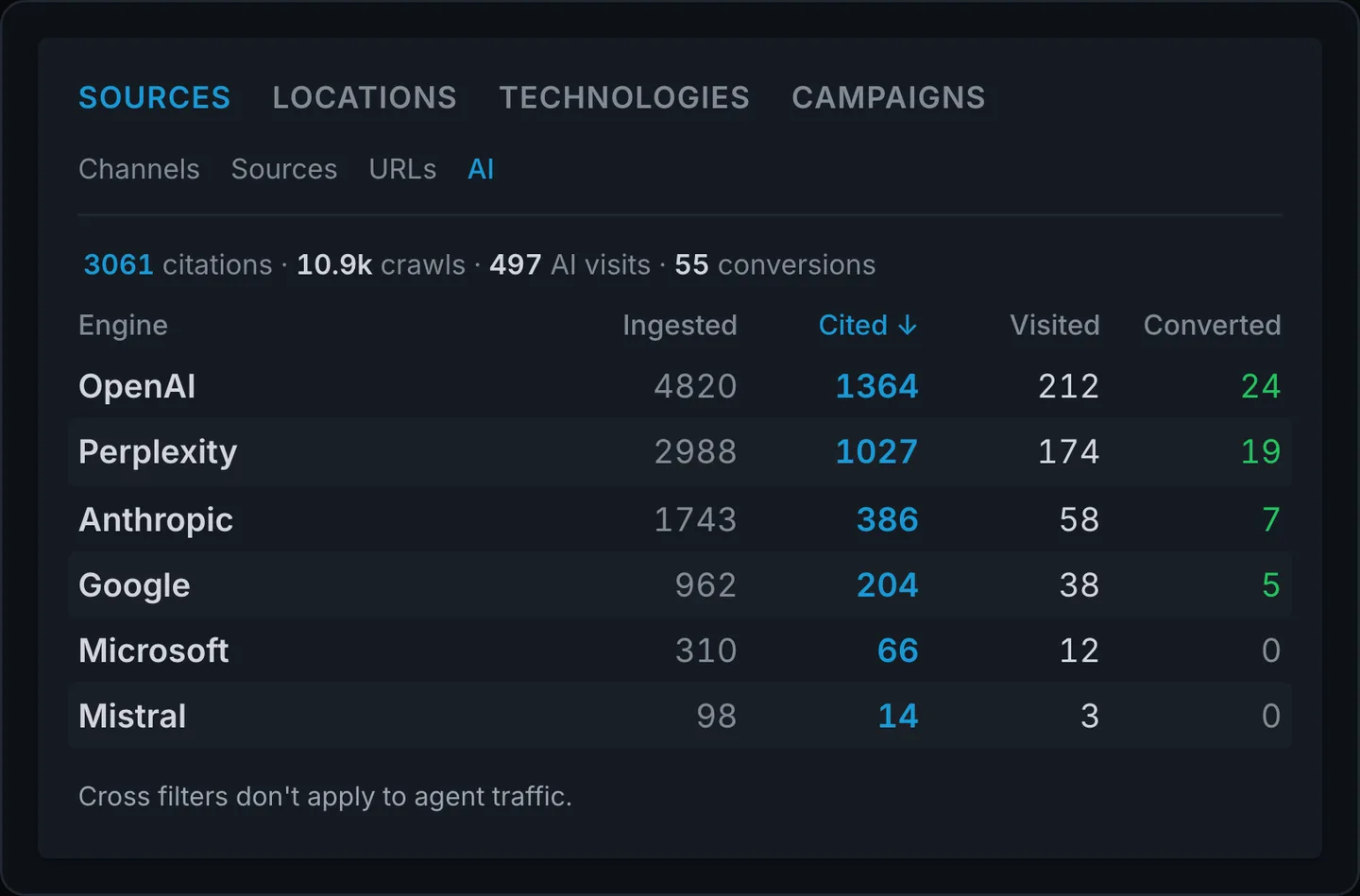
That split is now a screen, not a concept. The AI tab in the Sources panel carries the machine half: every crawl and citation, verified against the AI companies' published IP ranges. The AI Search channel carries the human half: the visits this article is about, with their engagement and conversions. In our own study, AI assistants read our pages about a hundred times for every visit they sent back. Now you can see both numbers for your own site, per engine.
Try Clickport free
30 days free. No credit card required.
The consent wall makes it worse
Now tie this to the cookie consent problem. In the EU, cookie-based analytics tools need a consent banner. The banner stops the whole tracking pipeline for anyone who clicks "Reject." And on a compliant banner, one where "Reject" is as easy to find as "Accept," the rejection rate runs 50 to 60%. That means half your visitors opt out before you measure a thing.
For AI traffic the two losses stack. Referrer stripping already takes 70% of your AI attribution off the table. Then consent rejection takes half of the 30% that's left. Add it up and a cookie-based tool on an EU site captures somewhere around 10-15% of the AI traffic you really got. A cookieless tool captures the full 30% that arrives with a referrer, because there's no banner and nothing to reject. That's the "roughly 2x more AI visibility" math: same stripped referrers, none of the consent loss.
The consent effect isn't theoretical. Orbit Media measured it on their own site: GA4 missed 55.6% of traffic against a cookieless tool running side by side once the consent banner was up. More than half the visitors, gone. For AI traffic the gap runs wider still, because AI users lean hard on mobile apps and embedded browsers, exactly where attribution falls apart first.
Cookieless analytics can't recover a referrer that was never sent. Nothing can. What they remove is the second loss: every visitor who shows up with a referrer gets counted, no banner in the way.
What AI visitors actually do on your site
Study after study tells the same story. AI visitors stay longer, read more, and buy more often than visitors from any other channel.
The reason is simple. The visitor is pre-qualified. Say someone asks ChatGPT "what is the best privacy-first analytics tool for small businesses" and ChatGPT names your product with a link. By the time they click, they already know what you do, why it matters, and how you stack up against the rest. The research is done. It happened in the chat, before they ever reached you. What used to take five Google searches and three comparison articles now fits in one AI conversation. The person who clicks through isn't browsing. They're checking you out before they buy.
Seer Interactive found the same thing: people work through their consideration inside the AI conversation, so by the click they're high intent and ready to convert.
How to get cited by AI search engines
Measuring AI traffic is only half the job. The other half is earning the citation that sends the traffic in the first place. People call this new craft Generative Engine Optimization, or GEO, and it plays by rules that aren't the old SEO rules.
It also pays to know which of your pages the engines already like. That's a report now, not a guess:
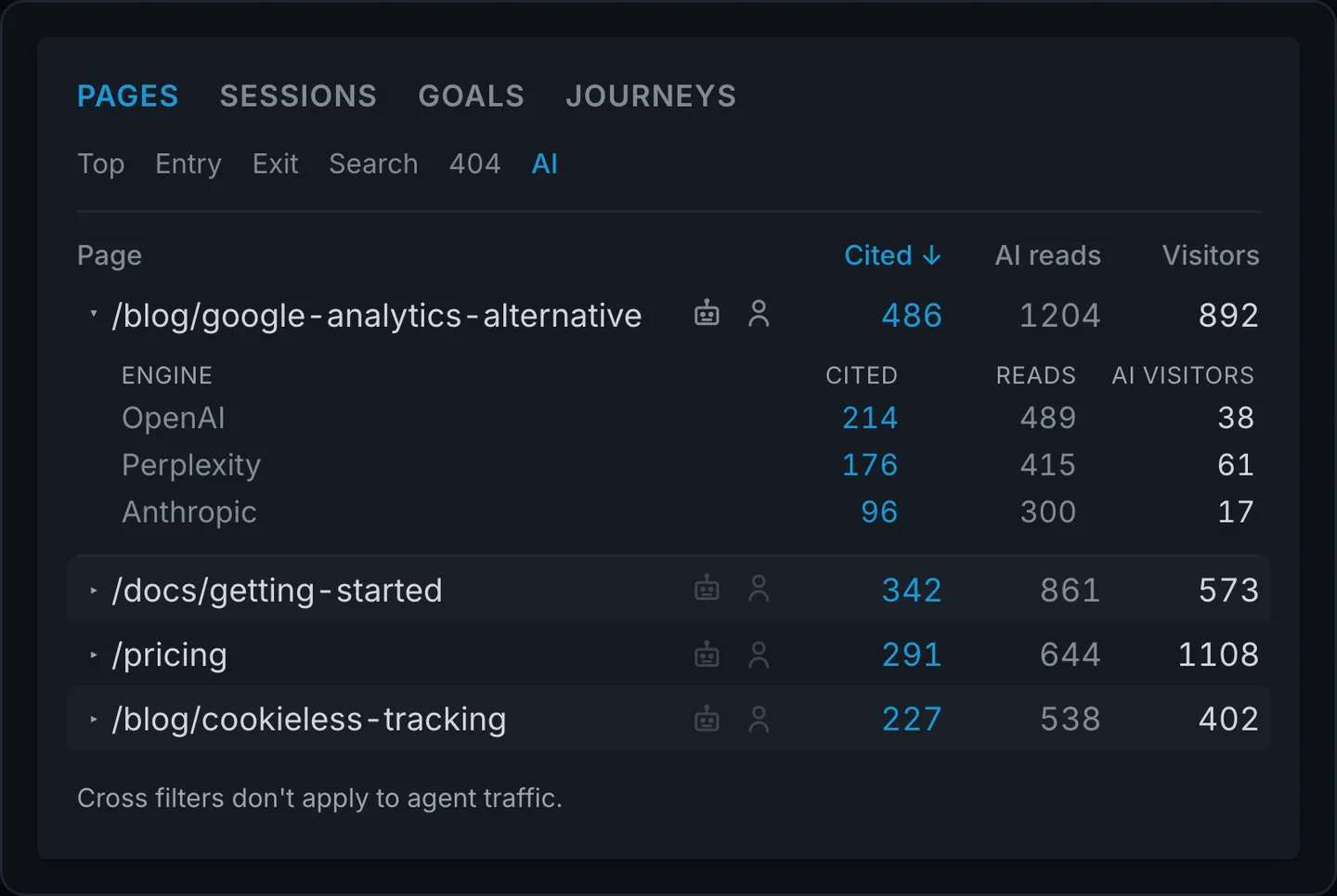
Here's the finding that should cheer up every small publisher. 74% of ChatGPT citations point to sites with domain authority under 80. In plain English: you don't need a big domain to get quoted, you need the best page on the question. In the same dataset, 44% of cited pages sat outside Google's top 20 results, pages that earn almost no traditional search clicks. AI search doesn't count your backlinks the way Google does. It picks pages for relevance, depth, and how specific they are. A small site with one genuinely great page on a narrow topic can sit in an answer right next to a brand that's been around for a decade.
That's the real shift. Old SEO is winner-take-all. Positions 1 through 3 take most of the clicks, and position 25 takes nothing. AI search reaches far deeper. Your page at #47 may never earn a Google click, yet ChatGPT, Perplexity, or an AI Overview can quote it. Content that was dead weight for traffic suddenly pulls its own weight.
The small site playbook
AI traffic grew 123% for small businesses across 391 sites in six months, per Search Engine Land. ChatGPT alone added 21% more traffic a month on average, and it compounds. These are small businesses, not enterprise brands. The door is open.
I'd work through these in order. They cost nothing but time.
Answer first, explain second. Put your definitions and direct answers at the top of every page. The Superprompt data says AI models weight the first 150 words heavily, and opening paragraphs that answer the question directly get cited 67% more often. Bury the key fact in paragraph 8 and the AI walks right past it.
Add data points. Pages with original data tables earn 4.1x more citations. Use exact numbers, dates, and named sources. "Email marketing has an average ROI of $36 per $1 spent (Litmus 2023)" is citable. "Email marketing has great ROI" is not. Same claim, only one gets quoted.
Update content regularly. A page touched within the last 30 days earns 3.2x more citations than one older than 12 months. AI leans hard toward fresh pages. A quarterly refresh keeps your best ones in the running.
Unblock AI search crawlers. Open your robots.txt and read it. If PerplexityBot and OAI-SearchBot are disallowed, your content can't show up in AI answers, full stop. Many sites block every AI crawler indiscriminately. That's good news for you, because it means thinner competition for the sites that let the search crawlers in.
Keep pages fast. Superprompt's data has Perplexity favoring sites that load in under 2 seconds. Speed was already a ranking factor for Google. Now it's a citation factor too.
Enterprise engagement analytics tools that measure this depth start at $7,000 a year. Clickport gives you AI channel classification, engagement scoring, scroll depth, copy detection, and goal tracking for EUR 9 a month. Every feature on every tier. No bolt-on AI analytics add-on.
What is coming next
Gartner predicted traditional search volume would fall 25% by 2026 because of AI. We're inside that window now. AI search engines already touch 12-18% of all web referral traffic worldwide, and that number is climbing.
And the next wave is already here. AI agents like OpenAI's Operator, since folded into ChatGPT's agent mode, browse sites and finish tasks for people. The "visitor" is the AI itself, not a person. It renders the page, runs the JavaScript, and can fire your tracking. It scrolls at machine speed, never hovers, and buys in three seconds flat. Your old engagement metrics mean nothing for a visit like that. This is why we built AI agent tracking as its own thing: agents get counted, verified, and reported, without polluting your human numbers.
So here's where you stand. Your highest-converting traffic source is hiding in your Direct bucket. It compounds every month, and every month the gap between what your dashboard shows and what really happened gets a little wider. Start measuring AI traffic now and you own the baseline for whatever comes next. Wait, and a year from now you'll stare at a flat dashboard and wonder where the growth went.
Clickport tracks AI search traffic on its own. Sixteen AI platforms classified the day you install it. No configuration. No regex. No consent barriers. Setup takes under two minutes.
Start your free trial
30 days free. See your AI search traffic within minutes.

Comments
Loading comments...
Leave a comment