The New Vanity Metrics: Why AI Visibility Scores Are the Klout of 2026
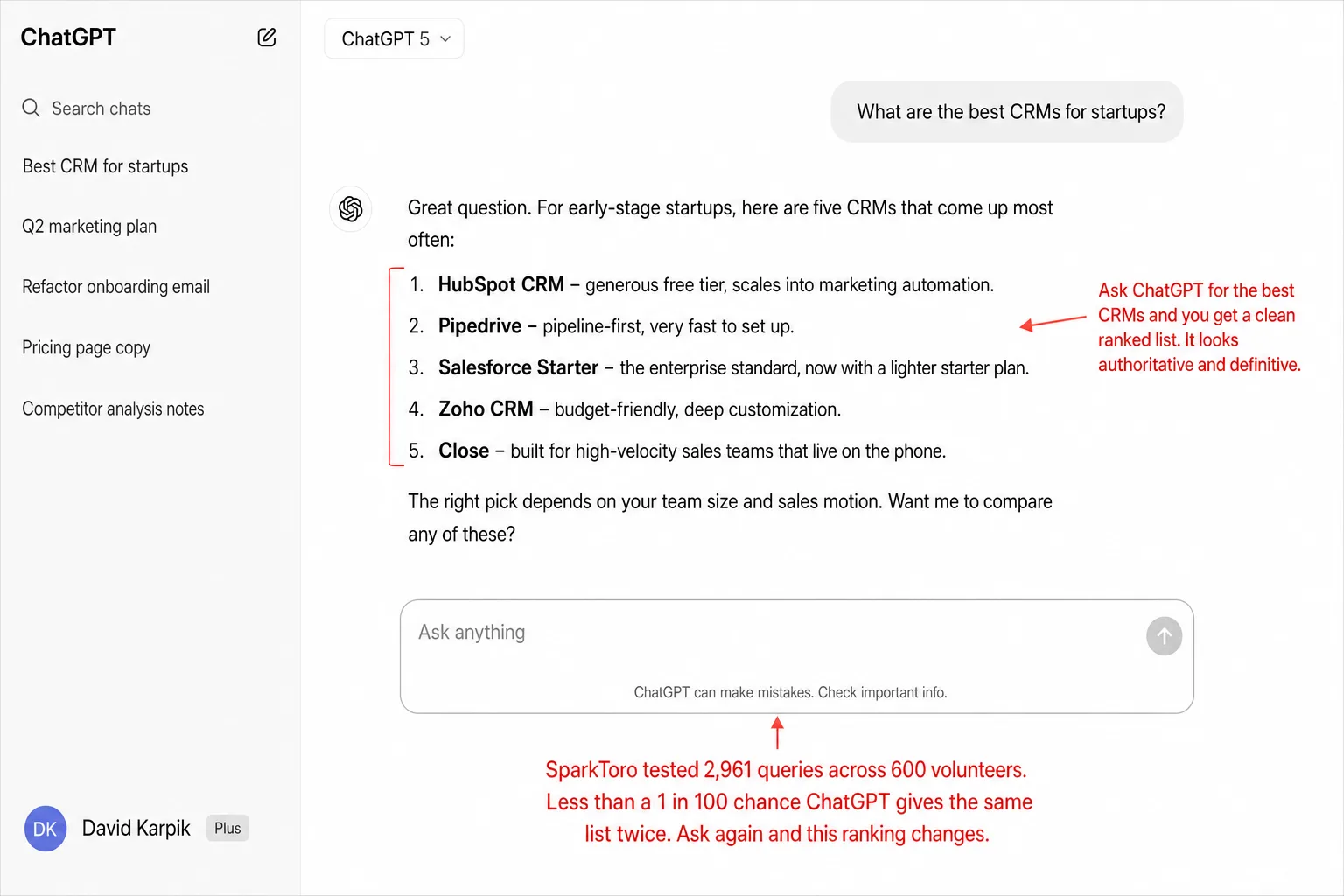
AI visibility tools run synthetic prompts through chatbots and call the results a "score." SparkToro found less than a 1 in 100 chance AI gives the same brand recommendations twice. Ask the same question again and the answer changes. Your analytics already tracks every real visitor AI sends you. The score adds nothing.
A quick note on who I am. I build Clickport, a privacy-first analytics tool with an AI Search channel, so when I tell you to measure visits instead of scores, I'm also talking my own book. Read me with that in mind, and check the sources as you go.
- AI visibility tools run 25-300 curated prompts per day through chatbots and call the results a 'score.' SparkToro found less than 1 in 100 chance AI gives the same brand recommendations twice.
- All AI platforms combined account for 0.15% of global web traffic. Google holds 90% market share and grew 21.64% in 2024. The panic is manufactured.
- Only 1% of users click links in AI summaries. ChatGPT sends 190x less traffic than Google despite processing 12% of search volume. The gap between 'mentioned' and 'visited' is enormous.
- Klout, Alexa Rank, Domain Authority, Facebook's video metrics: every era produces a vanity metric that looks like insight but measures noise. AI visibility scores follow the same pattern.
- Your analytics already tracks AI referral traffic via browser referrer headers. Real visitors, real engagement, real conversions. No synthetic testing or panel extrapolation needed.
Clickport now shows both halves of your AI traffic
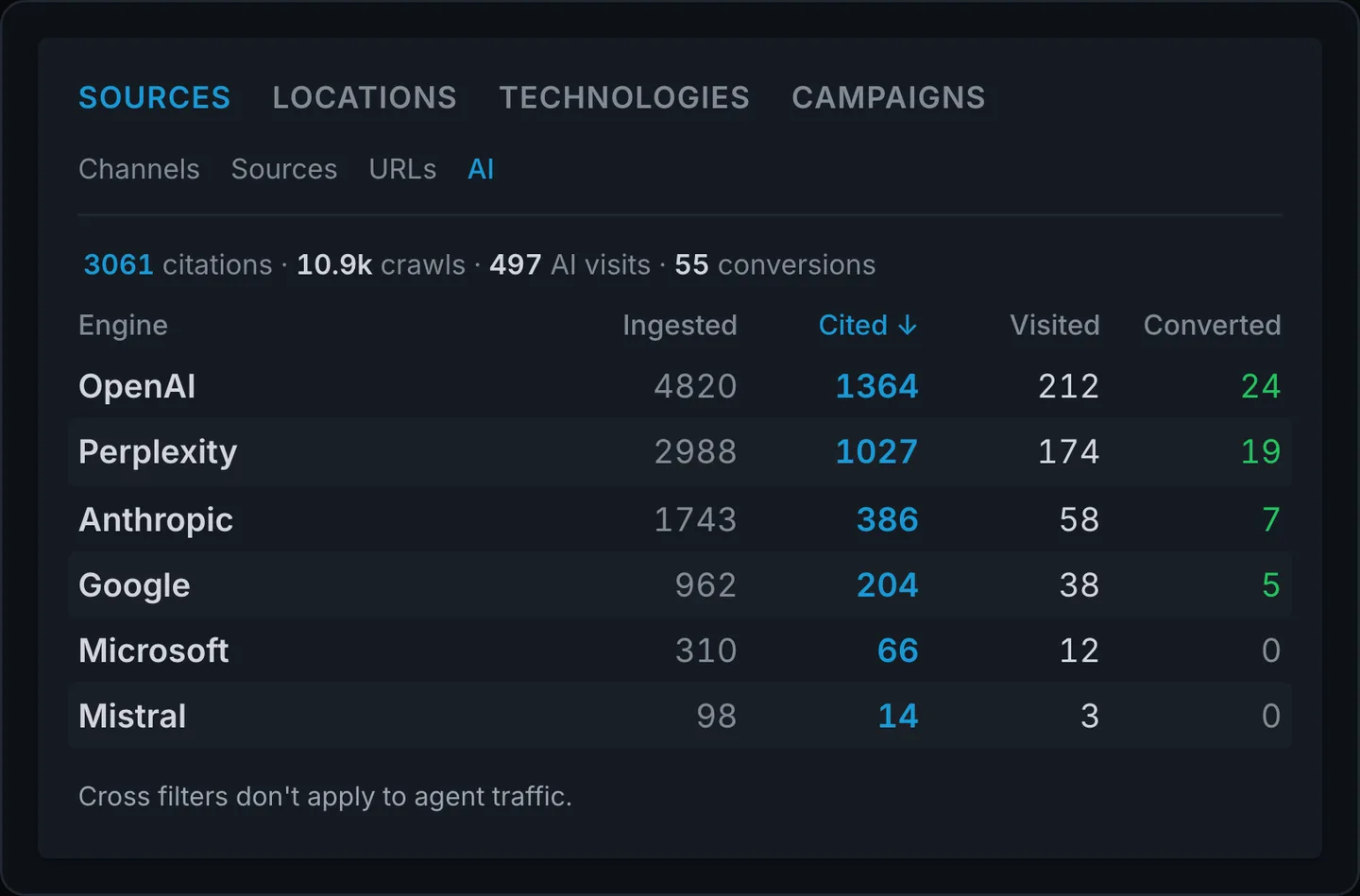
Since July 2026, the visits are only half of what Clickport tracks. The other half is the machines: every crawl and citation by OpenAI, Anthropic, Perplexity and the rest, verified against the AI companies' published IP ranges, and joined to the visits and conversions they send back.
That's the part no channel report can show you. In our own study, AI assistants read our pages about a hundred times for every visit they sent back. Now you can see the reads, the citations, the click-throughs, and the conversions on one screen, per engine. Humans in the AI Search channel. Machines in the AI tab. The full story is in the launch article.
Try Clickport free
30 days free. No credit card required.
A number that buys you nothing
I watched the SEO industry spend a decade worshiping Domain Authority. It's a score from 1 to 100 that claims to predict how well your site will rank on Google. People built careers on moving it.
Google never used it. John Mueller said it plainly: "We don't use domain authority. That's a metric from an SEO company." Statistician Jen Hood analyzed the data and found DA explains 0.1% of ranking variance for top-5 positions. In plain English: that's noise. The creator of the metric, Rand Fishkin, is described as embarrassed by how long it stuck around.
None of that stopped anyone. Agencies built business models around "improving DA." Job listings demanded minimum DA scores. A whole market for buying and selling links grew up around a number Google ignores entirely.
Now replace "Domain Authority" with "AI Visibility Score." Same structure. Same promise. Same gap between the metric and reality.
How AI visibility tools actually work
I'll tell you how these tools work. It's simpler than the dashboards make it look.
You sign up. You pick 25 to 300 prompts. Things like "best project management tool" or "top CRM for startups." The tool runs those prompts through ChatGPT, Perplexity, and other AI chatbots once a day using automated browser sessions. It reads the responses. Did your brand get mentioned? In what position? Positively or not?
Then it puts a number on your dashboard. The number isn't connected to anything.
That's it. That's the product.
Some tools go further, and this is the part I trust least. They buy data from unnamed "third-party consumer panels." That means people who installed a browser extension or VPN that watches their AI conversations in exchange for a free product. The tool takes that panel data and scales it up to guess what millions of people are asking AI.
This is the same method that made traffic estimation tools notoriously inaccurate. Screaming Frog tested the major traffic estimators against 25 real websites and found individual site estimates off by up to 94%. Promodo analyzed 184 websites and found an average 50% error rate across all major tools. In other words, the estimate for your site specifically is a coin flip.
Now point that same method at a market 100x smaller and 100x more volatile than web search. That's what AI visibility tools are selling you.
Less than 1 in 100
In January 2026, Rand Fishkin and Patrick O'Donnell from Gumshoe.ai published research that, I think, should have ended the AI visibility tool category overnight.
They had 600 volunteers run 2,961 queries across ChatGPT, Claude, and Google AI. Same prompts. Repeated multiple times. They measured consistency.
The result: less than a 1 in 100 chance that an AI tool produces the same list of brand recommendations when asked the same question twice. Less than 1 in 1,000 chance the brands appear in the same order. Put another way: the leaderboard reshuffles nearly every time.
Read that again.
The same question. The same AI. Different answer almost every time.
Fishkin's conclusion, and I can't improve on it: "Any tool that gives a 'ranking position in AI' is full of baloney."
This isn't a minor methodological quibble. It's a structural problem. AI responses are non-deterministic by design. They vary by context, time of day, conversation history, and random seed. Building a monitoring tool on top of something that changes with every query is like building a weather station on a trampoline.
The Digiday interviews with publishers confirm the skepticism from the people who would benefit most. Neil Vogel, CEO of People Inc: "This whole conversation is not rooted in any fact." Lily Ray, VP of SEO Strategy and Research at Amsive: "Anybody that's pretending to be an expert in this, they're lying."
2 Brand B
3 Brand C
4 Brand D
5 Brand E
2 Brand A ↓1
3 Brand F · new
4 Brand G · new
5 Brand B ↓3
Brands D and E: gone
We've seen this movie before
Every era produces a vanity metric. A number that looks like insight, feels like progress, and measures nothing that matters. A company invents a score. The industry adopts it. Businesses optimize for it. Years later everyone quietly admits it was meaningless.
Klout Score (2008-2018). It crushed your whole social media presence down to one number from 1 to 100. Justin Bieber scored higher than Barack Obama. The Pope was listed as an expert in "Miss Universe." A spammer with 11 followers hit a score of 59 just by posting 9,156 tweets. Job listings started asking for a "Klout score of 35 or higher." The Palms Casino gave high scorers better hotel rooms. Then someone checked the math: follower count alone explained 95% of the score. In other words, the rest of the algorithm did almost nothing. It shut down in 2018. Nobody missed it.
Alexa Rank (1996-2022). A global ranking of every website, built mostly on data from a browser toolbar. Google's Director of Research Peter Norvig showed how broken that was. His site got twice the pageviews of Matt Cutts' site, yet Alexa ranked it 25 times lower. The toolbar crowd was mostly webmasters and South Korean users, so the ranking meant nothing for everyone else. Amazon pulled the plug in 2022 after years of fading relevance.
Facebook Video Metrics (2015-2018). Facebook overstated how long people watched videos by 150-900%. Internal documents later showed engineers knew about the error for over a year before they said anything. Whole media companies believed those numbers and pivoted to video. They laid off writers and restructured. Vice, Mic, MTV News, Fox Sports, and Mashable all gutted their editorial teams. Then Reuters Institute data showed people spent only 2.5% of their visit on video pages. Facebook settled for $40 million. Real people lost real jobs over a faulty number.
Domain Authority (2004-present). Still here. Still explains 0.1% of ranking variance. Still feeding a whole industry of link buying. Google still doesn't use it. The pattern won't die, because the number is useful to the people selling services around it.
The through-line never changes. A proprietary score that's easy to track, hard to check, and impossible to tie to revenue. And the people who win most are the people selling the tracker.
The 190:1 gap
Here's the number that should end every conversation about AI visibility tools before it starts. It hasn't.
ChatGPT processes roughly 12% of Google's search volume. But it sends 190 times less traffic to websites. Since writing this piece I measured the same gap on our own servers: ChatGPT read our pages 7,825 times and sent 23 visitors. The 190:1 platform ratio and our 100:1 citation gap measure different layers. In other words, they agree on the story.
That's the gap between "AI mentioned your brand" and "AI sent you a visitor." It's not a crack. It's a canyon.
Pew Research Center looked at 68,879 Google searches. People clicked a link inside an AI summary only 1% of the time. Put another way, 99 times out of 100 they read the answer and moved on. Google's own AI Mode ends 92-94% of sessions without a single click to any outside website. Add up every AI platform together and you get 0.15% of global web traffic. That means 15 visits in every 10,000.
I'll put a funnel on it. Watch the thousand shrink.
AI visibility tools measure the top of this funnel. The "1,000 mentions" part. They can't see the bottom, because they don't watch your website. They have no idea whether one mention turned into one visit.
And here's the twist I like most. The few people who do click through from AI search are worth a lot. They spend 67.7% more time on your site, and they sign up at 11 times the rate of normal search visitors. They came to you because an AI named you by name. That's about as warm as a lead gets.
But you only see any of that if you measure the visit. Not the mention.
Google is not dying
The entire AI visibility category is built on a premise: AI search is replacing Google, and you need to be ready. The premise is testable.
The data says otherwise. All of it.
As of February 2026, Google holds 90.01% of global search market share. AI chatbots don't even show up in StatCounter's search engine rankings. And Google isn't shrinking. It grew 21.64% in 2024 to 5 trillion searches a year, and it gets 373 times more searches than ChatGPT. In plain English: for every one search on ChatGPT, there are 373 on Google.
Back in February 2024, Gartner predicted AI would cut traditional search volume 25% by 2026. In practice, the opposite happened. Search grew.
SparkToro looked at 41 websites with serious search activity and found AI tools make up 3.2% of all search. In practice, Amazon, Bing, and YouTube each pull more desktop search than ChatGPT. 95% of Americans still use a normal search engine every month. And the strange part: when people start using ChatGPT, their Google use goes up, not down. The two don't cannibalize each other. People just search more.
Fishkin puts it directly: "The 'AI vs. Search' narrative is largely made-up by media and influencers seeking attention, rather than an accurate reflection of reality."
None of this means AI search doesn't matter. It's growing, and the visitors it sends are good ones. I watch it daily on my own sites, and it's still a sliver of where your traffic comes from. Paying $200 to $500 a month for a special dashboard to watch 0.15% of web traffic, when your own analytics already shows you that traffic for free, is a solution hunting for a problem.
What gets measured gets managed (into the ground)
There's a rule in economics called Goodhart's Law: "When a measure becomes a target, it ceases to be a good measure."
The old Soviet nail factory is the classic case. Told to make a target number of nails, it churned out tiny useless ones. Told to hit a target weight instead, it made a few giant useless ones. The factory hit the metric every time and made nothing anyone could use.
AI visibility scores pull you the same way. The pull is built in.
Measure "visibility in AI responses" and you'll start writing for AI responses. You'll chop your pages into bits a chatbot can quote. You'll bolt on the stats, quotes, and citations that research says make AI more likely to mention you. In other words, you'll feed the AI better raw material.
And the Content Marketing Institute spotted the trap in that. Better content for the AI means the AI gives a more complete answer. A more complete answer means fewer people need to click through to you. You'd be fixing your traffic problem by making it worse.
The way out is to measure the thing that pays the bills. Did someone visit, and what did they do? I don't know a safer rule.
Scroll depth tells you if people read the page. Session duration tells you if they stuck around. Conversion tracking tells you if they acted. These are observed behaviors, not modeled guesses. They tie straight to money.
↓
AI gives better answers
↓
Fewer people click through
↓
Score goes up. Traffic goes down.
↓
Improve engagement on those pages
↓
More conversions, longer sessions
↓
Revenue goes up. That's the point.
The data you already have
You don't need a special AI monitoring tool. Your analytics already tracks AI search traffic.
When someone clicks a link in ChatGPT, Perplexity, or Claude, the browser sends a referrer header with the AI platform's domain in it. Any analytics tool that reads referrers can spot these visits. It's the same trick that has flagged Google, Bing, and social media traffic for decades. Nothing new to install.
The difference is what happens next. Everything below hangs on it.
A synthetic tool hands you a mention count. Your analytics hands you a visitor. And with a real visitor you get the whole story: which page they landed on, how far they scrolled, how long they stayed, what they clicked, whether they converted. You can line up AI search visitors next to organic search, social, and direct traffic. Same metrics, same dashboard, same link to outcomes.
The numbers back this up. SE Ranking studied 63,987 websites and found AI visitors spend 67.7% more time on a site than organic search visitors. Ahrefs data from around 76,000 websites shows ChatGPT sends 190 times less traffic than Google, even though it handles 12% of the search volume. Microsoft Clarity data from over 1,200 sites shows AI traffic signs up at 1.66%, against 0.15% from search. That means roughly eleven times the sign-up rate.
These are real, useful findings. And every one of them comes from watching actual behavior, not from running made-up prompts through a chatbot once a day.
organic search
(vs 2.8% Google)
than search
AI search is a real traffic source. Small, growing, and the visitors are good ones. So track it the way you track every other source: with real analytics on your own site. Not with a separate $200-a-month dashboard that measures what a chatbot said in a pretend conversation.
Measure what happened, not what might happen
The split is simple. I apply it to everything I measure.
Estimated metrics tell you what might be true. Observed metrics tell you what is true.
A visibility score is estimated. It's built from synthetic prompts, panel guesswork, and a private weighting formula. It tells you what AI might say about you, if someone asks the right question, the right way, on the right day.
A visitor session is observed. A real person on your real site, recorded by your real analytics. The scroll depth, the time on the page, the conversion: all of it happened. No modeling. No extrapolation. No formula.
And the money follows the real data. BCG and Google found that businesses using first-party data saw up to 2.9 times the revenue lift. Forrester found 75% of marketers call real-time behavioral data critical, yet fewer than half collect it. McKinsey found companies that lean hard on customer analytics are 2.6 times more likely to post much higher ROI. In other words: watch what people do, make more money. Same lesson three times.
The whole field is drifting toward direct measurement and away from modeled guesses. It's why GA4's modeled data gets criticized so often. It blends estimates with real events, and you can't tell which is which. It's why privacy-first analytics tools are growing fast. People want true numbers from 100% of their visitors, not sampled, modeled, consent-dependent approximations.
The question isn't "is AI talking about you?"
The question is: "Did AI send you a visitor, and what did they do?"
One of those questions costs $200 a month and produces a number you can't act on. The other is a filter in your analytics dashboard.
● Share of voice
● Citation count
● Estimated reach
● Sentiment score
● Pages viewed
● Scroll depth
● Conversions
● Revenue
What to measure instead
Cancel your AI visibility tool tomorrow and I promise nothing about your business changes. The score vanishes. Your traffic, conversions, and revenue all stay exactly where they were.
So here's what I'd watch instead. You've already got all of it in your dashboard.
AI search as a traffic source. Track it like you track organic search, paid search, and social. When someone lands from ChatGPT or Perplexity, your analytics logs it from the referrer header. No special tool. You see the breakdown per platform, the landing pages, the engagement, the conversions. Learn how this works.
Engagement quality by source. Set AI visitors next to your other channels. Do they scroll further? Stay longer? Convert better? That tells you whether AI traffic is worth anything to your business, not whether a chatbot said your name in a synthetic test. Engagement metrics that matter.
Content performance. Which pages pull AI referral traffic, and what do people do once they're there? If your guide to "best project management tools" gets 50 visitors a month from AI search and 14% of them convert, that's a real number you can act on. If 90% bounce, that's just as useful to know.
Conversion attribution. When an AI visitor fills out a form, starts a trial, or buys something, that conversion gets pinned to the AI Search channel. You can work out real ROI from AI traffic. Not estimated ROI. Not projected ROI. The actual, observed kind, from things that happened.
AI crawler activity. Apart from visitor tracking, you can watch which AI bots crawl your site and how often. That's the supply side: are AI systems reading your content? Pair it with visitor data, the demand side, and you get the full picture with no synthetic testing at all. I check both sides on my own site every week.
None of these are clever new metrics. They're the same ones you already use for every other traffic source. That's the whole point. AI search doesn't need its own category of tooling. It needs the same plain, careful measurement you apply everywhere else.
The question that matters
A growing industry is selling you a number. The number is built on synthetic prompts, estimated panel data, and proprietary formulas. It can't tell you if a single person visited your site. It can't tell you if a single dollar of revenue resulted from an AI mention. It fluctuates with every query because AI responses are non-deterministic by design.
The same industry produced Klout scores, Alexa rankings, and Facebook video metrics. All of them looked like insight. All of them measured noise. All of them eventually collapsed under the weight of their own irrelevance.
Meanwhile, every visitor who arrives at your site from an AI chatbot leaves a trail of real data. Where they came from. What they read. How far they scrolled. Whether they converted. This data exists in your analytics right now, waiting for you to look at it.
The question was never "is AI talking about you?"
The question is: "Did anyone show up? And what did they do when they got here?"
That's the only question that has ever mattered. The channel changes. The question doesn't.

Comments
Loading comments...
Leave a comment