ChatGPT Read Our Pages 7,825 Times. It Sent 23 Visitors.
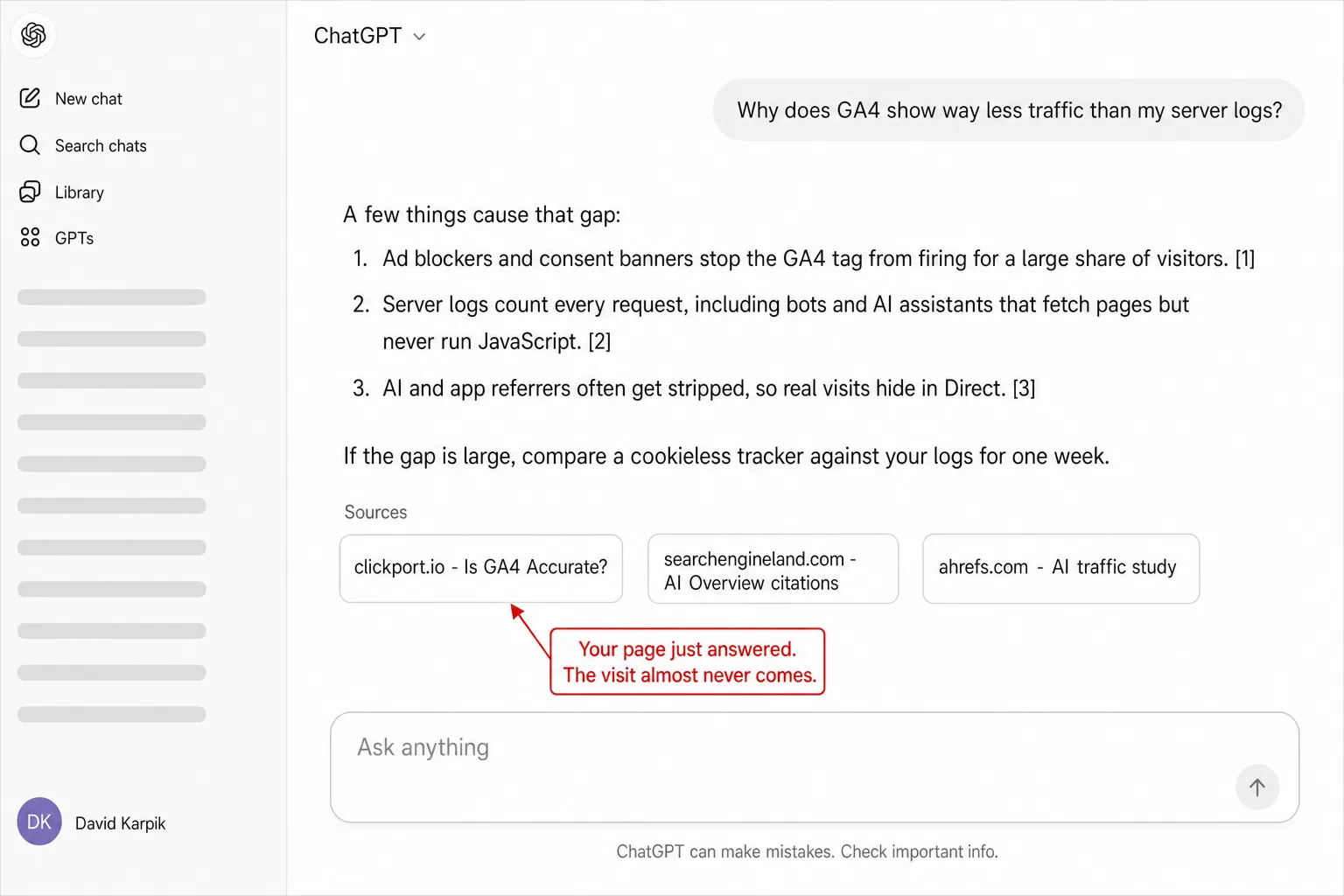
ChatGPT fetched our pages 7,825 times in the last 14 days. Every AI visibility tool on the market would call that winning. Those 7,825 verified fetches produced 23 visits. That's the gap nobody's dashboard shows you. Seeing it means holding both numbers at once, and when this study ran, no tool in the industry held both. It bugged me enough that we built it. More on that at the end.
I've written before about why AI visibility scores are vanity metrics. That was an argument. This is the receipt.
Here's what we measured, how we measured it, and the two findings that surprised me in the other direction.
- AI assistants fetched pages on two sites we measure 8,280 times in 14 days (June 23 to July 6, 2026) to answer live user questions, verified against the AI companies' published IP ranges. The same window brought 83 AI search visits. That's an AI citation gap of roughly 100 to 1. Eight days after publishing, a re-run showed it wider: about 150 to 1.
- Per engine, the gap varies enormously: ChatGPT cited a page 340 times per visit it sent. Perplexity: 14 times. Claude: about 16 (its fetch counts are user-agent-based, the others are IP-verified). ChatGPT reads more than every other measurable engine combined and returns the fewest visitors per read.
- The AI visitors who do land are the best traffic we can measure: 20.3% of AI Search sessions converted on the consumer site we studied, against 5.9% for all other channels combined. That is a 3.4x conversion premium.
- 95.2% of ChatGPT-User fetches verified against OpenAI's published IP ranges. The rest were vulnerability scanners spoofing AI user agents while probing for credential files.
- No AI visibility tool we checked ($29 to $489+ per month) measures traffic, conversions, or revenue from AI. Every headline metric they sell is mentions, sentiment, or share of voice.
The AI citation gap: 100 citations per visit
Between June 23 and July 6, 2026, AI assistants fetched pages on two sites we measure 8,280 times to answer live user questions. Not training crawls. Not index building. Live fetches, triggered by a real person asking a real question. Every one verified against the AI companies' own published IP ranges.
In the same 14 days, those two sites received 83 visits from AI search. That count includes 13 visits from Copilot and Kagi, whose fetches nobody can see. So the visit side is counted generously.
8,280 citations. 83 visits. That's the AI citation gap: roughly 100 to 1.
Put another way: for every hundred times an AI assistant pulled our content to answer someone's question, one person clicked through to the site that wrote it.
The pooled number hides a split you should know up front. The consumer site's gap was 49:1. The B2B site's was roughly 1,100:1. Both are measured below. 100:1 is the blend of these two sites, not a law for yours.
Update, July 15: eight more days of logs are in, and the gap got wider, not narrower. The fresh numbers are near the end of this article.
I want to be precise about what that number is and isn't, because precision is exactly what's missing from this debate. So the methodology comes first.
How we counted AI citations in server logs
A citation, in this study, is one HTTP request from an AI company's live-retrieval bot. These are the bots that fetch a page in the middle of a user conversation. OpenAI documents ChatGPT-User like this: "When users ask ChatGPT or a CustomGPT a question, it may visit a web page with a ChatGPT-User agent." Anthropic says the same about Claude-User, and Perplexity about Perplexity-User.
That's the whole trick. A ChatGPT-User hit in your server log means a live conversation pulled your page. It's not a proxy for a citation. It's the closest thing to one that anyone can count.
Every AI company runs three kinds of bots, and mixing them up is how most AI traffic numbers go wrong:
Claude-User
Perplexity-User
Claude-SearchBot
PerplexityBot
ClaudeBot
CCBot
We counted only the first column, across every nginx access log on our server for the 14-day window. Two sites: clickport.io (a B2B SaaS site) and a German consumer advice site we also measure.
Then we verified. OpenAI, Anthropic, and Perplexity all publish the IP ranges their bots use.
95.2% of the ChatGPT-User requests came from OpenAI's published ranges. The other 394 requests were fakes. Vulnerability scanners wear the ChatGPT-User agent while they probe for files like credentials.json and wp-config.php.bak.
Meaning: count AI citations by user agent alone and you're partly counting attackers. We dropped every unverified ChatGPT and Perplexity request from the totals.
One honest wrinkle: Claude. Anthropic publishes IP ranges too, but they only cover its cloud servers. Most Claude-User requests we saw came from hundreds of ordinary home IPs, one or two fetches each. My read: some Claude products fetch pages from the user's own device. No published range can cover that.
So Claude's fetches can't be IP-verified the way the others can. We handled it conservatively. Only Claude's 52 verifiable fetches count toward the 8,280 headline.
The per-engine chart uses Claude's full count of 289. Those requests don't look like the fake ChatGPT traffic. They pulled ordinary content pages, not credential files, from hundreds of different household IPs. Dropping them all would understate Claude.
That's also why the engine numbers add up to more than the headline total. Treat Claude's numbers as the softest of the three.
More limitations, stated flat. A fetch means your page was pulled into a conversation. It doesn't mean a link was shown. It doesn't even mean the answer used your page: retrieval grabs candidate pages and throws some away. And a user pasting your URL into ChatGPT triggers the same agent.
Caching cuts the other way. One fetch can serve many conversations, so fetches also undercount real usage.
The visit side has its own leak. Some AI visits arrive with no referrer and land in Direct, so visits are undercounted too. And Perplexity has been documented fetching without declaring itself, so its citation count is a floor.
Every one of these biases moves the ratio. None of them rescues it. Even if referrer stripping meant true AI visits were three times what we counted, the pooled gap would still be about 33:1. ChatGPT's alone would still be 113:1.
Why server logs at all? Because nothing else can see this. Our own tracker is JavaScript, and these AI fetchers don't run JavaScript.
In 30 days of Clickport's bot-detection data, the tracker recorded zero ChatGPT-User events. The server logs for the same host caught hundreds of fetches a day. Any JavaScript analytics tool has the same blind spot, including ours. The bot management docs cover what tracker-level detection can and can't see.
AI citations vs clicks, engine by engine
The headline gap is 100:1. The per-engine numbers are the finding I'd argue about at a conference, because the engines behave nothing alike.
ChatGPT read more of our content than every other engine combined. Eleven times more. And it returned the fewest visitors per read.
Perplexity read a fraction as much and sent the most visitors overall. Claude read the least, 289 fetches, and was the only engine that sent the B2B site any visitors at all: 4 of them.
In other words: the engine most likely to cite you is the engine least likely to send you anyone. If your GEO strategy is "get read by ChatGPT," you're optimizing for the worst exchange rate of the three engines anyone can measure.
Two engines are missing from that chart, and the reason matters. Microsoft Copilot answers from the Bing index and has published no distinct live-fetch user agent. Google's AI Overviews and Gemini answer from the Googlebot index. Google-Extended, despite the name, is a training opt-out token, not a crawler.
So for two of the five major AI engines, no citation count exists at all. For anyone, at any price. Referral traffic is the only signal those engines will ever give you.
Why ChatGPT reads everything and sends almost nobody
The zero-click pattern isn't unique to our sites. It's how the products are designed. An assistant's job is to answer the question, not to hand you a reading list.
The most rigorous public data agrees. Pew Research tracked 900 US adults through 68,879 real Google searches in March 2025. When an AI summary appeared, only 1% of users clicked a link inside it. That means 99 of every 100 never click a link inside the summary.
Bain's consumer survey found about 80% of consumers now rely on zero-click results in at least 40% of their searches.
And Similarweb's tracking shows the share of ChatGPT answers that include citations at all went from 0.6% in January 2025 to just 2.8% by August 2025. In other words: the reader sees a link in one answer out of 36. You get fetched either way.
Our logs add a texture the panels can't. We clustered the clickport.io fetches by IP and time window. The average was 1.04 pages per cluster. That's the pattern of individual questions, not crawl sessions walking through the site. The fetches spread around the clock and peak during European and American work hours, the way human traffic does.
Your content is doing customer support for the whole internet. It's just not getting the customer.
What Cloudflare's crawl-to-refer ratios measure, and what they miss
If you've seen scarier ratios than mine, they're probably Cloudflare's. Their radar data put Anthropic at 38,065 crawls per referral and OpenAI at 1,091:1 in July 2025. Their CEO has quoted numbers like 40,000:1 on stage. Those numbers are real. They just measure something different.
Cloudflare's ratio divides all requests from a company's bots by referrals. All requests means training crawls, index crawls, and live fetches together. By Cloudflare's own accounting, training is nearly 80% of AI bot volume.
Which means their famous ratios mostly say: AI companies crawl vastly more than they refer. True, and worth knowing. But it can't tell you what a citation is worth. The numerator is mostly bots stocking a warehouse, not bots answering a person.
Ours is the other number. We isolated the fetches where a human was on the other end, asking something, right now. As far as I can find, nobody has published a live-retrieval-only citation-to-click ratio before. Not Cloudflare, not the SEO platforms, not the visibility tools. That's the 100:1. The stat everyone argues about is "how much do AI companies take." The stat nobody had is "what does being the answer pay." Now you have both.
The problem with AI visibility scores
Which brings us to the product category built on the other side of this trade.
An AI visibility score runs a basket of prompts at the engines, parses the answers for your brand, and gives you a number. The problem isn't the ambition. The problem is what the number can't hold still, and what it can't see.
It can't hold still because the engines don't. SparkToro and Gumshoe.ai had 600 volunteers run identical brand-recommendation prompts 2,961 times. The odds of getting the same list of brands twice: under 1 in 100. In plain English: the scoreboard reshuffles every time you look at it.
Rand Fishkin's summary: "Any tool that gives a 'ranking position in AI' is full of baloney." To be fair to the other side, Fishkin also concluded that visibility frequency across many repeated runs is a defensible metric. Strong brands in narrow categories did show stable presence. The measurement isn't hopeless. The single-number score is.
And it can't see outcomes. Ahrefs analyzed ChatGPT's top 1,000 cited pages and found 67.7% are what they call off-limits to marketers: Wikipedia, homepages, app stores. That means two-thirds of the citation pie is off the table before you spend a cent.
The practitioners have noticed. Digiday found marketers describing the tools as "just a benchmarker". One CEO put it plainly: "If you use three different tools and give them the same prompts, you get three different answers."
Meanwhile the number that decides whether any of this matters is what the cited visitor did on your site. That number isn't in any of these products. It can't be. They don't have your sessions.
What AI visibility tools cost and what they actually measure
I checked the pricing and feature pages of seven AI visibility tools in July 2026. Here's the category in one table.
| Tool category | Price range | Measures | Measures traffic or revenue from AI |
|---|---|---|---|
| Dedicated trackers (Profound, Peec, Otterly, Knowatoa) | $29 to $489+/mo | Mentions, share of voice, sentiment, citations | No |
| SEO suite add-ons (Semrush, SE Ranking) | ~€79 to $99/mo extra | AI Visibility Score vs competitors, prompt tracking | No |
| Free graders (HubSpot AEO Grader) | $0 (paid tier $50/mo) | 0-100 score: sentiment, presence, recognition, share of voice, competition | No |
Not one of the seven measures traffic, conversions, or revenue from AI. Not as a feature, not as a promise.
The one vendor with hard outcome numbers in its marketing is HubSpot. And those numbers describe HubSpot's own content campaign, not anything its grader computes for you. The rest sell mentions and sentiment, priced up to $489 a month. In practice, connecting any of it to business outcomes is left as an exercise for the buyer.
I'm not saying these teams are dishonest. The honest ones are explicit that they benchmark presence, nothing more. I'm saying the market is pricing the scoreboard as if it were the game. If a tool can't show you what the cited visitor did next, it's measuring its own probes.
What AI visitors do after the click
Here's the first finding that pushed back on my own skepticism. The consumer site got 79 AI visitors we can measure conversions for. Per visitor, they were the most valuable traffic on the site.
20.3% of AI Search sessions converted, against 5.9% for everything else combined. That's a 3.4x premium. In practice: one in five AI visitors did the thing the site exists for. A conversion here is the site's own goal event, defined once and tracked identically across every channel.
And yes, 16 events is a small base: the 95% interval on that 20.3% runs from roughly 13% to 30%. Even the low end more than doubles every other channel.
Part of the premium could also be a landing-page effect rather than a channel effect, since AI visitors land on the strongest guides. I haven't isolated that. AI visitors also stayed noticeably longer.
In our engagement study I declined to publish a conversion multiplier because I didn't have one I trusted. This is that number, from our own sessions, dated and sample-sized: 3.4x, on a consumer site, in a 14-day window.
The published landscape roughly agrees on direction and disagrees wildly on size. Microsoft Clarity's 1,200-site panel found LLM visits converting to signups at 11x the rate of search. Adobe's retail data went from AI visitors converting 9% worse in early 2025 to 31% better by the holidays. And Ahrefs reported 23x on their own site. Several other multipliers you'll see quoted don't survive a trip to their primary source. Mine is small-sample too. That's why the sample size is printed on the chart.
My best explanation is simple: by the time an AI hands someone your link, the assistant has already qualified the visitor. The filter costs you a hundred citations. The one who gets through is ready.
Citations predict where AI visitors land
Second finding against my own thesis: the citations aren't noise. On the consumer site, the most-fetched page (686 verified fetches) was also the top AI Search landing page, with 31 of the 79 AI visits. The overlap held down the list. What the bots read most is where the people arrive. And where they arrive is increasingly commercial: AI visitors land on product pages at a higher rate than Google's.
Aleyda Solís found the same pattern in her Semrush-based study of 40 large sites. Citations concentrate on deep content while AI traffic lands on brand pages. One payments company drew 43% of its vertical's AI traffic on 7.3% of its citations.
Her caveat is worth repeating verbatim: "AI citations should not be treated as proof that a URL was the factual source behind an answer." Her data is modeled from the outside. Ours is logged from the inside. They agree on the shape.
We've since mapped that concentration properly: across four sites, the top 10% of pages carry 59% of all live AI reads, and the pages read day after day form a working map of which topics the assistants think you own.
There's a B2B twist in our numbers, though. On clickport.io, the most-fetched URL was the homepage: 1,670 fetches. The site's citation gap was around 1,100:1, versus the consumer site's 49:1. Translation, from our pair of sites: the consumer answers sent shoppers, the B2B answers kept them.
My read: people are asking ChatGPT what Clickport is, whether it's any good, what it costs. The assistant reads the homepage and answers, and the evaluation ends inside the chat window. On our B2B site, AI isn't a traffic channel yet. It's where the due diligence happens without us.
That's a real reason to care what the engines say about you. It is not a reason to buy a score, because the score doesn't know how the story ends. Your analytics does.
How to measure your own AI citation gap
You don't need a tool for this. You need your server logs and whatever analytics you already run. Four steps.
If you are measuring the gap because Google has offered to pay you for content used in AI answers, start with the break-even calculation for Google's AI contribution payments instead. It compares the offer with what those visits contribute to your business.
1. Count your citations. Pick the command for your server and run it over your access logs:
2. Verify the IPs if you want the rigorous version. OpenAI publishes ranges at openai.com/chatgpt-user.json, Perplexity at perplexity.ai/perplexity-user.json, Anthropic at claude.com/crawling/bots.json. Anything outside them wearing an AI user agent is probably a scanner.
3. Count your AI visits for the same date range. If your analytics has a dedicated AI channel, this is one click. Clickport classifies ChatGPT, Perplexity, Claude, Copilot, Gemini and friends into an AI Search channel automatically; here's how the tracking works and why a chunk of AI visits hides in Direct in every tool.
4. Divide, and then look at what the visits did. The gap tells you what a citation is worth. The conversion rate of those sessions tells you whether the channel deserves your attention anyway. Both numbers come from things you already own. Neither comes from a score.
Eight days later: the gap got wider
This article went live on July 7. The fetching didn't stop, so on July 15 I ran the same measurement over the eight days since. Same two sites. Same IP verification.
2,609 verified fetches. 17 visits back. Roughly 150:1, wider than the study window's 100:1.
ChatGPT got worse at its own game. 2,566 verified fetches, 4 visits sent. That's over 640 reads per visit, nearly twice its study-window rate of 340:1.
Perplexity all but vanished from our logs: at most 41 fetches we could see, down from 403 in the study window. The engines don't just disagree with each other. They disagree with themselves week to week. One more reason a single visibility score can't hold still.
The fakes kept coming too: 52 more requests wearing ChatGPT's user agent from IPs outside OpenAI's published ranges.
Two footnotes for rigor. A server log change mid-window left 689 fetches we couldn't attribute to either site, so they're excluded and the true gap is a bit higher than 150:1. And 17 visits is far too small a base to re-test the 3.4x conversion premium, so I won't pretend it does.
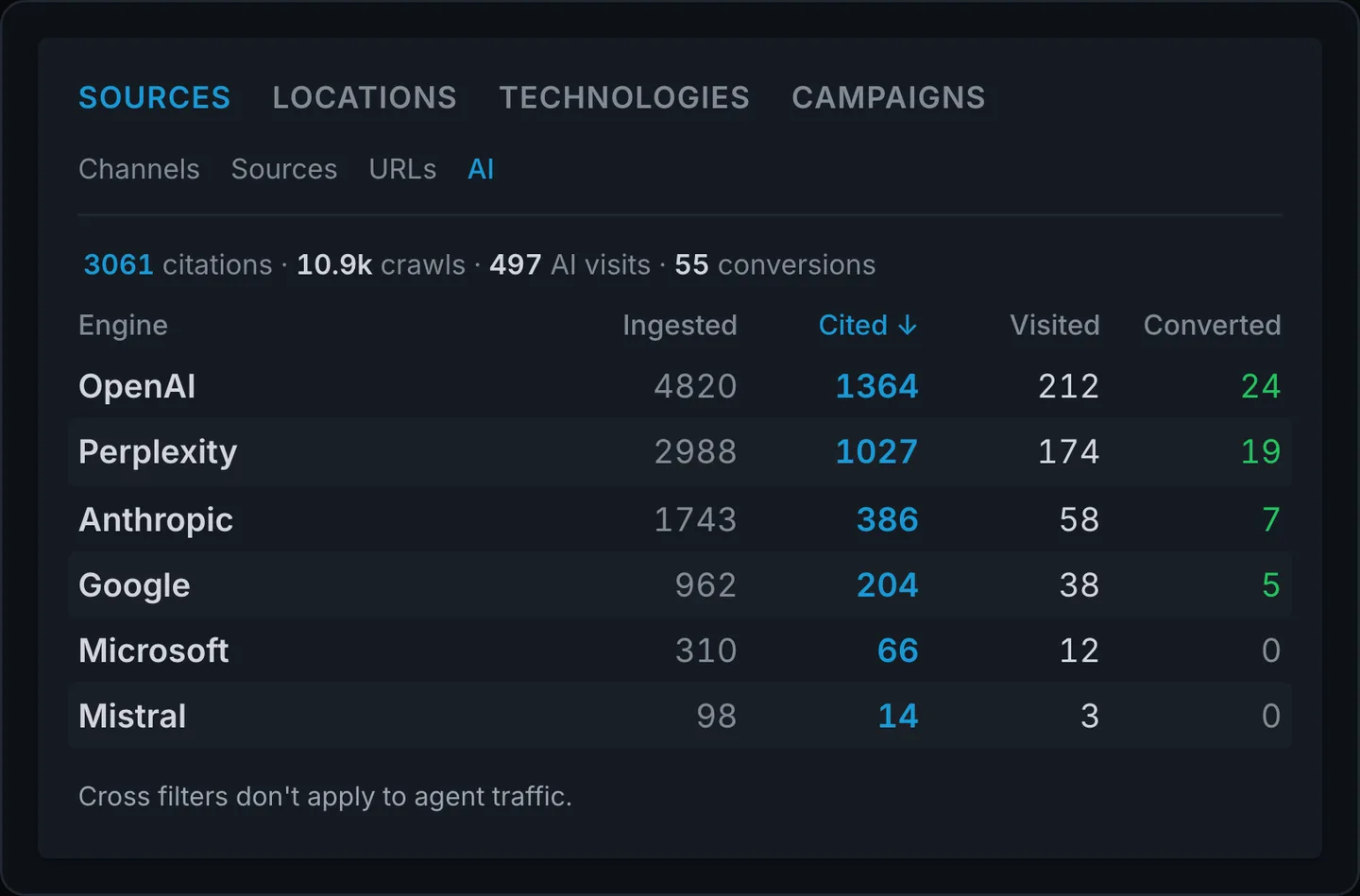
One more thing changed since July 7. The pairing I said nobody sells, citations next to sessions, is now in Clickport. AI fetchers still don't run JavaScript, so a small server-side connector passes their requests to us, and the dashboard pairs cited, crawled, visited, and converted per engine. Here's how the AI Agents tracking works.
How this squares with the numbers we've cited before
Two reconciliations, for the record. Our vanity-metrics article quotes Ahrefs' finding that ChatGPT sends 190x less traffic than Google relative to its usage. That's a volume ratio between platforms. The 100:1 in this study is a different instrument: our own citations against our own clicks, from logs.
And that same earlier article, along with our attribution guide, quotes third-party studies putting AI conversion at around 5x organic. Our first-party number is 3.4x.
Where our data and a third-party estimate disagree, I'll use ours going forward, because ours is the number for our sites. Use whichever was measured on yours, and if none was, measure it.
The score isn't the metric. The session is.
Someone will read this study as anti-GEO. It isn't. The citations were real, they predicted where visitors landed, and the visitors who came converted at 3.4x. AI search is the best-qualified small channel we've ever measured. Ignoring it would be as silly as buying a dashboard full of its mentions.
The argument is narrower and harder to dodge: visibility without an outcome attached is not a metric, it's a mood. ChatGPT read our pages 7,825 times and sent 23 people. A visibility score would have told us we were winning and billed us monthly for the good news. The server logs told us what winning is worth: about one visitor per hundred answers, each one better-qualified than anything else that walks through the door.
You already own both halves of that truth. Your server logs count the citations. Your analytics counts the sessions and what they did. Anyone selling you the number in between is selling you the part that doesn't cash out.
Measure the gap once on your own site. It'll cost you one grep and change how you read every AI visibility pitch this year.
Clickport now shows both halves of your AI traffic
Or skip the grep. Since July 2026, this study's method is a standing part of Clickport: every crawl and citation by OpenAI, Anthropic, Perplexity and the rest, verified against the AI companies' published IP ranges, and joined to the visits and conversions they send back.
The reads, the citations, the click-throughs, and the conversions sit on one screen, per engine. Humans in the AI Search channel. Machines in the AI tab. Your own citation gap, measured continuously instead of once. The full story is in the launch article.
Try Clickport free
30 days free. No credit card required.
FAQ
What is a good AI visibility score?
There's no defensible threshold. The engines return different brand lists on nearly every run: SparkToro and Gumshoe.ai measured under a 1-in-100 chance of the same recommendation list twice. Presence frequency across many repeated prompts is measurable, but no score value maps to any traffic or revenue outcome. The outcome data lives in your analytics, not in the score.
What do AI citations mean?
A citation event, measured rigorously, is an AI assistant fetching your page to answer a live user question. It means your content shaped an answer someone read. In our 14-day study, it converted to an actual visit about once per 100 fetches, varying from 14:1 (Perplexity) to 340:1 (ChatGPT).
Does ChatGPT send traffic to websites?
Yes, but at the lowest rate per citation of any engine we could measure: 340 verified fetches per visit in our logs. Industry panels agree AI referrals are small: Conductor puts AI at 1.08% of website traffic across the 10 industries it tracks, Semrush at under 0.15%. The visits ChatGPT does send convert well.
How do I track website traffic from ChatGPT?
Watch for referrers from chatgpt.com in your analytics, or use a tool that classifies AI engines into a dedicated channel automatically. Note that a meaningful share of AI visits carries no referrer and lands in Direct, so every tool undercounts it. Server logs are the only way to see the citation side.
Is ChatGPT sending less traffic to websites?
Per citation, ChatGPT's exchange rate is the worst we measured. But absolute AI referral volume is still growing across every major panel. The growth is spreading across more engines as Gemini, Claude, and Perplexity gain share. Small channel, rising fast, less ChatGPT-shaped every quarter.
Which is better, SEO or GEO?
Per session, our AI Search visitors converted at 20.3% versus 5.9% for everything else, so AI-referred visitors are individually more valuable. Per volume, organic search remains vastly larger: AI referrals are around 1% of traffic in the biggest panels. Treat GEO as a high-quality small channel inside your SEO work, not a replacement for it. Judge it by sessions and conversions, not visibility scores.
If you want the visit side of your own citation gap without building anything, you can try Clickport free. It classifies AI Search into its own channel out of the box, cookie-free, and the goals feature will tell you what those visitors were worth. Since this study, it can count the citation side too: the AI Agents connector logs the fetches JavaScript can't see. I want to know.

Comments
Loading comments...
Leave a comment