GA4 Finally Added an AI Traffic Channel. Here's What It Still Can't See.
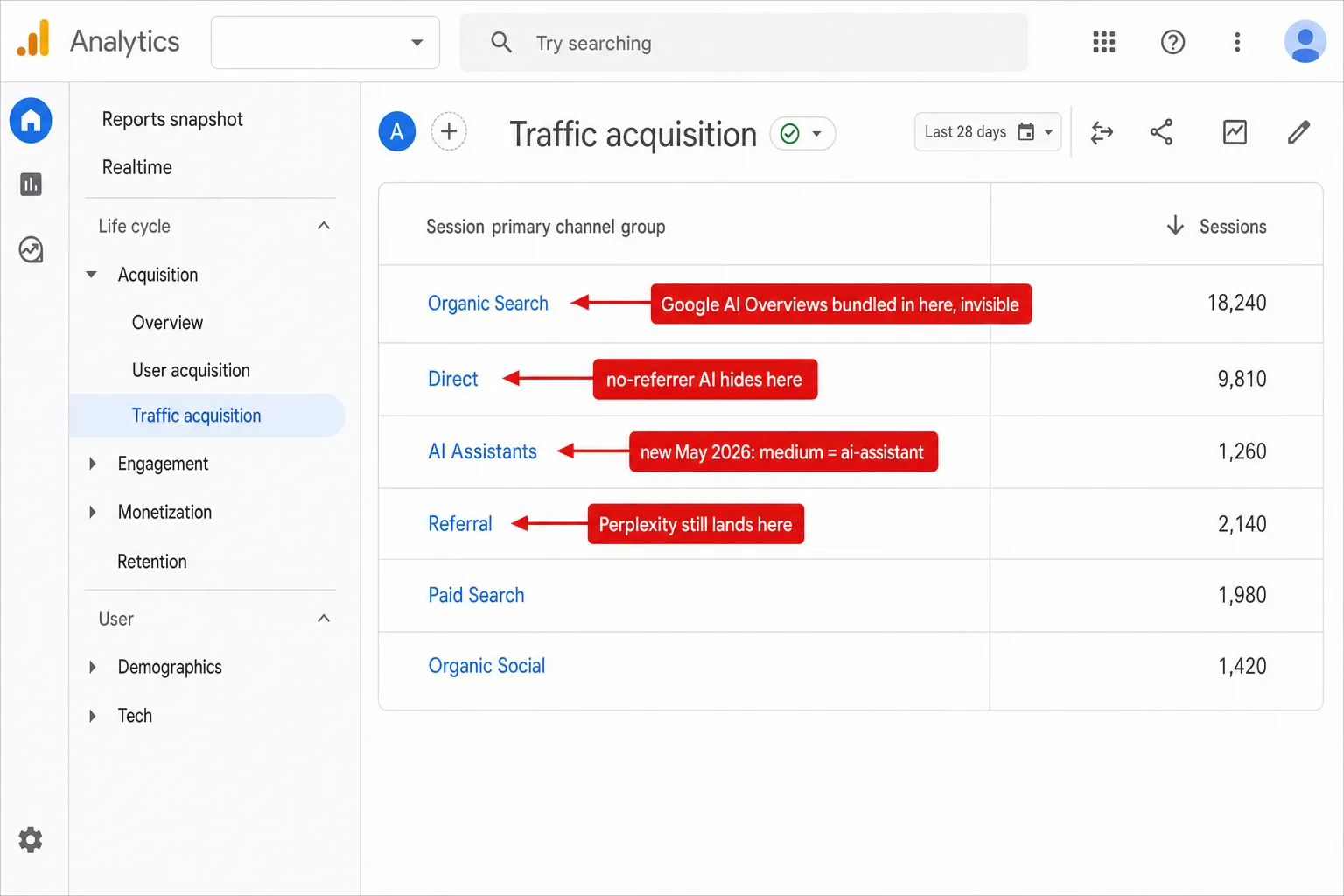
Google Analytics just did the thing everyone kept asking for. GA4 now has a native AI Assistants channel. When someone clicks through from a recognized AI tool like ChatGPT or Gemini, GA4 tags the visit with the medium ai-assistant and files it under a channel called AI Assistants, automatically, with no setup and no regex to keep alive.
That sounds like the AI attribution problem is finally solved. It isn't. The channel only fires when a referrer arrives that GA4 recognizes. So it still misses the no-referrer visit, it still files Perplexity in the wrong bucket, and it still can't see Google's own AI Overviews. Here's what the new channel does, and what it still can't show you.
A quick note on who I am. I build Clickport, a privacy-first analytics tool that has had its own AI Search channel for a while, so I have a horse in this race. But this isn't a dunk on GA4. The new channel is a genuine step forward, and the biggest gap it leaves is one no referrer-based tool can close, mine included. I'll be straight about that line the whole way down.
- GA4 added a native AI Assistants default channel in May 2026. It auto-tags a visit with the medium ai-assistant when it arrives from a recognized AI tool, with no setup and no regex to maintain. This is a real improvement: before it, AI traffic was scattered across Direct and Referral.
- The channel only fires when a referrer it recognizes arrives, so it misses no-referrer AI traffic, which still lands in Direct. In one server-log study, 56 Gemini-on-iOS visits showed up as just 5 GA4 referrals, about 9 percent of the real number.
- Google names only a few examples, like ChatGPT, Gemini, and Copilot, and has not published the full list of recognized referrers. Perplexity passes a perplexity.ai referrer, which classifies as Referral, so today it still lands there, not in the AI Assistants channel.
- Google's own AI Overviews and AI Mode stay inside Organic Search. Those clicks carry a google.com referrer identical to a normal search, so no tool can split them out, mine included.
- No referrer-based tool sees no-referrer AI traffic, Clickport included. The narrower edge is a dedicated AI Search channel, live since February 2026, that runs before Organic and includes Perplexity, so referrer-bearing AI is not buried.
Clickport now shows both halves of your AI traffic
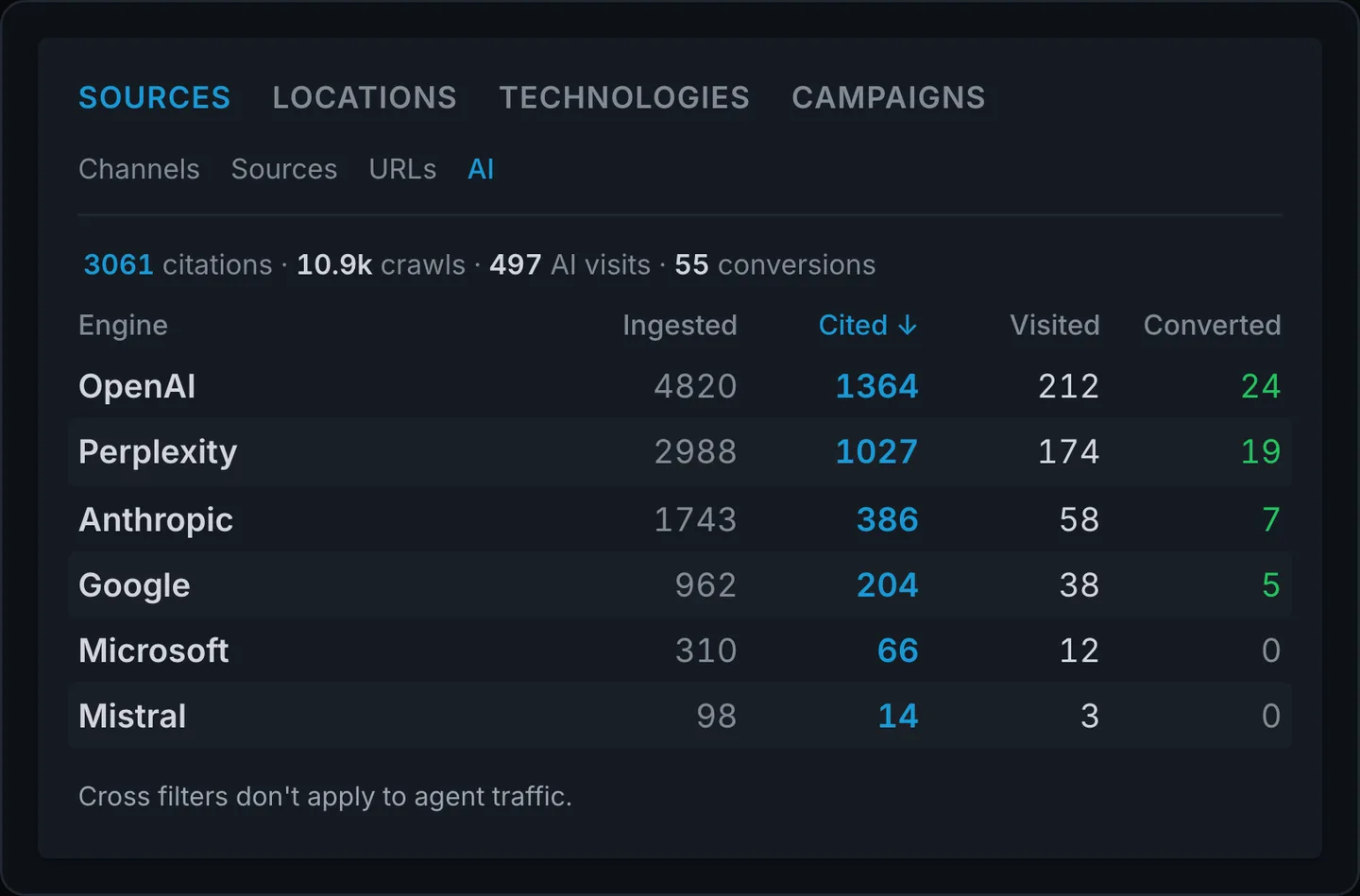
Since July 2026, the visits are only half of what Clickport tracks. The other half is the machines: every crawl and citation by OpenAI, Anthropic, Perplexity and the rest, verified against the AI companies' published IP ranges, and joined to the visits and conversions they send back.
That's the part no channel report can show you. In our own study, AI assistants read our pages about a hundred times for every visit they sent back. Now you can see the reads, the citations, the click-throughs, and the conversions on one screen, per engine. Humans in the AI Search channel. Machines in the AI tab. The full story is in the launch article.
Try Clickport free
30 days free. No credit card required.
What GA4 shipped
GA4's default channel group now includes AI Assistants. When a visit arrives from a recognized AI tool, GA4 assigns the medium ai-assistant and drops the session into the AI Assistants channel, with no manual setup, as Search Engine Land reported in May 2026. You don't build a regex. You don't maintain a list. It just appears in your reports.
This matters because of where that traffic used to go. Before the channel existed, a click from chatgpt.com landed in Referral, and a click from the ChatGPT mobile app, which doesn't carry a referrer, landed in Direct. AI was split across two buckets, mixed with everything else. I wrote about exactly that mess in why ChatGPT traffic shows as Direct in GA4. So a dedicated row is a real improvement. For the first time, the referrer-bearing slice of your AI traffic has a home.
ChatGPT app (no referrer) → Direct
gemini.google.com click → Referral
ChatGPT app (no referrer) → still Direct
gemini.google.com click → AI Assistants
Notice the one row that didn't move. The app visit with no referrer is still sitting in Direct. That's not a detail. That's the whole story.
A channel is only a referrer list
Here's the thing you need to understand about the new channel, because every limit below comes from it. The AI Assistants channel is a referrer match. GA4 looks at where the visit says it came from, checks it against a list of AI tools it recognizes, and if it matches, it tags the session ai-assistant. No fingerprint. No model. No cookie. Just a referrer, checked against a list.
A referrer is the bit of information a browser passes along that says "this person came from this other page." It's the only signal in play here. And it has two weaknesses that no amount of channel grouping can fix. The visit can arrive with no referrer at all. Or it can arrive with a referrer that isn't on Google's list. Both still happen constantly, so let's walk through where the AI traffic keeps hiding.
Gap one: the visit with no referrer
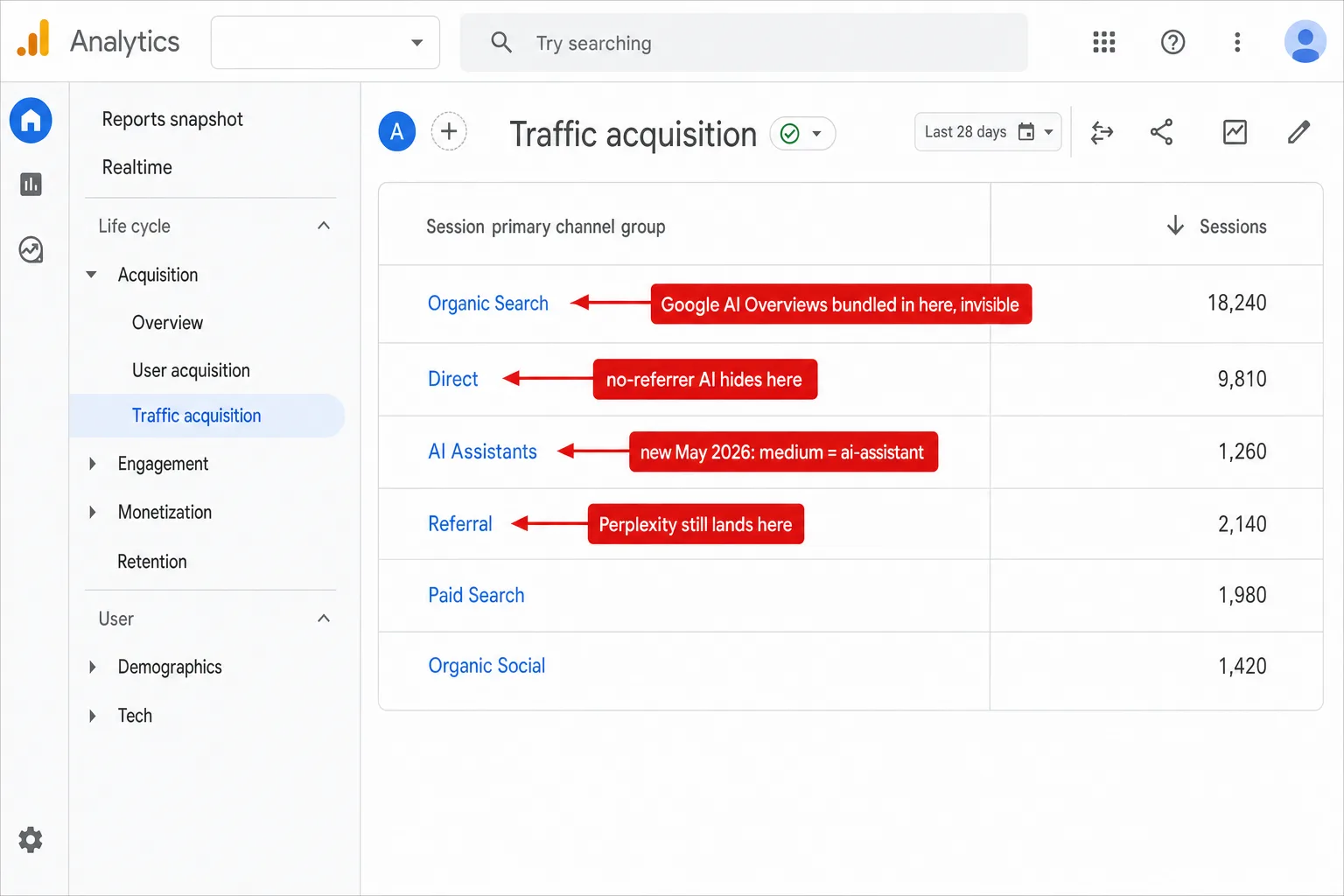
This is the big one. A huge share of real AI traffic arrives carrying no referrer, so GA4 has nothing to match and drops it into Direct, where you'd never think to look. The new channel never sees it.
It happens every time someone taps a link inside a native AI app. The link opens in an in-app browser, and that environment strips the referrer before the request even leaves the phone. It happens when someone copies your URL out of an AI answer and pastes it into a new tab. It happens when they read the answer, remember your brand, and type your address an hour later. None of those carry a referrer. None of them land in the AI Assistants channel.
How big is the gap? The agency Wheelhouse DMG ran the cleanest test I've seen: they compared their server logs to GA4 over the same window. Their logs caught 56 visits from Gemini on iOS; GA4 recorded just 5 referrals. That means GA4 saw 9 percent. Put another way, one real visit in eleven made the report. And that's a floor, not a ceiling, because Gemini on iOS is one of the few apps that even identifies itself. Most AI apps leave less of a trace, not more.
On the sites I measure, a third of AI-classified traffic arrives with no referrer at all. I dug into the four mechanisms that strip it, and the consent rejection that stacks on top in the EU, in why ChatGPT shows as Direct in GA4. The new channel changes none of that. It can't see the in-app tap. It can't see the copy-paste. It can't see the visitor who types your URL from memory. A channel made of referrers is blind to the visit that brought none.
Gap two: Perplexity still lands in Referral
The second gap is about which referrers are on the list. Google's own channel documentation names only a few examples, ChatGPT, Gemini, Copilot, and Grok among them, and Search Engine Journal pointed out that Google hasn't published the full list of recognized referrers. So you can't know for certain what's in and what's out.
You can see one thing that's out, though. Perplexity. A Perplexity visit, including from its Comet browser, arrives with a perplexity.ai referrer. That isn't on Google's list, and a perplexity.ai referrer classifies as plain Referral, so that's where it lands, not in the new channel. One of the fastest-growing AI search tools sits in the same bucket as a backlink from someone's blog. ChatGPT's Atlas browser is worse off again: it tends to strip the referrer, so it falls back into Direct.
This is the fragile part. Channel membership is a list, and lists go stale. A platform changes its referrer behavior, or a new one launches, and the channel quietly stops catching it until Google updates the list. It's better than maintaining your own regex, but it's the same kind of maintenance, just moved to Google's schedule instead of yours.
Gap three: Google's own AI Overviews stay inside Organic
The third gap is the one Google has the least reason to fix. When someone clicks a link inside an AI Overview or AI Mode on a Google results page, that click carries a google.com referrer, the exact same referrer as a normal blue-link search result. As MeasureU puts it, there is no way to separate an AI Overview click from a traditional search result. To any analytics tool, it looks identical to organic search, because at the referrer level it is identical.
So AI Overview traffic doesn't go to the AI Assistants channel. It goes to Organic Search, blended in with everything else from Google, invisible as a separate thing. No tool can split it out, mine included, because there's no signal to split on. The referrer is just google.com.
Sit with what that means. The single biggest source of AI-influenced traffic for most sites is Google's own AI, right there in the results page. And it is the one slice the new AI channel is structurally guaranteed never to show you, because Google has no interest in telling you how much of your "organic" is now a zero-click AI summary with one link underneath.
What a dedicated AI Search channel does, and what it can't
So where does this leave a tool like the one I build? Let me lead with the limit, because it's the honest part. Clickport is cookieless and referrer-based for source attribution, exactly like GA4's new channel. So the no-referrer visit lands in Direct for me too. The in-app Gemini tap, the copy-paste, the typed URL: I can't recover those, and neither can anyone else. And AI Overviews stay in my Organic Search bucket as well, for the same reason they stay in GA4's: the referrer is plain google.com. No referrer, no source, for any tool on the market. I won't pretend otherwise.
The edge is narrower than that, and real. Clickport classifies every visit into a channel, 16 of them, and AI Search is one of them. It runs before the Organic Search rule, so a referrer-bearing AI visit gets pulled cleanly into its own channel instead of being buried in Direct or Referral. It's done that since February 2026, months before GA4 shipped its native version. Perplexity is on the list too, which means a referrer-bearing Perplexity visit doesn't sink into the generic Referral pile here. It lands in AI Search.
That AI Search row carries the other half of the story. On the sites I measure, AI Search visitors engage more than any other channel, a 60.8 engagement score against 44.3 for organic search, which I broke down in a separate study. That means the smallest channel sends the most engaged visitors. So the slice that does carry a referrer is worth seeing on its own, not blended away.
One honest caveat on that row, though. AI Search is still small, roughly 1.5 percent of traffic across the sites I measure, even though it has quadrupled in three months. In plain English: it's growing fast off a small base. And it's volatile. A single model release from OpenAI, Anthropic, or Google can swing it overnight, across every site at once, with nobody's hand on the dial. Treat AI Search as a leading indicator of where attention is moving, not as a headline number you report to the board.
The honest takeaway
GA4's new channel is the right move, and you should use it. It's a better starting point than the Direct-and-Referral mess it replaces, and it costs you nothing to turn on, because it's already on.
Just don't mistake a better starting point for the finish line. A referrer is still the only thing GA4 can see, and the only thing I can see, and the only thing any analytics tool you'll ever install can see. So the no-referrer visit keeps landing in Direct, Perplexity keeps landing in Referral, and Google's own AI Overviews keep hiding inside organic. The channel labels the AI traffic that announces itself. The rest is still out there, unlabeled, in the buckets you've always had.
And clicks are only half the ledger anyway. The reads happen before any referrer exists: AI bots fetched pages across the sites I measure tens of thousands of times in the same window that produced a handful of AI visits. Since writing this piece, we built the other half: watching the AI bots that read your website, server-side and IP-verified, next to the sessions they eventually send.
If your Direct number keeps climbing and you want to see how much of it is AI you can name, try Clickport free for 30 days. One script tag, no cookies, no credit card. Your first referrer-bearing AI Search session shows up in its own channel the moment it arrives, instead of buried in Referral. I can't recover the no-referrer visits, and I'll never tell you I can, but everything that carries a source gets labeled honestly.

Comments
Loading comments...
Leave a comment