Which AI Bots Are Reading Your Website? Now You Can Watch Them Work
A bot wearing ChatGPT's name read one of our pages while I wrote this paragraph. That's not a guess. It happens hundreds of times a day across a subset of the sites we measure, every time someone somewhere asks a question our content can answer.
For two years this traffic was invisible. Not small. Invisible.
Bots passed half of all web traffic last year. The AI ones read your site a hundred times for every visitor they send back. And the analytics tool you're running shows you none of it. Ours didn't either.
We measured what one of those reads is worth two weeks ago. This article is about the reads themselves: which bots they are, why they're on your site, and how to watch them in your own logs today.
- Across a subset of the sites we measure, bots wearing AI and crawler names hit more than 20,000 times in 15 days (June 29 to July 13, 2026). The single biggest verified reader was ChatGPT-User, with 10.8x the reads of verified Googlebot on the same sites in the same window.
- Every major AI company runs up to three kinds of bots: a training crawler (GPTBot, ClaudeBot), a search indexer (OAI-SearchBot, PerplexityBot), and a live fetcher that reads your page in the middle of a real conversation (ChatGPT-User, Claude-User, Perplexity-User). Each one means something different for your site.
- JavaScript analytics cannot see any of this: AI bots don't execute JavaScript, so the tag never fires. Our own tracker recorded zero ChatGPT-User pageviews in a window where server-side data held over 6,000 verified fetches.
- 88.1% of the hits claiming to be Googlebot failed IP verification in the same 15 days: roughly seven fakes for every verified hit. A user-agent grep counts the fakes too. Checking against the operators' published IP ranges is what separates them.
- You can count AI bot reads yourself with one command over your server logs; the grep patterns for training, indexing, and live-retrieval bots are in this article, along with where the DIY approach stops.
Why is ChatGPT visiting your website?
ChatGPT visits your website for one of three reasons. GPTBot is collecting content that may train future models. OAI-SearchBot is indexing you for ChatGPT's search features. And ChatGPT-User is fetching a page right now, because a real person just asked a question your site can answer.
Three bots, one company, three completely different meanings.
That split isn't an OpenAI quirk. Every major AI company does the same thing, and documents it:
| Company | Trains models | Builds a search index | Answers live questions |
|---|---|---|---|
| OpenAI | GPTBot | OAI-SearchBot | ChatGPT-User |
| Anthropic | ClaudeBot | Claude-SearchBot | Claude-User |
| Perplexity | None (says it doesn't crawl for model training) | PerplexityBot | Perplexity-User |
| Google-Extended (a robots.txt token, not a bot) | Googlebot | User-triggered fetchers (Google-NotebookLM and others) |
The definitions come straight from the companies themselves. OpenAI documents ChatGPT-User as firing when "users ask ChatGPT or a CustomGPT a question." Anthropic says Claude "may access websites using a Claude-User agent" when people ask questions. Perplexity states flatly that PerplexityBot "is not used to crawl content for AI foundation models." Google sorts its crawlers into common crawlers, special-case crawlers, and user-triggered fetchers.
One company is missing from the table on purpose. Microsoft never joined the pattern. Copilot answers from the Bing index, so Bingbot is a search crawler and an AI feeder in one. There is no separate Copilot fetcher for you to count. Keep that in mind when you see a "complete" AI bot list. For some engines, the read side can't be observed at all.
Two details in that table trip people up. Google-Extended never appears in your logs, because it isn't a bot. It's a robots.txt token that tells Google not to use Googlebot's crawl for Gemini training. Grep for it and you'll find nothing, forever.
And Perplexity-User ignores robots.txt, by Perplexity's own documentation. Their logic: a human asked for the page. You can't block it with a text file. You can only see it in the data.
Why does this matter? Because the three reads are three different relationships. A training crawl is a donation to someone else's model. An index crawl is a bid to appear in AI search results. A live fetch means your page is being read to a human right now. That last one is the closest thing to a citation you can count. It's the one worth watching weekly.
Your analytics has never seen any of this
The mechanics are plain. Analytics scripts run in browsers. An AI bot requests your HTML, takes it, and leaves. No browser. No JavaScript. No pageview.
Vercel measured this at network scale and put it in one sentence: "none of the major AI crawlers currently render JavaScript." ChatGPT's crawlers even fetch JavaScript files, 11.5% of their requests. They just never run them.
Here's our own receipt. Clickport's tracker is JavaScript, like every web analytics tool. In the same 15 days where our server-side data held over 6,000 verified ChatGPT-User fetches, the tracker recorded zero ChatGPT-User pageviews. Not few. Zero.
The tracker wasn't misconfigured. It was doing its job perfectly. Its job just happens inside a browser these bots never open.
In other words: if your analytics runs in the browser, your AI read count is zero today. Not because nobody's reading you.
GA4 deserves its own paragraph, because it's blind twice. The bots that never run JavaScript never reach it, same as every tool. And the rare bots that do fire hits get removed against the IAB bot list, silently. Google's own documentation says you "cannot disable known bot traffic exclusion or see how much known bot traffic was excluded."
GA4 did add an AI Assistants channel in May 2026. It classifies referral clicks only, and it excludes Google's own AI Overviews. I wrote up what that channel does and doesn't cover separately. Short version: it's the visits column, added years after the reads column started filling up.
What AI bots read: 15 days of first-party data
Between June 29 and July 13, 2026, bots wearing AI and crawler names hit a subset of the sites we measure more than 20,000 times. Every hit went through the same pipeline. Read the user agent. Check the source IP against the operator's published ranges. Store a verdict.
Here's what that traffic claims to be doing:
Verification sorts that pile into three verdicts. 46% of hits proved they were who they claimed to be. 20% were provably fake. 34% couldn't be settled either way. In plain English: nearly half could prove it, and one in five was lying. More on the liars in a minute.
The verified column is the interesting one. The top verified agents across these sites, in order: ChatGPT-User first by a wide margin, then Bingbot, Applebot, Googlebot, PerplexityBot, Perplexity-User, GoogleOther, and OAI-SearchBot with single-digit hits.
Read that list again. The biggest verified reader of these sites isn't a search engine. It's ChatGPT answering live questions, at 10.8x the volume of verified Googlebot. Put another way: for every time Google's crawler read these sites, ChatGPT read them nearly eleven times, for a person asking something at that moment.
The industry data says we're not an outlier. Imperva's 2026 Bad Bot Report put automated traffic at over half of all web traffic in 2025. That was the first year humans became the minority. That means the average request hitting the average website is no longer a person.
TollBit measured one AI bot visit for every 31 human visits in Q4 2025, up from one per 200 at the start of that year. Which means the AI share of your front door grew about sixfold in twelve months.
And Cloudflare clocked GPTBot's request volume growing 305% in a single year, climbing from their #9 crawler to #3. The reads are not a curiosity. They're becoming the main use of your content.
A hundred reads per visitor
I'll keep this section short because the full study has its own article. Across two of these sites, AI assistants fetched pages roughly 100 times for every visit they sent back.
Cloudflare sees the same shape from their side of the network: OpenAI at 887 crawls per referral in mid-2025, Anthropic at 50,000. Their July 2026 summary says AI crawlers request content "anywhere from a hundred to tens of thousands of times for every visitor they send back." Being read is the default. Being visited is the exception.
So why watch a channel that pays back one visit per hundred reads? Because of what the visits do. In our study window, AI Search sessions converted at 3.4x the rate of every other channel combined. Similarweb's panel has ChatGPT referrals converting at 7.1%, second only to paid search. In practice, the rare AI visitor arrives closer to a decision than almost anyone else you get.
The reads are the leading indicator. The visits are small, late, and better qualified than anything else that walks in. If you wait for the visits to show up in your referral report, you're reading the story weeks after it was written.
Most of the "Googlebot" on your site isn't Google
In those same 15 days, thousands of hits across the same sites claimed to be Googlebot. Google's published verification methods confirmed 11.9% of them. The other 88.1% came from IP addresses Google doesn't operate.
Scrapers wear trusted names. No name is more trusted than Googlebot.
In other words: seven out of every eight "Googlebot" hits were something else in a costume. Mostly scrapers betting, correctly, that nobody blocks Googlebot.
Verification is possible because the real operators want to be verifiable. OpenAI, Anthropic, Perplexity, and Google all publish the IP ranges their bots operate from. You can look at one right now: openai.com/gptbot.json is a plain JSON file of address ranges. Google documents two methods: match the IP against their published ranges, or run a reverse DNS lookup and confirm the hostname ends in googlebot.com or google.com.
A user-agent string is a claim. An IP check is a verdict.
We've caught cheap rented servers wearing Google crawler names. My favorite was a machine whose reverse DNS came back as a "bugbounty" host. Any count that skips verification is counting these too. And every grep-based count skips verification. If you've ever quoted a Googlebot number from a raw log, you've quoted some fakes.
How to track AI bots in your server logs
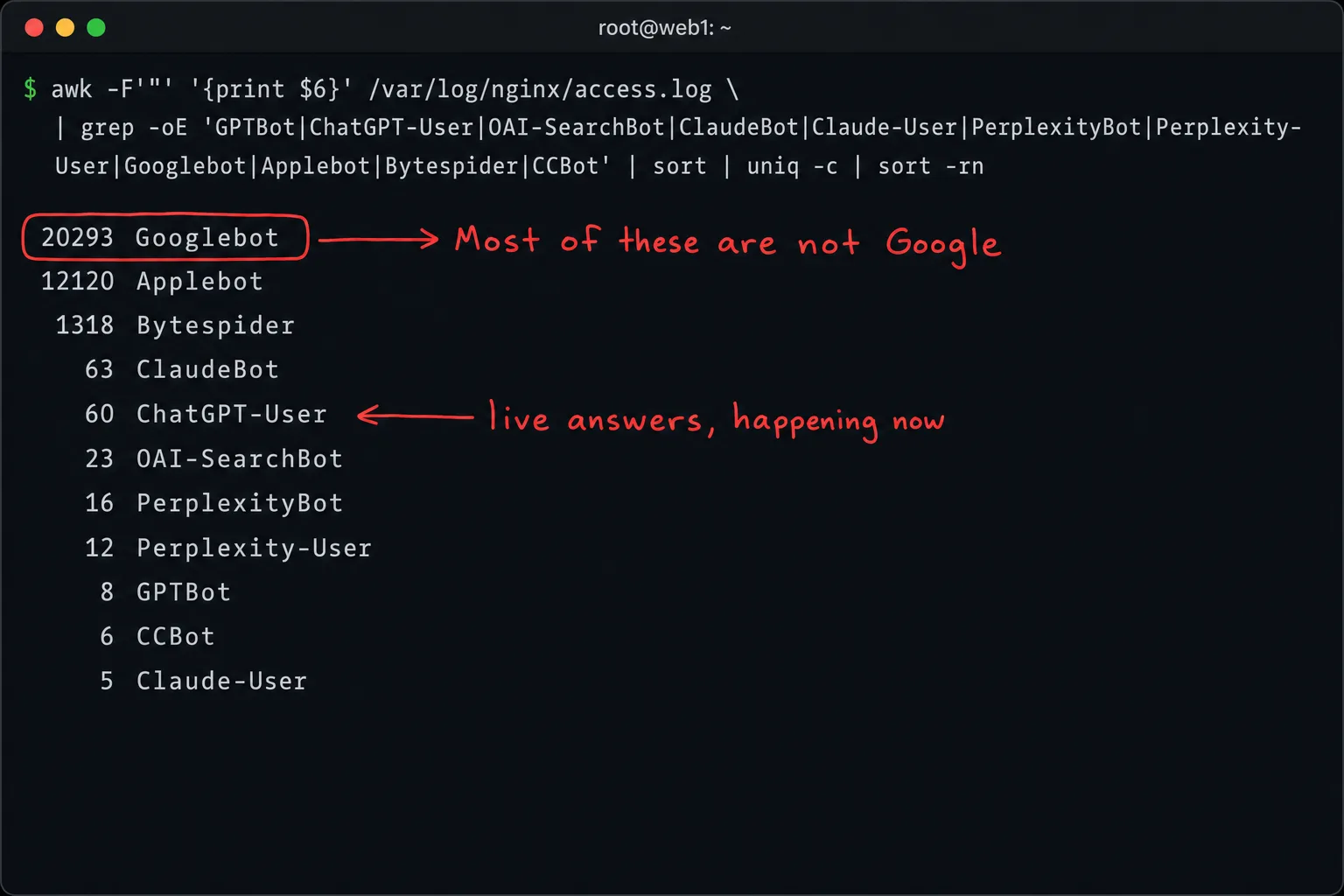
You don't need any product to start, ours included. You need your access logs and one command. Here it is running against one of our own servers this morning:
That's six and three quarter hours of one morning: 20,293 hits claiming to be Googlebot. Everything you now know about spoofing applies to that number. Whatever your grep says about Googlebot, read it as a claim, not a count.
Use zgrep and access.log* to include rotated logs. Split the pattern by role if you want the three counts separately: training bots (GPTBot|ClaudeBot|CCBot|Bytespider|meta-externalagent), index builders (OAI-SearchBot|Claude-SearchBot|PerplexityBot|Applebot|Amazonbot), and live fetchers (ChatGPT-User|Claude-User|Perplexity-User). The live-fetcher count is your citations. For the citations-to-visits math, the calculator in our citation-gap article takes both numbers and places you against our benchmarks.
Now the honest part, because I'd rather you hear the limits from me. The grep approach stops in four places.
The count believes everyone. Your 20,293 "Googlebot" hits include the scrapers. Separating them means fetching the operators' IP lists and checking every hit, forever, as the ranges change weekly.
The logs rotate away. Most default configs keep 14 days. Your trend line dies at the rotation boundary.
The CDN eats the evidence. If Cloudflare or any cache serves the page, the request never reaches your log. On heavily cached sites your grep sees a fraction of the reads. Cloudflare's own AI Crawl Control is a fair way to see what the CDN sees, if you're on it.
And the number connects to nothing. A count in a terminal can't tell you which pages the bots read, whether those pages get cited, whether citations become visits, or what the visits were worth. That join is the whole game. It's exactly the part a log file can't do.
What AI reads can tell you: five situations
A read count on its own is trivia. Joined to pages, engines, and outcomes, it starts answering real questions. Five situations where I've watched the data earn its place:
Content teams: your most-read pages are your citation surface
In our citation-gap study, the page AI read most was also the top AI landing page. The reads predicted where the people arrived. So your most-read pages show which content the engines are pulling into answers, weeks before any referral shows up in analytics. Here's that view on our own site right now:
Two things I'd flag in our own table. Our France privacy article is the most-cited page on the site: 386 citations in 14 days, and 4 visitors to show for it. The page AI finds most useful is one our referral report barely mentions. Yours will have one of these too.
The per-engine split matters too. That second page is read by OpenAI and Anthropic in equal measure. But Huawei and ByteDance read it as well, with zero citations attached. Same page, four companies, four different reasons.
The other end of the table is just as useful. One ecommerce team wrote publicly about discovering, through server logs, that AI crawlers read their blog constantly but never touched their product pages. That's a selection step happening before any traffic exists. A referral report can't show it. And it decides which part of your site gets to exist in AI answers.
We've since turned this reading data into a method: find the topics AI assistants think you own by looking for the pages they re-read day after day. On the sites we measure, the top 10% of pages carry 59% of all live reads.
Marketers: close the loop or close the topic
"Should we care about AI traffic" is a budget argument in most companies right now, argued with screenshots of other people's studies. The reads give you your own answer: engine reads, citations, visits, and conversions and revenue on one screen, for your site.
Maybe your funnel shows real money, like the consumer site in our study where AI sessions converted at 20.3%. Maybe it shows six visits and zeros, like ours below. Either way the argument is over. Your own data ended it.
The fastest version is a chart overlay. Draw one engine's reads next to your visitor curve for a quarter. If the reads climb while visits stay flat, you've measured the zero-click story on your own site. If both climb, you've found a channel while your competitors are still debating whether it exists. Either line beats a hunch.
Publishers: know your training-to-citation split
For a publisher, the split between training reads and live-answer reads is the licensing question in miniature. Training reads build someone else's asset. Live fetches are your content being served to an audience, with or without credit.
The market has noticed. 79% of top news sites now block at least one AI training bot. News Corp licensed its content to OpenAI for a reported $250 million over five years. Cloudflare has blocked AI crawlers by default for new domains since July 2025.
Your robots.txt policy should come from your own split, not from the mood of the week. And remember: Perplexity-User ignores robots.txt by its own documentation. Blocking is a request. Measuring is how you check who honored it.
Technical SEO: crawl health for a second audience
Everything you do for Googlebot's crawl budget now has a second audience. Are AI bots hitting 404s? Vercel found ChatGPT wasting 34.8% of its fetches on 404 pages, against Googlebot's 8.2%. So the answer is probably yes, and the fix is probably cheap.
What's your AI-to-Googlebot read ratio? Ours is 10.8:1 in ChatGPT's favor. If yours is inverted, your content may not be surfacing in answers at all. And when you change robots.txt, the per-agent counts show you which operators respected it, day by day.
Site owners: the reads panel is a spoof detector
Flip the verification layer around and it's a security instrument. The 88.1% fake-Googlebot figure isn't an abstraction. Those are scrapers and scanners on your site today, wearing names your firewall was told to trust.
A reads view with verdicts shows you the costume party directly. That's where deciding what to block starts. One dataset, two jobs: which AI engines read us, and who's pretending to be one.
One funnel: ingested, cited, visited, converted
Everything above is measurable by anyone with log access and patience. What didn't exist, in any web analytics platform I know of, was the join. Your log knows about the reads. Your analytics knows about the visits. Neither knows about the other.
So we built it. Clickport now ingests server-side agent hits, verifies each one against the operator's published IP ranges, classifies it by engine and intent, and joins it to the visits and conversions the tracker already has. As far as I can tell, that makes it the only web analytics platform where AI reads, citations, visits, and conversions live in one dashboard.
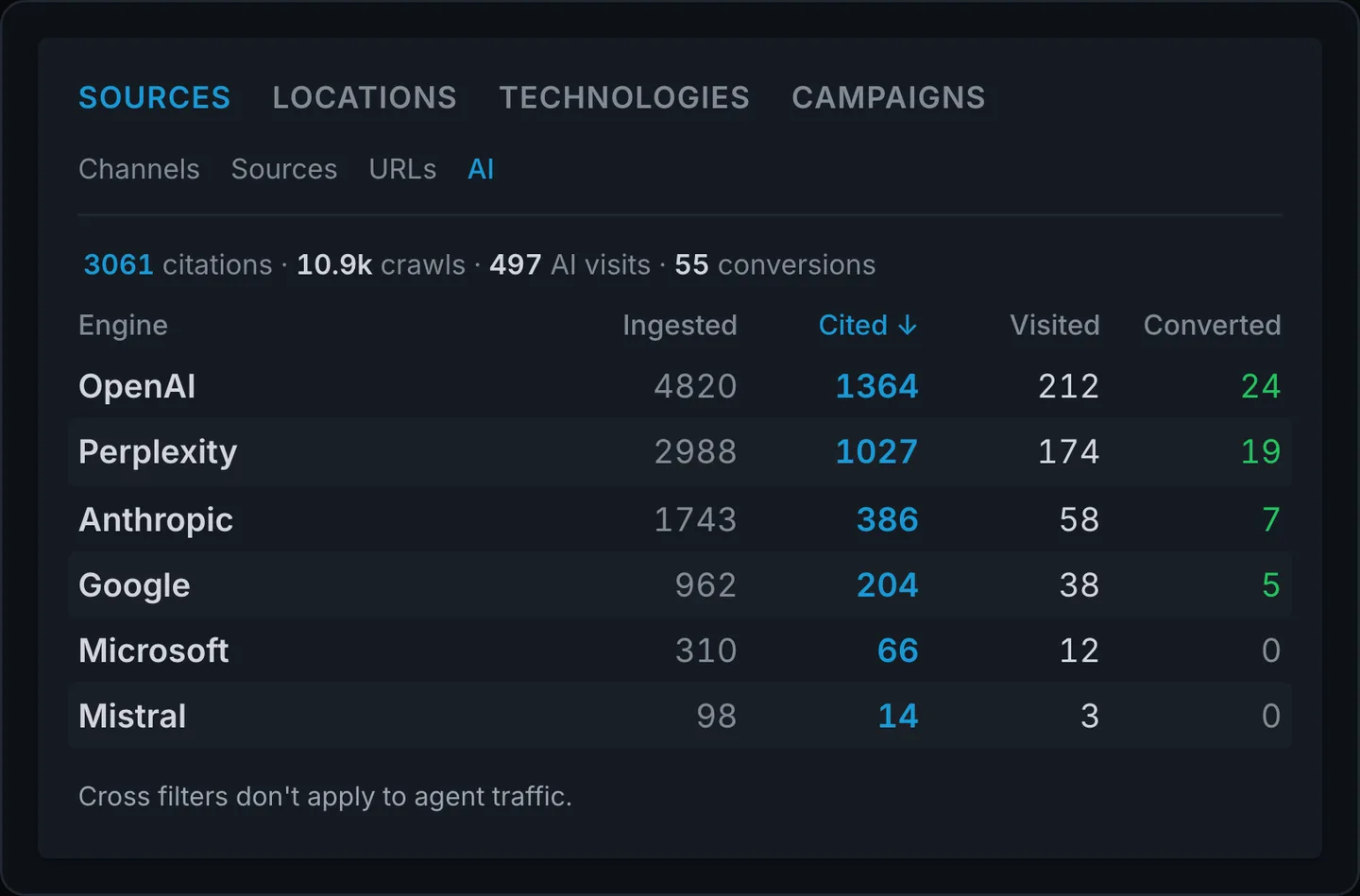
Here's the engine funnel with our own real numbers in it:
Notice our last column is zeros. Six AI visits, no conversions, on our own B2B site, in 14 days. I could have picked a prettier example. I'd rather show you the honest one.
The zeros are information too. They told us that on our site, AI is where due diligence happens without us, not yet a conversion channel. That's a different content strategy than "AI drives revenue." Industry averages would never have told us which story was ours.
Notice Carnegie Mellon, Huawei, and ByteDance too, quietly out-crawling every AI engine you've heard of, with zero citations to show for it. You only find out who's at the buffet by looking.
Beyond the funnel, the same data feeds a per-page engine split (the Pages table above), a chart overlay that draws any engine's reads next to your visitor curve, and a verification verdict on every hit. Agent hits don't count against your pageview quota either. That matters when the bots outnumber your visitors.
One honest cost: this data only exists on your server, so it needs a connector there. Not a tracker change. A dumb pipe: one key, one snippet, a few minutes, as a Cloudflare Worker, a WordPress plugin, or a few lines in any server. The setup guide covers each path.
If you manage client websites, the agency API walkthrough shows how to read separate crawler reports with one Team key. It includes a two-site test and the client access checks your portal needs.
What this doesn't show you
Three limits, stated plainly. A launch article that reads like a brochure helps nobody.
AI visits that arrive without a referrer land in Direct. That's true in every analytics tool, ours included. Some engines and apps strip the referrer, so the visited column reads low, and some ChatGPT traffic will always hide in Direct. Treat visited counts as a floor.
If a cache serves the page without touching your server, the connector never sees the hit. The WordPress plugin misses full-page-cached requests. On heavily cached sites, the Cloudflare Worker is the honest path, because it sits in front of the cache.
And there's no prompt data in here. We can't tell you what question triggered a fetch, what the answer said, or how visible your brand is inside ChatGPT. We won't pretend to. I've written about why simulated visibility scores are a vanity metric. This is the observed half: what the engines did on your site, verified.
On privacy: verification happens at ingest, the verdict is stored, and the bot's IP is discarded. Same posture as the rest of Clickport.
Clickport now shows both halves of your AI traffic
Everything above lands in the Sources panel, next to the traffic you already watch. The AI tab carries the machine half: crawls, citations, and verified engines. The AI Search channel carries the human half: the visits, what they read, and what they converted on. One screen, per engine, IP-verified at ingest.
In our follow-up study, the engines read about a hundred pages for every visit they sent back. Your site has its own ratio. Now you can watch it move.
Try Clickport free
30 days free. No credit card required.
FAQ
Why do bots visit my website?
Because most web traffic is now automated: Imperva measured bots at over half of all traffic in 2025. The visitors include search engine crawlers, AI training crawlers, AI search indexers, live AI fetchers answering user questions, and scrapers or scanners impersonating all of the above. Each has a different purpose, which is why counting them by name alone misleads.
Can AI read my website?
Yes. AI bots fetch your HTML directly, and Vercel measured the four biggest AI crawlers at around 1.3 billion fetches in a single month on their network alone. What they don't do is execute JavaScript, so content that only renders client-side is invisible to most of them, and so are your analytics tags.
Does Google Analytics show AI traffic?
Only the click side. GA4's AI Assistants channel, added May 2026, classifies visits that arrive with an AI referrer, and it excludes Google's own AI Overviews. The bot reads never appear: AI bots don't execute the GA4 tag, and the few bots that do fire hits are removed against the IAB bot list silently, with no report of what was excluded.
Should I allow AI crawlers on my website?
Decide per role, from your own data. Blocking training bots like GPTBot doesn't remove you from AI answers, since live fetchers and search indexers are separate bots; 79% of top news sites block at least one training bot while staying citable. Measure your training-to-citation split first, then write the robots.txt that matches your interest.
Is ChatGPT a web crawler?
ChatGPT is three different bots. GPTBot is a classic crawler collecting training data, OAI-SearchBot indexes for ChatGPT search, and ChatGPT-User is not a crawler at all: it fetches individual pages on demand when a user's question needs them. In our data, ChatGPT-User out-reads the other two combined by a wide margin.
How do I check which AI bots visit my website?
Grep your server access logs for the agent names (GPTBot, ChatGPT-User, ClaudeBot, PerplexityBot and peers); the commands are in this article. To trust the counts, verify hits against each operator's published IP ranges, because in our data 88.1% of "Googlebot" hits were fakes. Or use analytics with server-side agent tracking built in.
The reads were always there
Nothing in this article is new behavior. The bots were reading your site last year too. What's new is that you can watch: which engines, which pages, verified or fake, cited or ignored, and what came back. Half the internet's traffic spent two years off the books. It doesn't have to stay there.
You can try Clickport free and have the reads flowing next to your visitors in about five minutes with the setup guide. Or start with the grep above, today, on your own logs. I'm collecting these.

Comments
Loading comments...
Leave a comment