Whatever You Call It, AI Search Traffic Engages More Than Any Other Channel
AI search visitors score 60.8 out of 100 on engagement. The next-best channel sits at 44.3. Put another way: first beats second by 16.5 points. That's the highest engagement score of any traffic channel on the Clickport platform, and it holds across every kind of site.
I'll get to where those numbers come from. First, the argument they walk into.
There's a loud debate on LinkedIn right now about whether GEO is a real discipline or just SEO with a new name.
Google recently published a guide titled "Optimizing your website for generative AI features on Google Search." The punchline, in their own words, is that "optimizing for generative AI search is optimizing for the search experience, and thus still SEO." A wave of SEO professionals took a victory lap. Andrii Shum at SeoProfy posted that the document "officially ends the GEO-vs-SEO debate." Rahul Marthak at sneo.ai wrote that "Google just officially said stop doing this and half the SEO world wasn't listening." Lily Ray, Founder of Algorythmic and VP of SEO & AI Search at Amsive, told her audience: "SEO is still the foundation for AI search."
The other camp pushes back. Voices in publications like Wired and Singularity Digital argue that AI search is its own discipline, with its own tactics, and that dismissing it as "just SEO" misses the point.
Cyrus Shepard, longtime SEO voice and former Head of SEO at Moz, reasons from a different angle. In a recent LinkedIn post he asked whether AI citations are "worth pursuing" and answered yes, despite noting that AI citation CTRs are "significantly lower than regular search results." His question isn't whether the tactics belong to SEO or to a new discipline. It's whether the work pays off either way.
Engages consistently across every site.
Engagement varies widely from site to site.
I'm not picking a side on the tactics. I don't have a strong view on whether llms.txt does anything, whether content chunking matters, or whether buying mentions to influence AI visibility is worth it. Google says no. Other people say yes. Those experiments will play out in their own time.
There's a different question underneath all of it, and this one I can answer with my own data: whichever optimization camp is right, are AI search visitors worth the effort?
I run Clickport, a privacy-first web analytics product. Which means I'm selling the medicine I'm about to prescribe, so judge the method, not my incentives. Customers track their sites with a cookie-free script. Every channel is measured the same way, and the data sits in our own database. I pulled 180 days of aggregate engagement metrics from across the Clickport platform and looked at how AI search traffic behaves next to every other channel.
The answer isn't subtle. Whatever you call this category of traffic, and whatever you do to earn it, the visitors it sends you are more engaged than any other channel. By a lot. And more consistently than any other channel. The data doesn't settle the tactics debate. It settles the value question.
- AI search visitors score the highest engagement of any traffic channel we measure: 60.8 out of 100. The next-best channel, Organic Search, sits at 44.3. Every other channel is below 50.
- It's also the most consistent channel. Cross-site standard deviation is 7.5 for AI Search vs 16.2 for Organic Search. Organic swings from site to site. AI Search stays in a tight band.
- Every major AI engine sends similar quality: ChatGPT 62.5, Perplexity 61.5, Gemini 65.5, Copilot 69.2, Claude 59.0. It isn't a ChatGPT effect. It's an LLM effect.
- The likely reason: an LLM checks relevance before the click. The visitor arrives with their basic question answered and a specific reason to read on.
- AI Search is still small, around 1.5% of sessions on our platform, but that share has roughly quadrupled in three months. The quality is established. The volume is catching up.
Clickport now shows both halves of your AI traffic
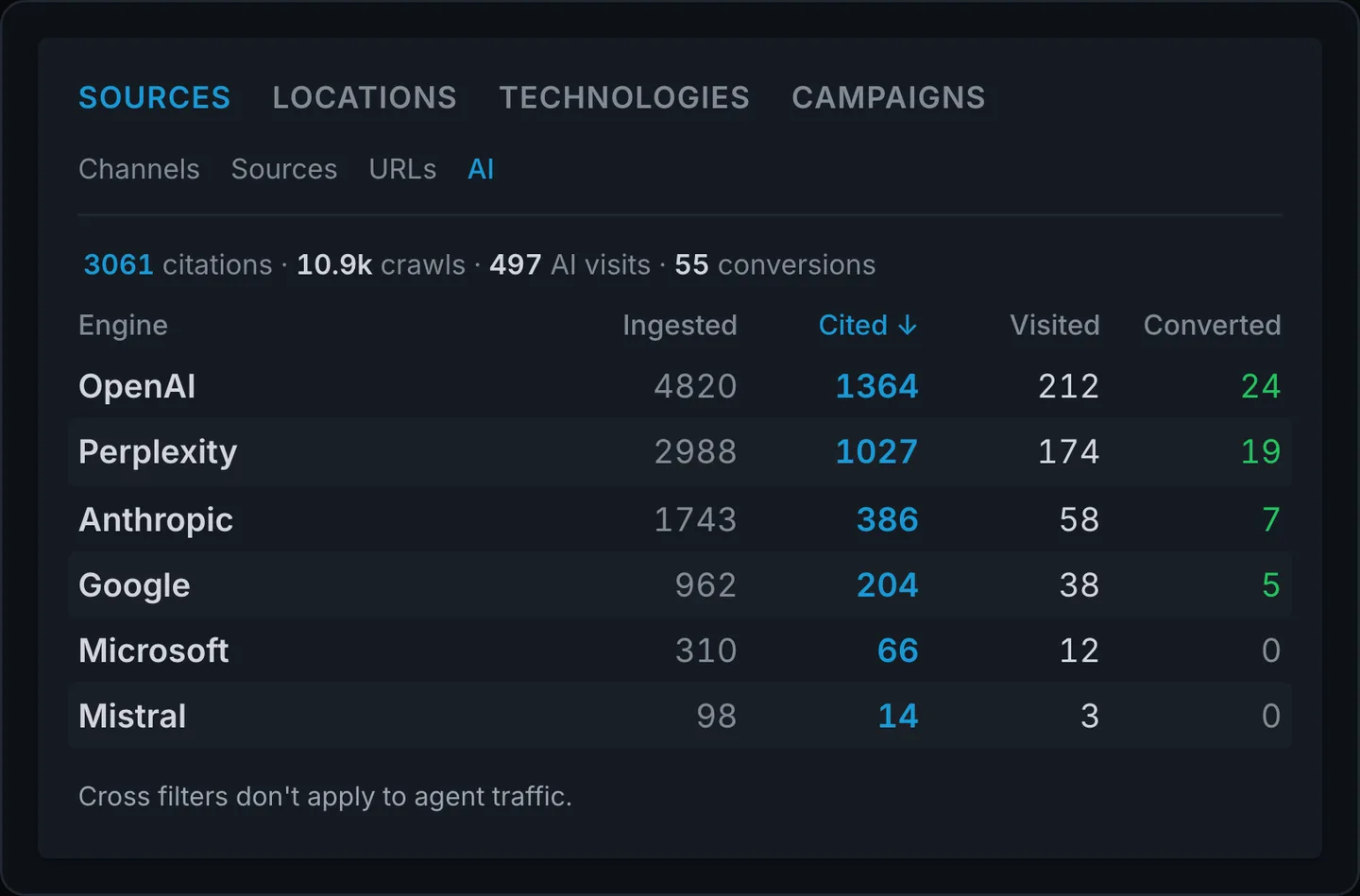
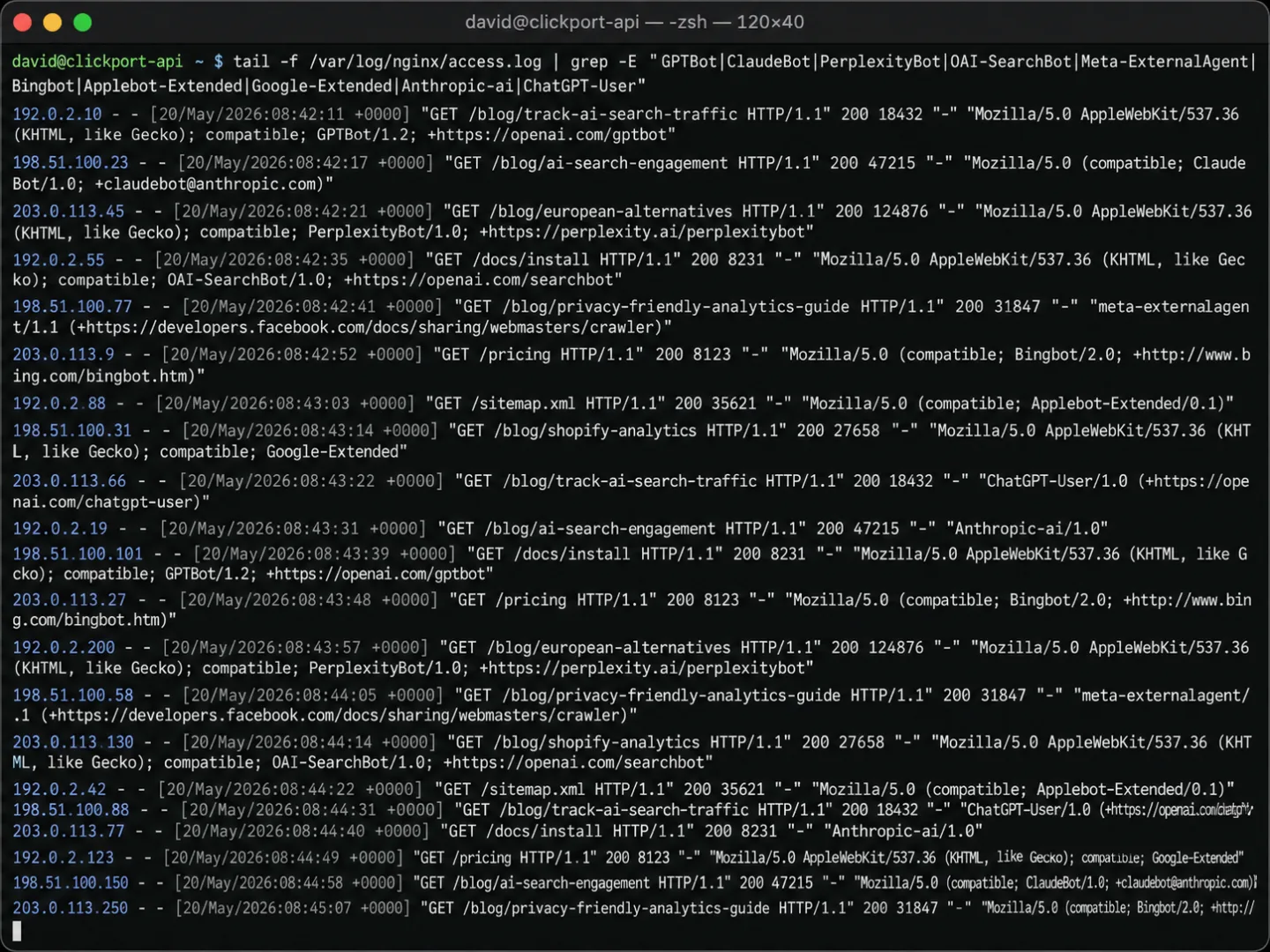
Since July 2026, the visits are only half of what Clickport tracks. The other half is the machines: every crawl and citation by OpenAI, Anthropic, Perplexity and the rest, verified against the AI companies' published IP ranges, and joined to the visits and conversions they send back.
That's the part no channel report can show you. In our own study, AI assistants read our pages about a hundred times for every visit they sent back. Now you can see the reads, the citations, the click-throughs, and the conversions on one screen, per engine. Humans in the AI Search channel. Machines in the AI tab. The full story is in the launch article.
Try Clickport free
30 days free. No credit card required.
What we measured, and how
Everything below comes from the Clickport platform over the trailing 180 days. The engagement score is a 0-100 composite of scroll depth and time on page. In practice: how far you scroll and how long you stay. Bots get filtered out at ingestion, before anything reaches the score. Every figure here's a percentage, a mean, or a standard deviation.
The tracker is cookie-free. Every session stands alone, with no visitor identity to slice. No raw session counts. No per-site numbers. Nothing here traces back to any one site or customer.
The headline: AI Search is in a tier of its own
Here's the engagement score for every channel on the Clickport platform over the trailing 180 days.
| Channel | Mean engagement | Std dev |
|---|---|---|
| AI Search | 60.8 | 7.5 |
| Organic Search | 44.3 | 16.2 |
| Referral | 43.6 | 15.8 |
| Organic Social | 35.9 | 13.8 |
| Direct | 23.9 | 12.2 |
AI Search scores 60.8 out of 100. The next channel down is Organic Search at 44.3. That's a 37% gap. In plain English: the visitors an LLM sends you engage well over a third more than the visitors Google sends you.
The rest of the field is further back. Referral traffic from other websites comes in at 43.6. Organic Social, despite every page being plastered with share buttons, lands at 35.9. Direct traffic, the people who type your URL or click a bookmark, sits at 23.9. That means Direct lands at less than half AI Search's 60.8.
AI Search is the only channel that lands solidly in the green band. Organic Search and Referral are middle of the pack. Organic Social and Direct sit in the bottom quartile.
One honest caveat. The mix of sites on the Clickport platform isn't a representative sample of the whole web, so a different mix might nudge the absolute numbers up or down. But the thing you act on is the ranking of channels against each other. And that ranking isn't in doubt.
And the engagement is consistent, which no other channel is
The mean is one half of the story. The other half is the standard deviation: how much engagement swings from site to site.
That number tells you whether a channel is reliably good or just sometimes good. A channel with mean 50 and std dev 5 looks the same on every site you measure. A channel with mean 50 and std dev 20 looks the same on average but really runs from 30 to 70 depending on the site. With the second one, you can't predict what a new site will see. You're guessing.
In our data:
- AI Search has the lowest cross-site standard deviation of any channel: 7.5. Wherever it has enough traffic to register, engagement stays in the green band, above 50. Even at the low end of the range, it clears that line.
- Organic Search has more than double the spread: std dev 16.2. Which means twice the guesswork. On some sites Organic Search engagement is excellent. On others it's mediocre or worse. There's no floor you can count on.
- Every other channel sits somewhere in between.
This is the part I find most interesting. Organic Search engagement on a given site is close to a coin flip. It hangs on which queries happen to find the site, which keywords the search engine matched, and whether the landing page was the right answer to the search. Get the perfect query-to-page match and Organic Search is fantastic. Get a flood of off-topic queries and those visitors bounce.
AI Search doesn't behave that way. Across every site in our dataset with enough AI Search volume to measure, the visitors arrive engaged. The variance is small. The floor is high.
Why I think this is happening
Let me call this a hypothesis, not a proof. With the data I have, I can't fully isolate the cause. But one explanation fits the numbers better than any other: LLMs filter for relevance before the click in a way that traditional search engines don't.
Type a query into Google and the engine matches it against the index using keyword signals, link signals, freshness, authority, and a hundred other things. What you get back is a ranked list of pages that are probably relevant. Then you click and judge for yourself whether the page answers your question. Sometimes it does. Sometimes it doesn't. The click comes before the relevance check.
Ask ChatGPT, Perplexity, Gemini, Copilot, or Claude the same question and the order flips. The LLM reads the candidate pages, works out which ones answer the question, and writes an answer that cites them. You read the answer first. If you then click through to a cited page, you click to verify, to read more, or to do something. The relevance check already happened. The click is a deliberate next step, not a guess.
That's the prewarmed effect. AI search visitors arrive past the awareness stage with their basic question already answered. They click because they want something specific, and the page they land on is one the LLM has already judged relevant. So they engage. And whether they engage no longer hangs on how well your keywords match a query, because the LLM was matching intent, not keywords.
That's also why the variance is so much smaller for AI Search than for Organic Search. Organic Search is a keyword-matching system, and keyword matching is noisy. AI search is closer to a relevance-reasoning system, and relevance reasoning is steadier.
None of this should be controversial. It's the same thing other people have spotted from other angles. Search Engine Land reported that LLM traffic converts at consistently higher rates. Microsoft's Bing Webmaster blog acknowledged that AI search changes how conversions get measured. Adobe measured lower bounce rates. What our data adds is the engagement-score lens and the cross-site consistency finding. The conversion-rate story has been told. The consistency story, as far as I can tell, hasn't.
Every major AI engine looks similar
Before I pulled this data, one question nagged at me. Was this a ChatGPT effect, or an LLM effect? ChatGPT is so dominant that it could be skewing the whole picture on its own. The answer in our data isn't ambiguous: every major AI engine delivers similar engagement.
| Engine | Mean engagement score | Share of AI Search |
|---|---|---|
| Copilot (Microsoft) | 69.2 | ~3% |
| Gemini (Google) | 65.5 | ~6% |
| ChatGPT (OpenAI) | 62.5 | ~47% |
| Perplexity | 61.5 | ~13% |
| Claude (Anthropic) | 59.0 | ~1% |
Every engine sends traffic that clears the 50-point line. In other words: pick any engine, the visitor quality holds. ChatGPT carries most of the volume, which is no surprise given its market share. But Perplexity, Gemini, and Copilot are right there on engagement. Copilot even edges out ChatGPT per session, though on a much smaller sample, so read that ranking as a direction, not a verdict.
So the lesson isn't "chase the highest-engagement engine." The lesson is that wherever the visitor came from, they engage. If your plan is to get cited in any of them, you don't have to agonize over which one.
About 29% of AI Search sessions arrive with the referrer stripped. In plain English: roughly 3 in 10 AI visits can't say which app sent them. That usually means the visitor was inside an LLM's mobile or desktop app, and the app never passed the source URL through. We classify these as AI Search from UTM parameters or other tracker hints, but we can't tell which app sent them. Engagement on these sessions runs a touch lower, in line with mobile app sessions across every channel, and still above the floor of every non-AI channel.
A note on volume: small, but growing fast
The biggest caveat to all of this is volume. AI Search is still a small share of total traffic. On the Clickport platform it averages around 1.5% of all sessions. That means roughly 1 visit in 65. Next to Organic Search, which runs around 30% on most sites, and Direct, often the single largest channel, AI Search is a sliver.
But look at the slope. Over the trailing three months, AI Search share has roughly quadrupled. It started at a fraction of a percent and now sits at a small but real fraction. At that rate it becomes a channel worth its own line in the report within a year or two, not five years out.
The biggest publishers are already telling their teams the same thing. Rand Fishkin flagged in a recent LinkedIn post that Condé Nast CEO Roger Lynch has told all of the company's brands to plan as if search traffic to their sites will be zero. In Lynch's own words from a TBPN interview: "Every year, our search traffic was down more than we had forecast. So last year I told our teams, 'Assume there's no search.' You have to have your businesses planned as if search is zero. We don't expect it to be zero, we expect it to be a single-digit percentage of our traffic." When a publisher the size of Condé Nast treats single-digit search traffic as the new baseline, a small but consistently high-engagement channel like AI Search is exactly what you take seriously now rather than later.
The combination is what makes it unusual. Small, high-quality, and growing fast all at once. That's the kind of channel that pays back early work. By the time AI Search is 10% of traffic on most sites, the early movers will already have AI-citable content in place. Catching up later almost always costs more than getting in front of the trend now.
This is where the GEO-vs-SEO debate stops being abstract. Whatever tactics turn out to win citations in AI search results, whichever camp is right about the methods, the visitors who show up when those tactics work are the most engaged stream any site is getting today. So the work is worth more than the volume share lets on.
What an engaged visit looks like in practice
A mean engagement of 60 is just a number on a chart. So what does that visitor do all session?
- Scrolls around 50% of the page depth
- Spends 6 to 8 minutes actively engaged
- Reads through the article, often clicks links
- Scrolls around 20% of the page depth
- Spends under 2 minutes on the page
- Often bounces (60%+ of Direct sessions)
These two visitors aren't a little different. They're different in kind. The AI Search visitor reads an article. The Direct visitor lands and leaves.
The same mechanism explains both. The AI Search visitor came because an LLM told them this page would answer their question, so they read it. The Direct visitor came because they typed a URL or clicked a bookmark, which often just means opening their banking site or a tool they use every day. That kind of page doesn't need to be read. It needs to be used.
Desktop is doing most of the work
One more thing worth noting, even though it doesn't move the headline. AI Search leans toward desktop more than Organic Search does. On Clickport, roughly 86% of AI Search sessions come from a desktop browser. That means 6 of 7 AI visits land on a big screen. For Organic Search it's closer to 75%. The rest is mobile and tablet.
That fits how people use these tools. ChatGPT, Perplexity, Gemini, and Copilot get hammered on desktop during research sessions. Someone is at a laptop, working on something, asking questions, then clicking through to read in depth. Mobile AI search exists and is growing. But the desktop-research case still rules.
For marketers there's a practical read here. If you're building AI-citable content, you can lean into desktop-friendly formats: longer articles, tables, code blocks, structured data. Most of these visitors arrive on screens where those things render well.
What about conversions?
I want to deal with this head-on, because someone will ask. Other studies, including some I linked earlier, report that AI search traffic converts at three to five times the rate of organic search. We see the same direction in our data. But I'm not going to lead with a multiplier. Here's why.
A conversion rate depends entirely on how each site owner defines a conversion. One site counts form submissions. Another counts newsletter signups. Another counts button clicks. When the definition shifts that much from site to site, an aggregate conversion rate gets hard to read. And plenty of sites never define a conversion at all, so their sessions pad the denominator and never touch the numerator. The math still spits out a number. The number just lies.
Here's what I can say. Where conversions are tracked on the Clickport platform and AI Search has enough traffic to measure, AI Search converts at a higher rate than Organic Search. The lift swings by site, but the direction holds. It isn't 5x everywhere. It's sometimes 2x, sometimes more. Which means the direction is solid, the multiple isn't. Engagement is the cleaner story because it's tracked the same way everywhere. The conversion story is real, just messier.
I've since published our own first-party multiplier from a controlled 14-day study window: 3.4x, with the sample size printed on the chart. For the wider landscape, other studies have published theirs. Engagement remains the metric we measure most cleanly across every site.
What this means for your site
Three practical takeaways, in rough order of importance.
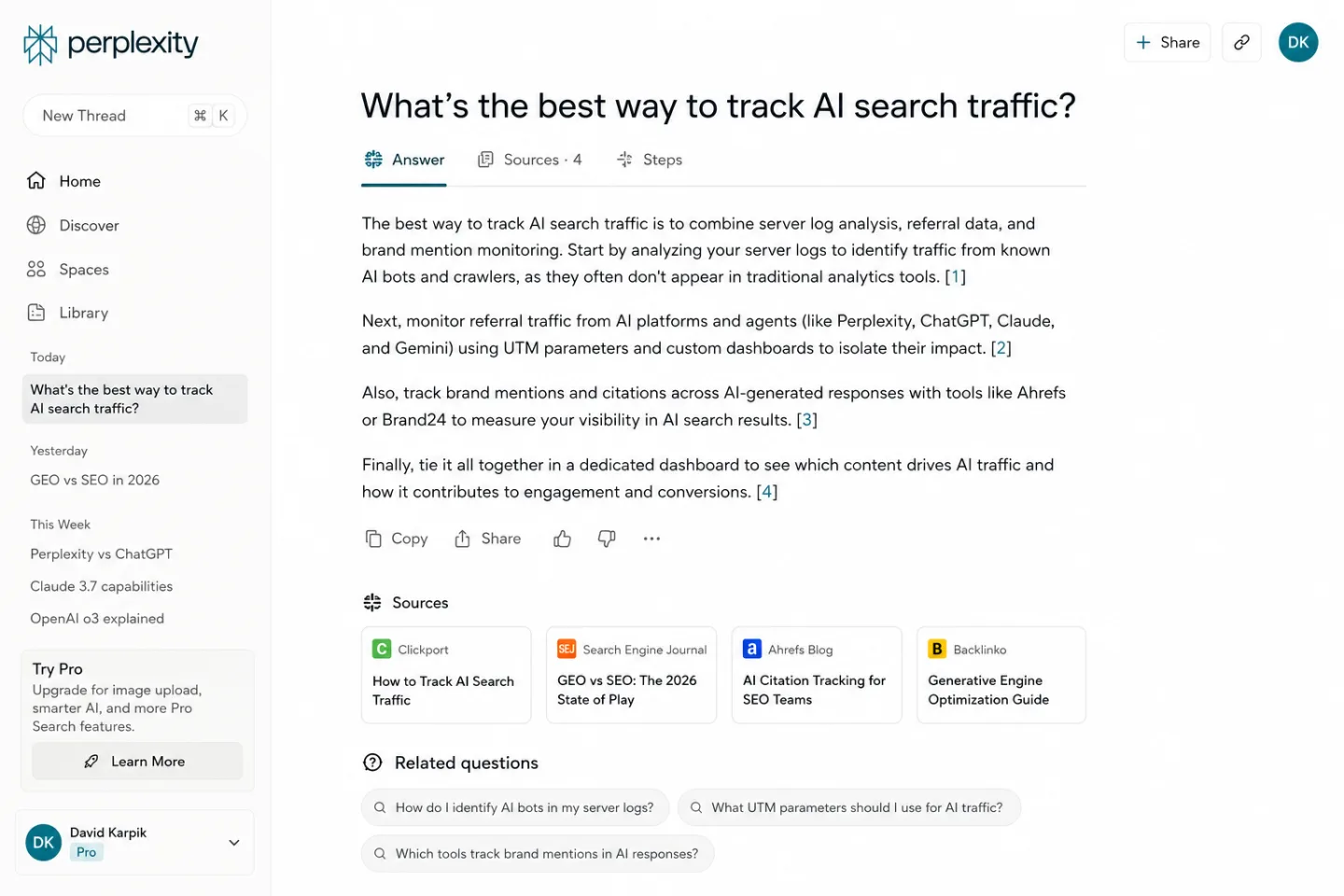
Track AI Search as its own channel, not bucketed with Organic Search. Most analytics tools, including older Google Analytics setups, dump AI search referrals into Organic Search or Referral. That hides the quality difference. If you can't see AI Search on its own, you can't decide anything about it. Clickport classifies AI Search as its own channel out of the box. Some other privacy-friendly tools have started doing the same. GA4 can be coaxed into surfacing AI sources, but it takes manual setup. We covered the attribution mechanics in full in How to Track AI Search Traffic.
Even at a small volume share, AI Search is worth optimizing for. A channel that engages at twice the per-visitor rate of your next-best channel is worth more than its volume share lets on. A 1.5% AI Search share at 60+ engagement beats a 5% share of a 25-engagement channel. In plain English: quality times growth beats raw volume. The math is on your side.
The tactics debate is unsettled. The value question isn't. Whether GEO is its own discipline or just SEO, whether you should write llms.txt files, whether content chunking matters, none of that changes the part I can measure. The visitors who make it to your site from an LLM citation are the most engaged stream you have. Whatever you do that earns more of those citations pays back more per visitor than any other channel.
A short note on what this piece is not
Let me be clear about what this article is and isn't.
- It isn't an argument for either camp in the GEO-vs-SEO debate. I don't have a view on whether
llms.txt, content chunking, or AI-targeted formatting work as tactics. The people who care about those will sort it out by testing over the next year or two. - It's a data observation. Visitors who arrive from AI search engines, however they arrive, behave differently from every other channel. That holds no matter which tactic produced the visitor.
- It fits both camps. If you think AI search optimization is just good SEO, this data fits. Solid SEO that earns LLM citations delivers higher-engagement traffic than anything else. If you think AI search is its own discipline, this data fits too. Visitors who respond to GEO-specific tactics engage at a level no other channel touches.
Both camps can use these numbers without signing on to the other. That's the point. The data doesn't pick a side.
How to see this on your own site
Want to know what AI Search engagement looks like on your own traffic? The shortest path is to run an analytics tool that breaks AI Search out as its own channel and scores engagement per channel. Clickport does both by default. If you already use it, the Sources panel splits AI Search out on its own, and the Engagement column shows you how it stacks up against your other channels on the same site.
Setup is one script tag and about five minutes. No plugin, no PHP, no database overhead, no cookie banner. Within a few days you have your own version of the table above, built from your own traffic.
Maybe you find AI Search is already a real share of your visitors and you just never measured it. Maybe you find it's still a sliver. Either way, the engagement column sitting next to it is usually the moment the channel stops feeling abstract and starts feeling like something you want more of.
That's exactly how it went for me when I first saw it in our own data. The headline number was striking. The cross-site consistency is the part that made me write this down.
And if you're seeing something different in your own AI Search numbers, email me what you've got.

Comments
Loading comments...
Leave a comment