Google's AI Contribution Payments: Is the Offer Worth It?
Google is testing payments for websites whose content helps produce AI answers. Participating publishers see a monthly earnings figure in Search Console, without a detailed explanation of the calculation. Digiday's reporting describes how the pilot works.
If you receive an offer, the useful question is how it compares with what your visitors are worth.
A small payment could replace the advertising revenue from thousands of visits. For a business that sells expensive services, the same traffic could represent much more revenue.
I'd start with that difference before deciding whether the offer is worthwhile.
- Compare the payment with the value of visits you estimate you have lost, not with the size of the payment on its own.
- AI impressions show visibility. They do not measure lost visits, so you cannot multiply impressions by an old click-through rate and call the result a loss.
- In the examples below, 2,000 visits represent €12 to €48,000 in revenue, depending on the business. The figures are illustrative assumptions, not measurements.
- Accepting a payment and blocking AI access are linked decisions, because the pilot pays for grounding and the controls govern grounding. Google has not documented how they interact.
- Google has not announced the programme publicly, and no payout figure has been published by Google or by any participant.
What does Google's AI contribution pilot pay for?
According to the help text Digiday obtained from documentation only participants can see, the pilot pays websites when their content contributes significantly to the creation of answers in Gemini, AI Overviews or AI Mode. Content that is cited or linked after an answer has been generated does not qualify.
Google describes this process as grounding: supplying web content at the point the answer is produced, to improve its freshness and factuality. Its June policy statement says Google is "piloting a new way to partner with websites whose content meaningfully contributes to the freshness and factuality of generative AI responses through the process of grounding". That statement does not name the pilot, mention Search Console or mention payment, so reading the two as the same programme is an inference rather than something Google has stated.
Two absences are worth knowing before you weigh an offer. Google has not announced the programme publicly: there is no blog post, no Search Central update and no public help page, and the participant documentation is gated. And no payout figure has been published anywhere, by Google or by any participating site.
According to Digiday, Google has approached dozens of publishers. Participants receive a Search Console panel with monthly earnings and some history.
The reporting does not provide a payment rate or a breakdown of earnings by page. You can see the total, but you cannot check how much a particular article earned.
That makes your own business data useful. It gives you a way to assess the amount, even when you cannot inspect Google's calculation.
What are your visitors worth?
Start with this calculation:
Estimated revenue lost = estimated visits lost × revenue per visit
Suppose you estimate that a group of pages loses 2,000 visits a month. The table shows what those visits could represent for three businesses.
These are illustrative assumptions, not industry benchmarks or measurements from Clickport customers.
| Business example | Revenue per visit | Revenue associated with 2,000 visits |
|---|---|---|
| Advertising-funded publisher | €0.006 | €12 |
| Ecommerce store | €0.80 | €1,600 |
| B2B lead-generation site | €24 | €48,000 |
Here is the calculation behind each row.
The publisher earns €6 per 1,000 pageviews. Assuming one pageview per visit, each visit earns €0.006.
The store sells an €80 order to 1% of visitors. Its average revenue per visit is €80 × 1%, or €0.80.
The B2B site turns 1.5% of visitors into leads. If 10% of those leads buy a €16,000 contract, each visit represents €24 in expected revenue.
The B2B revenue may arrive months after the visit. It also depends on enough leads becoming customers for the assumed conversion rates to hold.
The point is that visit counts alone cannot tell you whether a payment is substantial. You need to know what those visits contribute to your business.
Use the value of the affected pages
A pricing-page visitor and a visitor reading a basic definition may have very different intentions.
If AI answers mainly affect your informational articles, use the value of visitors who arrive on those articles. A site-wide average could overstate their value.
For a financial decision, also account for the costs of delivering the sale. An €80 order does not leave €80 after product costs, fulfilment and fees.
Revenue gives you an initial comparison. The amount remaining after those costs gives you a better basis for assessing compensation.
How do you estimate the visits you have lost?
This is the difficult part.
Google's Generative AI performance report counts appearances of links to your site in AI Overviews and AI Mode. It does not show how many visits would have happened without those features.
You therefore cannot multiply AI impressions by an old click-through rate and label the result "lost visits".
Some people still click. Others may never have visited your site, even without an AI answer.
If you have historical data, compare the same pages and similar search queries over time. Check changes in rankings, search demand, seasonality and devices before attributing the difference to AI.
For example, assume 100,000 comparable search impressions:
| Scenario | Click-through rate | Visits |
|---|---|---|
| Earlier period | 2% | 2,000 |
| Current period | 1.2% | 1,200 |
| Difference | 0.8 percentage points | 800 |
That is an observed difference of 800 visits. It does not establish that AI caused the entire decline.
For planning, you could calculate the effect of losing 400, 800 or 1,200 visits. These would be scenarios, not a statistical confidence interval.
At €0.80 in revenue per visit, those scenarios represent €320, €640 and €960.
I'd prefer that range to a precise-looking total built on an uncertain assumption.
What can Google's reports tell you?
Three separate Google features matter here:
| Feature | What it tells you |
|---|---|
| AI contribution earnings panel | The payment reported for participating sites |
| Generative AI performance report | How often links appear in supported Search AI features |
| Search generative AI control | Whether your content can appear in those features |
The earnings panel and performance report describe different events. A displayed link is a different thing from content contributing to an answer.
Their coverage also differs. The Search performance report covers AI Overviews and AI Mode, while the reported payment pilot includes Gemini.
That makes "payment per 1,000 AI impressions" an imperfect comparison. Dividing the total payment by Search impressions does not reveal Google's payment rate.
GA4 adds another limitation. Its AI Assistant channel excludes AI Overviews and AI Mode, which Google places in Organic Search. Google's channel definitions state this explicitly, describing Organic Search as arrivals via non-ad links in organic-search results, "including Google's AI Overviews and AI Mode".
You can measure what those visitors do after arrival. That channel alone cannot separate them from ordinary Google search visitors.
Should you accept a payment that does not replace the lost revenue?
Possibly.
Suppose you estimate €640 in lost monthly revenue and receive an offer of €100. The payment covers about 16% of that estimate.
That tells you how much of the estimated loss the payment covers. It does not tell you whether refusing the offer improves your position.
Refusing a payment does not itself demonstrate that the missing visits will return.
The decision also depends on the agreement and your alternatives. Before accepting, establish:
- What uses of your content the agreement permits.
- What payment information Google provides.
- Whether participation creates additional work or costs.
- How you can leave the programme.
- What happens if you change your AI access settings.
A payment could be useful additional income while still providing limited compensation for a larger change in your business.
Equally, a larger payment may be unattractive if the terms impose costs or restrictions you do not want.
The calculation helps you assess the amount. The terms determine what you exchange for it.
What happens if you block AI access?
Google's Search generative AI control lets you exclude your content from supported Search AI features.
Google says exclusion removes your content and links from those features. You also lose the traffic and impressions they would otherwise provide.
Blocking therefore does not simply restore the earlier search experience. Other websites can still appear in the AI answer.
Google-Extended is a separate control. It covers specified uses for Gemini model training and grounding in Gemini Apps and Vertex AI. Google's crawler documentation explains its scope.
Because the pilot pays for contributions to answers, blocking eligible uses could affect earnings. That is an inference from the documented controls, not a confirmed statement about your agreement.
Ask Google how each setting affects your participation before changing it.
Start with the pages that matter to your business
You can do useful work before receiving an invitation.
Open the Generative AI performance report and review the Pages tab. Then examine the traffic and business results associated with those pages.
Some may attract readers who rarely buy. Others may introduce customers who return later to subscribe, order or request a quote.
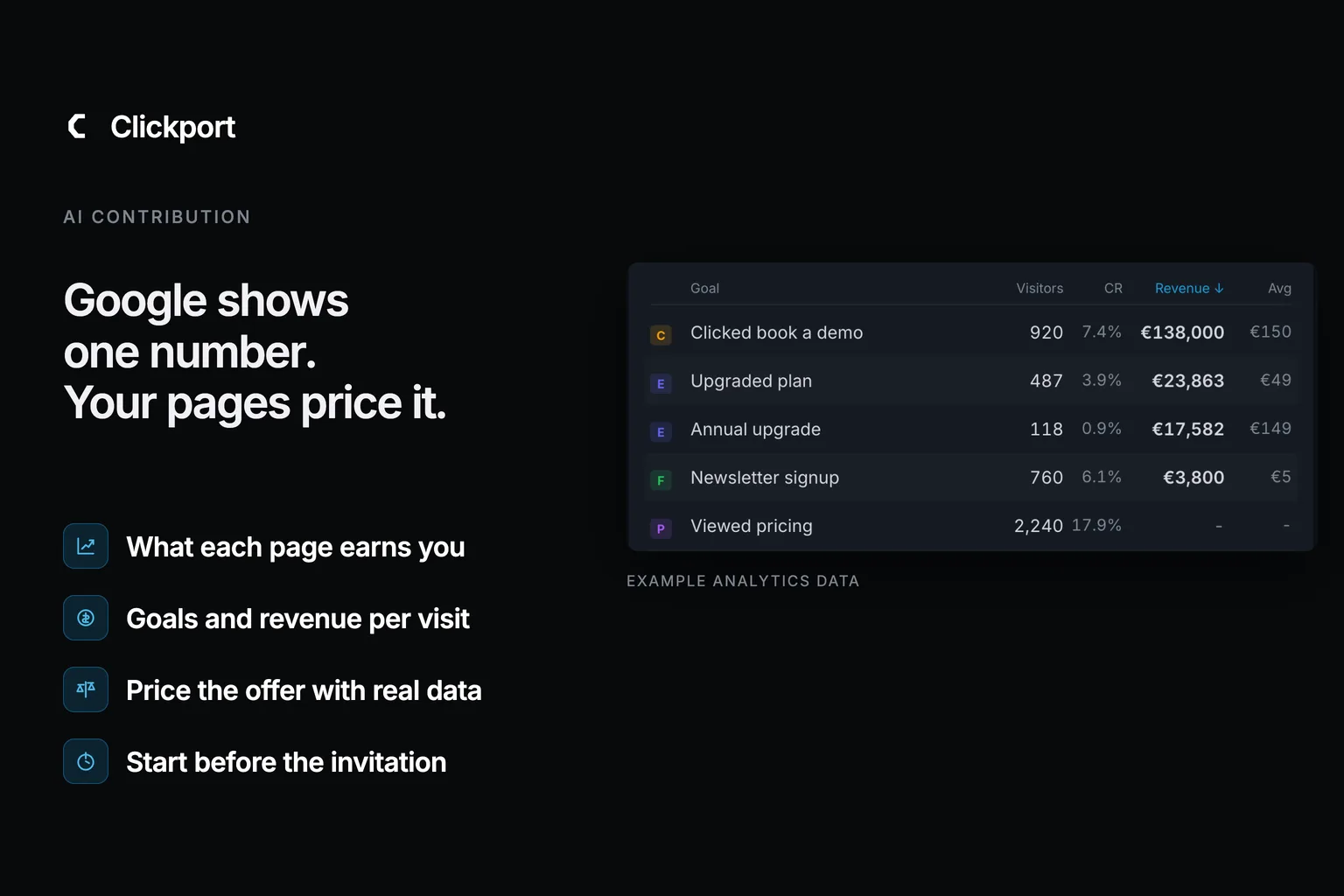
In Clickport, you can review traffic sources, pages, completed goals and attributed revenue. Use those measurements to understand the value of the visitors you receive.
The AI Search channel groups recognised AI referrals. It should not be treated as a complete record of visits from Google's AI features.
For this comparison, focus on the affected pages and relevant visitors. Do not assume that traffic from another AI service has the same value as the Google visits you are assessing.
Google's payment becomes easier to judge once you understand what those pages contribute to your business.
If you need those measurements, start a Clickport trial and set up the goals or revenue tracking relevant to your site. The switching guide explains how to move from Google Analytics.

Comments
Loading comments...
Leave a comment