AI Search Traffic: More Buyers, Fewer Readers in 2026
I almost didn't run this study. AI search is under 5% of search sessions on the sites we measure, and I've argued before that you shouldn't chase it. But when Kevin Indig's data showed AI Mode swapping publishers for products, I wanted to know if our traffic shows the same shift. It does, and more clearly than I expected.
- AI visitors landed on product listings 72.8% of the time; organic search 63.9% (one marketplace).
- ChatGPT sends 80.3% of its visitors to product pages; Perplexity sends 54.8% to articles.
- Google's AI Mode cut publisher mentions nearly in half in 30 days.
- AI search is under 5% of search sessions, but its share has doubled since March.
- Adobe data: retail AI traffic flipped from converting 38% worse to 42% better in a year.
AI search flipped from articles to products
Something changed in how AI search surfaces decide who to mention. Kevin Indig's Growth Intelligence Brief #22 measured it: in the 30 days to July 15, Google's AI Mode cut its mentions of publishers nearly in half while tripling Home Depot's mentions and quadrupling Wayfair's. The shift from informational to commercial mentions runs across 15 of 20 verticals he tracks.
It's not just AI Mode. Semrush studied 600,000+ keywords and found AI Overviews grew 71% on commercial-intent searches in six months, while shrinking 5% on transactional ones. Meaning: the AI answers now show up while people research what to buy, and step aside at the final buy click.
The machines moved from summarizing articles to recommending things you can purchase. That's the whole story in one sentence.
Publishers lose the clicks, merchants get the buyers
For content sites this shift is brutal. Pew Research found that when an AI Overview appears, only 8% of people click any regular result, against 15% without one. Ozone's ad data, covering about 20 billion impressions, shows publisher ad request volumes down 32% to 37% year over year in the US in Q2 2026. In plain English: half the clicking stops.
Merchants live in a different world. Shopify told investors AI traffic grew 7x and AI-driven orders 11x between January and its Q3 2025 earnings call. Walmart found that checkout inside ChatGPT converted at about a third of its own site's rate and pulled back, but said the same ChatGPT traffic brings more new customers than search does. Which means the buyers keep coming. If you publish, you lose twice. If you sell, you might not.
I run a content-heavy site myself. I don't love this. But the data doesn't care what I love.
Where AI visitors land: what our data shows
One site we measure is a high-traffic B2B product marketplace with two clearly separated halves: a product catalog and an editorial section. That split makes it a clean test. Over the 90 days to August 8, 2026, it saw 6,960 AI search sessions and 200,941 organic search sessions. Here's where each group landed.
AI search visitors landed on product listings 72.8% of the time. Organic search sent 63.9%. The editorial section shows the mirror image: 22.0% of AI landings against 27.8% for organic search. Put another way: on the same site, in the same 90 days, the AI engines route people toward the catalog and away from the articles.
Even inside the editorial half, the pattern holds. 31.9% of AI editorial landings hit product-review pages, twice the 16.1% rate for organic search. Which means even the reading is shopping. When AI visitors open an article, it's an article about what to buy.
A note on method: pages were classified by URL structure alone, with fixed rules set before measuring, and ambiguous category pages excluded from both buckets. I first tried a generic classifier across every site we measure. It didn't survive contact with real URLs, so I scoped to the one site where the split is unambiguous. The AI sessions themselves look thoroughly human: 21.1% bounce rate and 1.79 pages per visit, healthier than any other channel on the site. Still, one site, not the web. Treat it as a case study that happens to agree with Indig's mention data from the other side, and check whether your own numbers rhyme with it.
ChatGPT shops, Perplexity reads
The blended number hides the best finding. The engines don't agree with each other.
ChatGPT sends 80.3% of its visitors straight to product listings. Perplexity sends most of its visitors, 54.8%, to editorial pages instead. Meaning: ChatGPT behaves like a shopping assistant, Perplexity behaves like a research assistant, and treating "AI traffic" as one channel hides that split. OpenAI leaned into this on purpose: it shipped shopping research in ChatGPT in November 2025 and Google followed with shopping ads inside AI Mode in February.
Does AI traffic buy anything?
Here's where the industry numbers seem to fight each other, and maybe you've noticed it too. Orbit Media measured 97 B2B sites and found AI visitors converting at about 3x the rate of other organic traffic. Microsoft Clarity saw LLM referrals hit a 1.66% sign-up click-through rate against 0.15% for search across 1,277 domains. But the most rigorous study in the pile, 973 ecommerce sites in Marketing Science, found ChatGPT referrals convert to purchases worse than nearly every traditional channel: affiliate visitors are 86% more likely to convert, organic search visitors 13% more. In plain English: for straight web-shop purchases, the old channels still win.
Both sides are right, and they don't contradict once you look at what's being counted. The positive studies measure low-friction actions like signups and leads, where a pre-qualified AI visitor shines. The negative one measures completed purchases across all of ecommerce, where the average still favors Google. And the average won't sit still: Adobe Analytics data covering over a trillion US retail visits, reported by TechCrunch, shows AI traffic converted 38% worse than regular traffic in March 2025 and 42% better by March 2026. In other words: the gap closed in one year.
On our own consumer-site data, AI search sessions converted at 3.4x the rate of other channels. Small volumes, real conversions.
Keep the volume honest, though. Every study above, ours included, agrees AI referrals are still a tiny slice: under 0.2% of visits in the Marketing Science sample, about 0.5% in Orbit's. On the sites we measure, AI search was 2.05% of search-driven sessions in March and 4.72% in the first week of August. In other words: small, but doubling. Part of that rise is organic search shrinking faster than AI grew over the summer, so read it as a share shift, not a boom. No fear, no hype. Just a channel growing fast from a low base, sending people who increasingly arrive ready to buy from you.
How to see it in your own analytics
When Google traffic falls, use this guide to checking the business impact. It separates search visibility, visits, and confirmed outcomes before estimating a cost.
You don't need a study for your own shop. You need three things GA4 doesn't make easy: a real AI channel, visits that don't hide in Direct, and revenue tied to sessions.
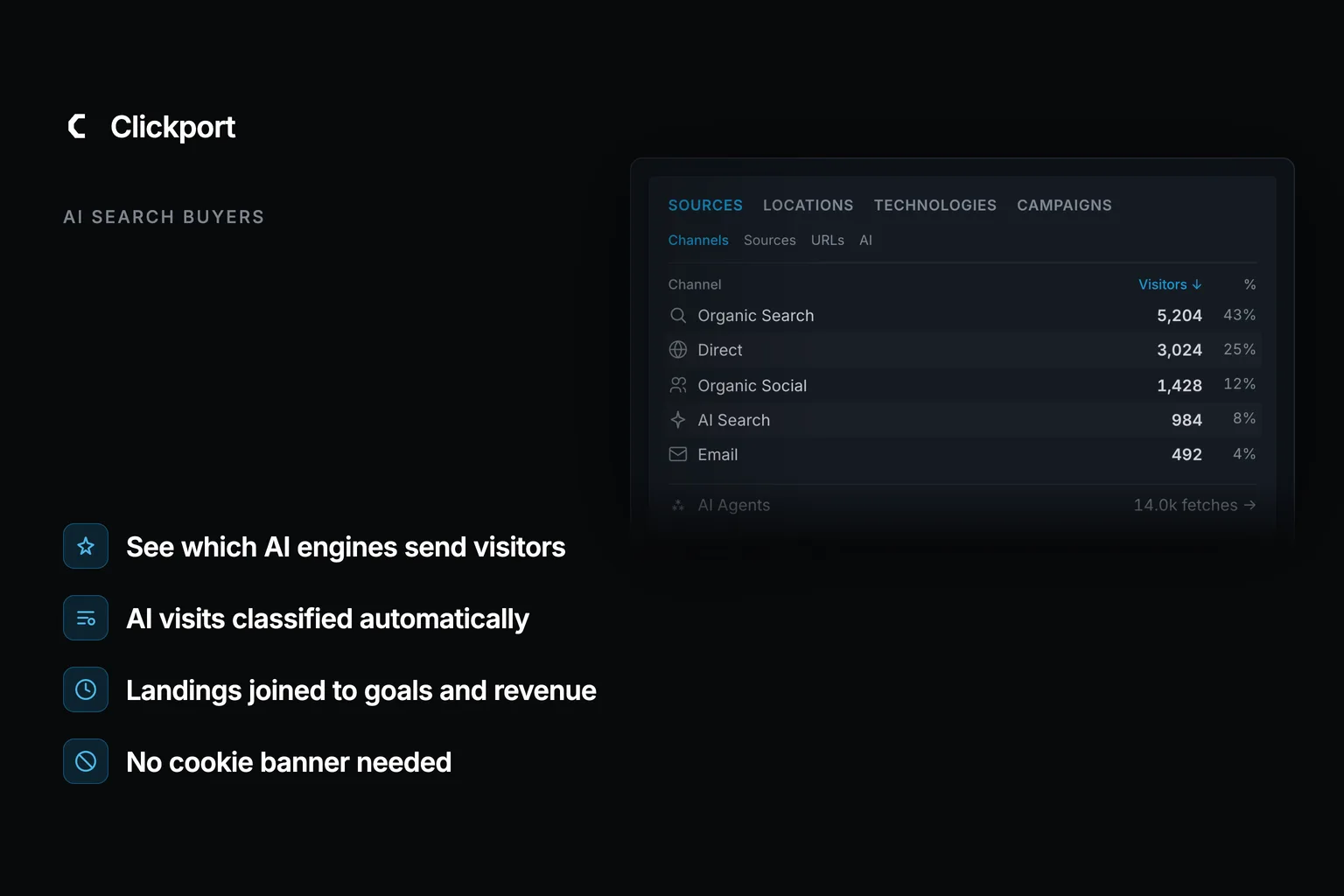
In Clickport it's one flow. The Channels panel shows AI Search as its own channel, split by engine, classified automatically. Click it and the whole dashboard filters: which pages AI visitors land on, which goals they hit, and what revenue their sessions produced. If your product pages show up under AI landings the way that marketplace's do, you'll see it in about five minutes. The full setup for tying revenue to AI sessions is in the attribution guide.
Then decide with numbers, not headlines. If AI sends you 12 buyers a month, you'll know they're buyers. If it sends you nothing, you'll know that too, and you won't waste a quarter optimizing for a channel that isn't yours yet.
The readers left first. The shoppers are next.
The publishers already learned what an AI-mediated web does to reading traffic. Merchants are now learning the other half: the visitors who do click out of an AI answer skip your blog and walk straight to the shelf. Fewer readers, more buyers, and a referral share that's still small but doubling. Whatever you sell, the moment to start measuring this channel is before it matters, not after.
You can try Clickport free and see your AI search traffic, landings, and revenue on day one. And when you're ready to leave GA4's Direct-traffic guessing game behind, switching takes one snippet.
FAQ
How much traffic comes from AI search?
Across published studies and our own data, AI search referrals are under 2% of most sites' traffic. On the sites we measure, AI search grew from 2.05% of search-driven sessions in March 2026 to 4.72% in the first week of August, partly because organic search shrank faster. Small, but roughly doubling in five months.
Does ChatGPT traffic convert?
It depends on what converts. For signups and leads, studies show ChatGPT visitors converting up to 3x better than organic search. For completed ecommerce purchases, a 973-site academic study found ChatGPT referrals convert worse than organic search and affiliate traffic, though Adobe's retail data shows the gap flipped positive in 2026.
Why does AI traffic show up as Direct in GA4?
Many AI tools strip the referrer, especially mobile apps, so GA4 can't source those visits and files them under Direct. GA4's newer AI channel doesn't help there; it only catches recognized referrers. Clickport classifies AI search visits into their own channel automatically, including several no-referrer patterns.

Comments
Loading comments...
Leave a comment