Agentic Commerce Analytics: What Counts as an AI Sale?
If a report says AI brought your shop €410, what happened? Someone might have asked ChatGPT for a recommendation and clicked through to buy. They might have paid inside another assistant. Or an agent might have operated a browser on their behalf.
Those are different purchase paths. A source label alone won’t tell you which one happened.
That’s where I’d start with agentic commerce analytics: keep the source of the order, the place checkout happened and the evidence about who completed it separate. You can then give a client a useful sales report without presenting every AI referral as a robot doing the shopping.
I compared Shopify’s current checkout and reporting documentation with the way Clickport links payments to website visits. The distinction becomes clearer when you compare the website report with the order book.
- A sale attributed to an AI channel does not prove an autonomous agent bought the product. Report the source and checkout path separately.
- Shopify’s agentic sales reporting combines referral-based and direct-checkout sales, and includes Shop. Inspect individual channels before interpreting the total.
- Shopify says client-side analytics pixels do not fire in Microsoft Copilot direct checkout. The order can exist without a recorded visit to your online store.
- In the six-order example, €260 of website-attributed AI revenue is already included in €410 of AI-channel orders. Adding them would count three orders twice.
- Unattributed revenue stays unknown until you have source evidence. A gap between your order records and analytics is not an estimate of autonomous purchases.
What should agentic commerce analytics count?
Before choosing a metric, decide what question you’re answering. I’d keep these three in separate columns:
| Question | Evidence to look for | What it doesn’t establish |
|---|---|---|
| Which channel received credit for this order? | A recorded referral, an attributed website session or the platform’s order-channel record | Who operated checkout, or whether the sale would have happened anyway |
| Where did checkout happen? | The recorded checkout surface: your store or a supported checkout inside an AI channel | Whether the customer delegated the whole purchase |
| Did an agent purchase autonomously? | Evidence of the authorized task and its execution, where available | Something a referrer label or revenue total can answer on its own |
Consider a person who uses AI to compare bags, follows a recommendation and buys from the shop. That’s a useful AI referral. The person could still have checked the size, read the returns policy and entered their payment details themselves.
Now consider a checkout embedded in an assistant. It can remove the trip to the merchant’s website while still asking the customer to confirm the purchase. “Inside an AI app” describes a location. It doesn’t describe how much decision-making the customer delegated.
An agent operating a browser is another possible path. You would need evidence about that particular execution to identify it reliably. I wouldn’t assign that label to a visit because it came from an AI-related domain.
This distinction helps with ordinary reporting too. You can evaluate which AI sources bring leads and sales without first solving the much harder question of whether the buyer was acting through an autonomous agent.
What does Shopify include in agentic sales?
Shopify gives us a concrete example of why the definitions matter.
Its agentic storefront reporting documentation says sales combine referral-based purchases and direct checkout. The same reporting includes Shop activity. Its online-store conversion rate, however, uses online-store sessions that completed checkout divided by online-store sessions. That denominator doesn’t describe every conversation or purchase inside an assistant.
I’d inspect the individual channels before using the combined total in a client presentation. Keeping Shop visible as its own row also lets the client distinguish it from ChatGPT, Copilot and other channels they may be evaluating.
The checkout routes differ. As checked on 24 September 2026:
- Shopify’s ChatGPT channel sends shoppers to the merchant’s online-store checkout, in an in-app browser or a new browser tab. That’s the behavior described in Shopify’s ChatGPT guide.
- Microsoft Copilot direct checkout, for eligible stores and customers, can finish inside Copilot. Shopify’s Copilot guide says client-side analytics pixels don’t fire there. It documents server-to-server checkout signals instead. Those signals don’t automatically connect every analytics tool.
A browser checkout gives your measurement setup a place to run, but you still need to check that it works. A direct checkout can produce a valid order without that website visit. Neither route, by itself, establishes unattended buying.
That is the practical result of the document comparison: the order report and the website report can describe different parts of the same business. A difference between them is something to reconcile before calling either one wrong.
For Shopify readers, there’s another setup limit: its documented agentic performance analytics currently exclude headless stores. Check the current platform guidance for your own setup rather than assuming every store has the same report.
Six orders, two different AI revenue totals
Let’s give the difference some numbers.
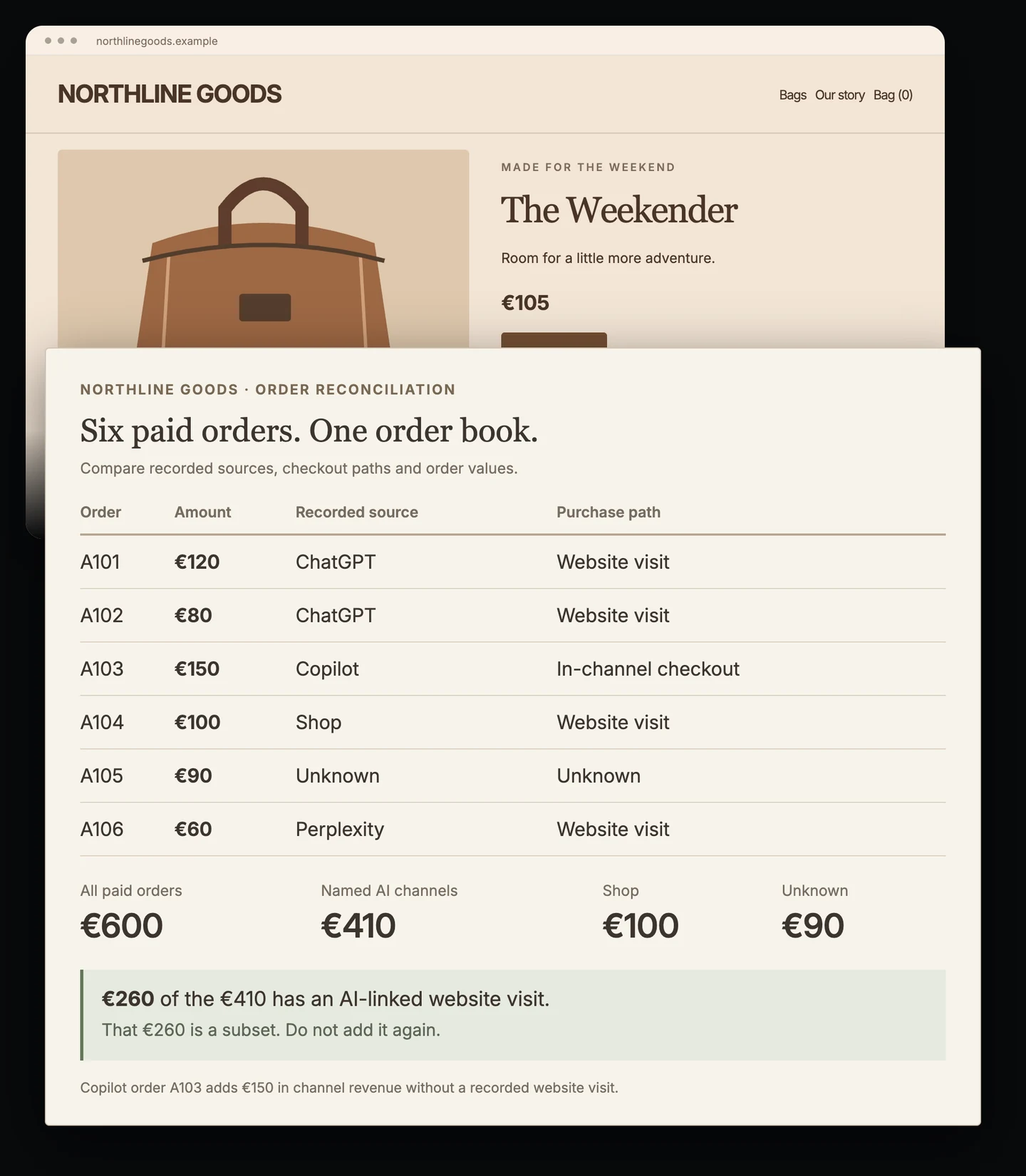
Consider Northline Goods, a shop we’ll use with made-up numbers to walk through the comparison. It has six paid orders in one reporting period, all in euros. We use the same recorded order-value basis throughout, with no refunds, currency conversion or timing differences. Website revenue events have been matched to orders where the table says a visit exists.
For each order, the worksheet records its source, checkout path and whether it matches a website visit.
| Order | Recorded value | Source evidence in this example | Checkout path | Matching website visit? |
|---|---|---|---|---|
| A101 | €120 | ChatGPT referral | Website | Yes |
| A102 | €80 | ChatGPT referral | Website | Yes |
| A103 | €150 | Copilot channel on order | In-channel checkout | No recorded visit |
| A104 | €100 | Shop referral | Website | Yes |
| A105 | €90 | Unknown | Unknown | No recorded visit |
| A106 | €60 | Perplexity referral | Website | Yes |
The website report can attribute €260 to the recognized AI referrals: €120 + €80 from ChatGPT and €60 from Perplexity.
The order worksheet supports €410 for those named AI channels when we also include the €150 Copilot order. For this comparison, Shop remains a separate €100 row. The remaining €90 has no known source.
Both AI totals are useful. They answer different questions:
- €260: How much recorded revenue is linked to the website’s identified AI referral visits?
- €410: How much order value has evidence assigning it to ChatGPT, Perplexity or Copilot, including the in-channel purchase?
The €260 is already inside the €410. Adding the two would produce €670, counting A101, A102 and A106 twice. That would even exceed the shop’s €600 total for all six orders.
And the €90 gap stays unknown. It could not be assigned to AI from this table. We have no source evidence for it.
We also don’t have a count of autonomous purchases. The worksheet establishes sources and paths under its stated assumptions. It doesn’t record who selected the product, entered the details or confirmed payment.
This is why I prefer starting with a few order IDs instead of a large percentage. You can see precisely where the two reports overlap.
What can website analytics tell you?
The website part still deserves attention. Those visitors arrive on pages you control, encounter your offer and decide whether to continue.
In Clickport, recognized AI Search visits can be examined alongside the revenue linked to their recorded sessions. For payments sent through a payment integration or the Revenue API, that link needs a checkout reference matching a recorded session. Without a match, those payments stay unattributed; the amount doesn’t create a missing website visit.
Here is Northline’s website view for the same period. ChatGPT shows €200 and Perplexity €60. The Visitors column shows recorded visitors; Revenue shows the payments attributed to those visits.
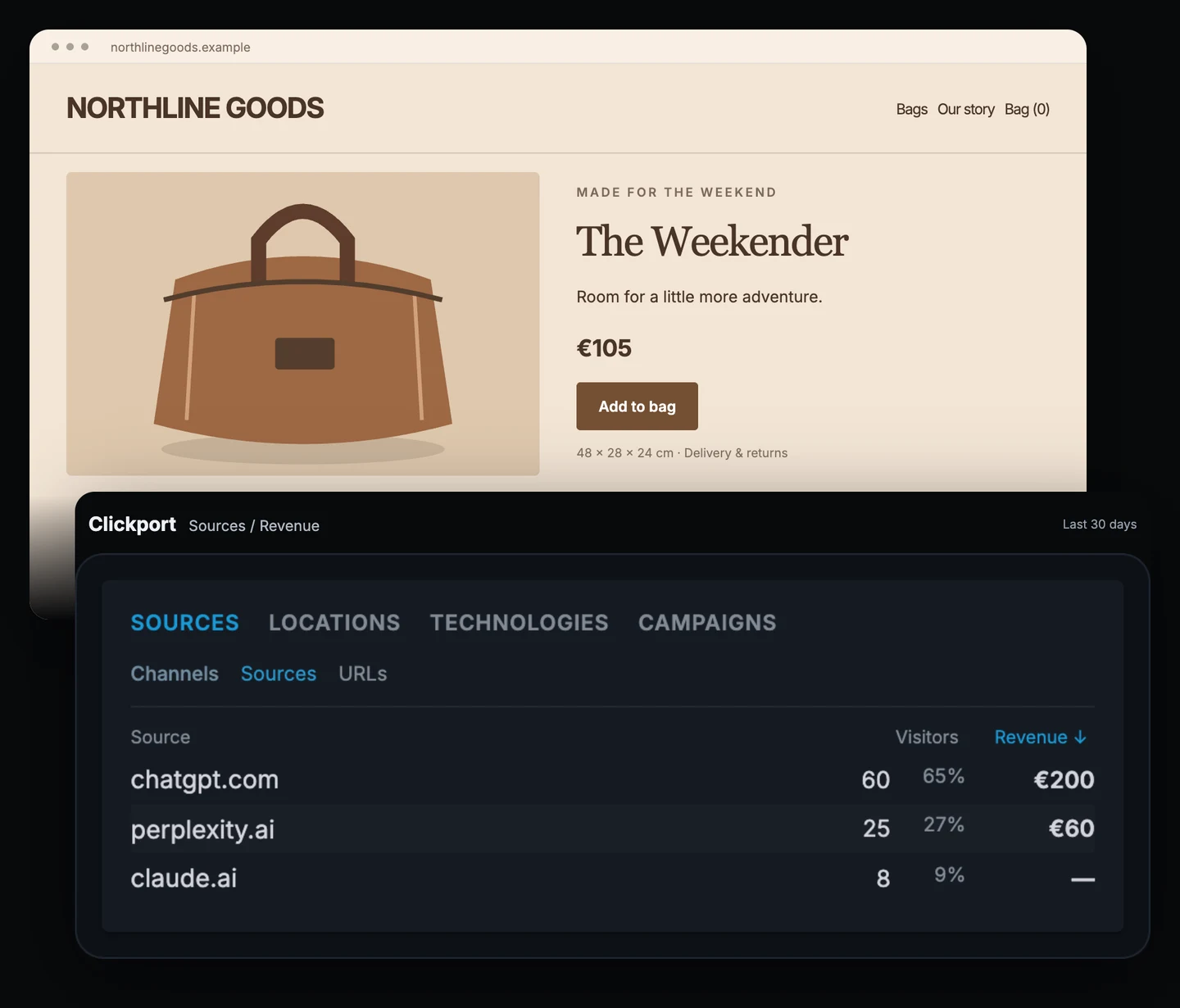
I’d use this report to choose what to inspect on the site. Which product pages do AI visitors land on? Do those pages answer sizing, delivery and returns questions? Do visitors reach the next step, and is the payment integration recording the outcome?
These are business questions worth asking of AI traffic. They don’t require a claim that the assistant completed the purchase.
For a custom setup, the Revenue API can accept payment events from a backend even without a recorded website visit. That can preserve the revenue amount, but it does not recover the missing source. Sending an AI name as metadata is not a substitute for attribution evidence.
Installation matters as well. On Shopify, putting the tracker in the storefront theme doesn’t cover checkout; our Shopify guide describes the separate checkout setup. That setup should not be assumed to cover the Copilot direct-checkout path described above.
If your existing platform report already answers your question about channel orders, use it. Clickport helps with the identifiable visits and actions on your website. Your order system remains essential for purchases that happen elsewhere, just as it does when customers buy or book on an external website.
How would I reconcile a client’s report?
Start with a small set of orders you can inspect. Keep the channel names and order IDs, and agree on what each amount means before comparing totals.
First, align the reporting period and money. Use the same dates, time zone and currency. Decide whether the comparison includes tax, shipping, discounts and refunds. A gross order value and a net payment figure can disagree even when both systems recorded the purchase correctly.
Then identify the overlap. Where available, match each payment event to the corresponding order. Mark whether there is a recorded website session and what evidence supports the source. A platform channel, a website referrer and a guess based on a missing visit should not be treated as interchangeable.
Choose one revenue collection route per order. If you send the same sale through several integrations, check what each one records. Don’t assume every combination of browser events, payment webhooks and custom imports removes duplicates automatically.
Keep refunds visible. A later refund changes the money retained without changing the fact that the original order happened. Record the adjustment under the reporting convention you chose. Don’t quietly compare one report before refunds with another after them.
Leave unexplained orders unassigned. Check collection failures, date boundaries and value definitions before proposing a source. “Not in the website report” is a finding to investigate, not a channel name.
A client note for Northline could read:
We recorded €410 in orders with ChatGPT, Perplexity or Copilot source evidence. Of that, €260 is linked to tracked website visits and €150 came through Copilot’s in-channel checkout. Shop contributed a separate €100. We couldn’t establish the source of another €90. These records don’t tell us how many purchases were autonomous.
The next action follows from the question. If the client wants to improve the website, examine the visits and landing pages. If they want to understand in-channel sales, inspect the order records and that checkout’s supported reporting. If they want to know whether an agency’s work caused extra sales, attribution alone won’t settle it. That requires a comparison designed to separate the work’s effect from other changes.
Does the adoption research justify waiting?
I wouldn’t wait for a forecast to settle the reporting definitions.
The EHI study that prompted this article surveyed 218 people in German-speaking retail in July and August 2026. Its 10 September release says 26.6% considered investment likely at present, nearly two-thirds in five years and almost three-quarters in ten years. EHI conducted the work for SoftServe.
That is a survey of expectations. It doesn’t say investment starts only in ten years, and it doesn’t measure the share of purchases completed by agents.
For a shop or agency, the immediate question is smaller: do your existing orders show enough activity to justify more work? You can answer that more usefully with clear channel definitions and a reconciled order sample than with a prediction about the end of websites.
Start with the sales you can explain
An AI referral can be valuable even when the customer does all the buying. An in-channel order can be valuable even when your website tracker never sees checkout. Keep those outcomes visible without turning them into a claim about autonomous shopping.
My starting point would be the six-order exercise above: match a few real orders, separate the website-attributed subset from the broader channel total, and write down what remains unknown. That gives you a report you can use when the next client asks whether their AI investment is paying off.
If you want to understand the identifiable AI visitors reaching your website and the payments linked to those visits, try Clickport. Start with one source and one useful outcome. If you’re moving from Google Analytics, the switching guide covers the setup. Keep your order records alongside it so purchases outside the website remain part of the conversation.

Comments
Loading comments...
Leave a comment