Is Google Analytics Legal in Germany? Cookie Consent, 18 DPAs, and Why It's Complicated
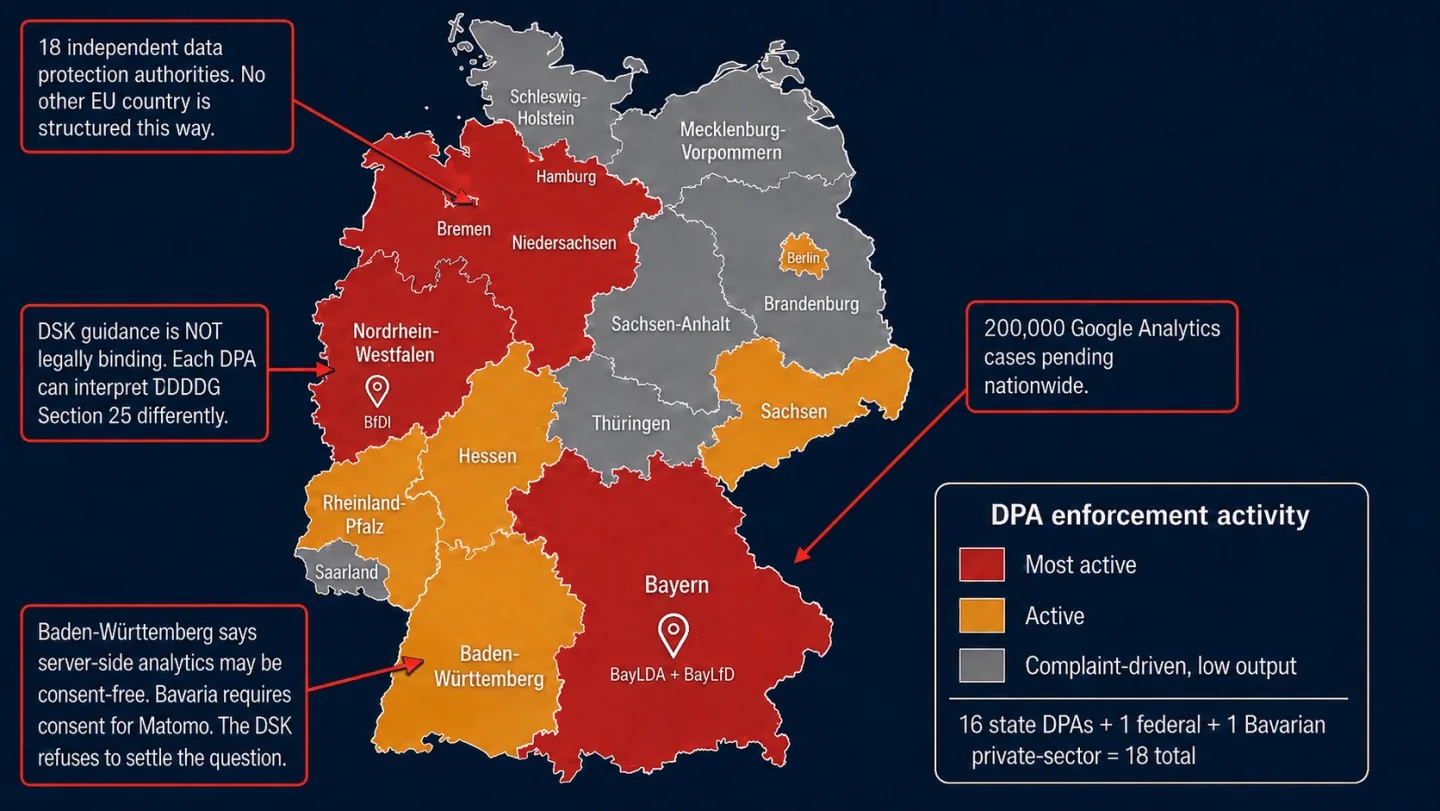
Germany has the strictest privacy rules in Europe and the most ways to get sued for violating them. Google Analytics isn't banned here, but it's practically unusable without consent. Your state DPA can fine you up to EUR 300,000 under the TDDDG. A competitor can Abmahn you for several thousand euros. A court in Frankfurt just ruled your analytics provider is directly liable. And your cookie-based analytics only see 10-20% of your actual German traffic anyway. In plain English: 4 visitors in 5 never make it into your charts. Every other article about German cookie consent gives you a compliance checklist. This one explains why a checklist isn't enough.
- Germany has 18 independent data protection authorities (1 federal + 17 state-level) that coordinate through the DSK but cannot issue binding decisions. A 2019 mass-complaint wave dumped roughly 200,000 Google Analytics reports on them, and the backlog shaped enforcement for years.
- The TDDDG (formerly TTDSG) requires consent for ALL analytics cookies. Industry lobbied hard for an analytics exemption during the legislative process and the law shipped without one. France and the Netherlands both have more lenient positions on first-party analytics than Germany.
- In March 2025, the BGH ruled that DSGVO violations are actionable under competition law. German commentators read that straight onto cookie consent: competitors can send Abmahnungen (cease-and-desist letters) that typically cost the recipient several thousand euros.
- Cookie-based analytics in Germany capture 10-20% of actual traffic. Germany has some of Europe's highest ad blocker adoption (roughly 44%), consent rejection rates of 55-60%, and about 30% of traffic uses browsers with built-in tracking protection.
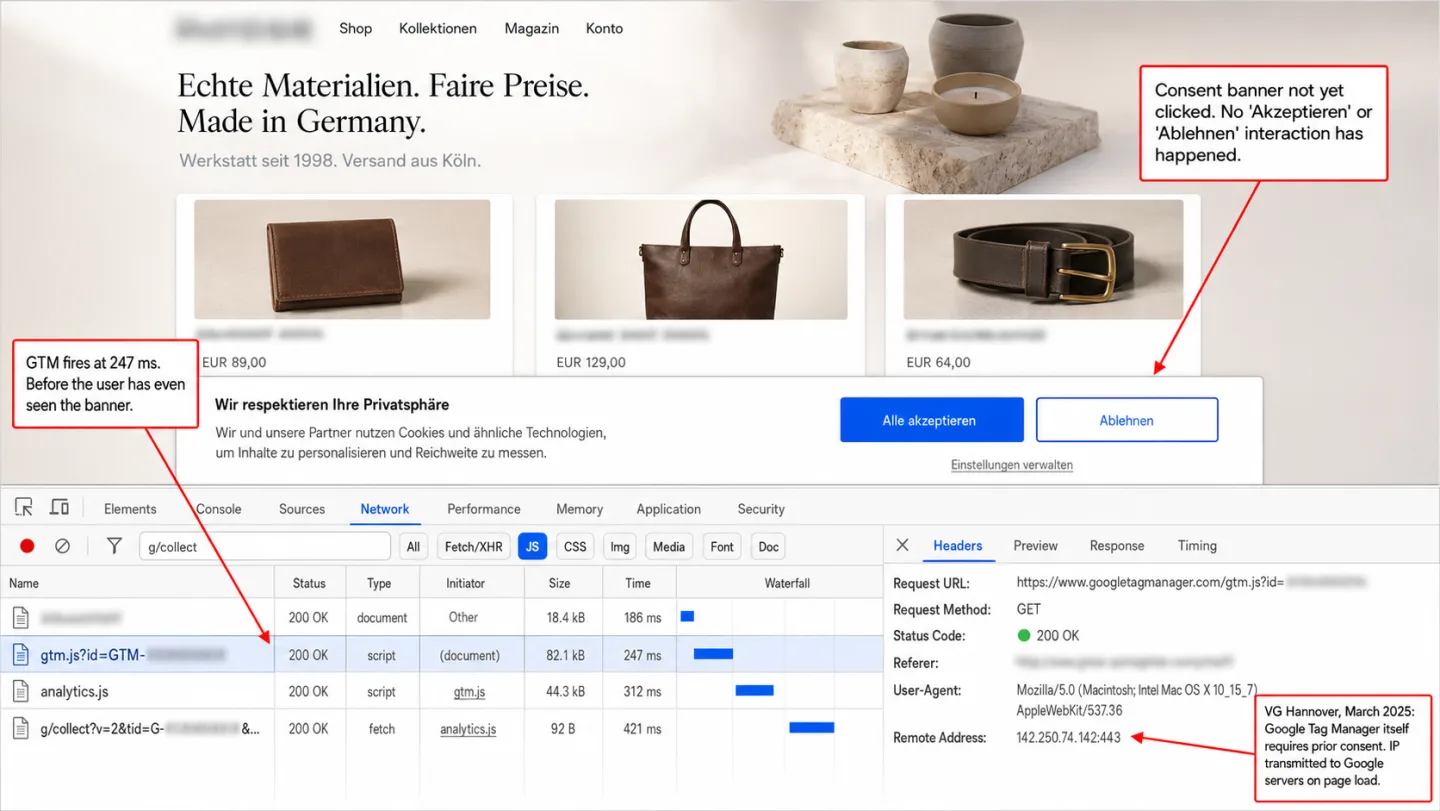
- A March 2025 court ruling found that even Google Tag Manager requires consent before loading, because it transmits IP addresses to Google servers. A December 2025 Frankfurt ruling held a third-party tracking provider directly liable for cookies set without consent.
Germany's privacy DNA
Germany's relationship with data protection is constitutional. On December 15, 1983, the Federal Constitutional Court struck down Germany's census law and declared a new fundamental right: informationelle Selbstbestimmung, the right to informational self-determination. No other country has this. The right is derived from human dignity and the free development of personality under Articles 1 and 2 of the Grundgesetz, and it means every German citizen has a constitutional right to decide who knows what about them.
That 1983 ruling is the intellectual ancestor of the GDPR. The concept of data protection as a human right, not just a consumer preference, started in Karlsruhe. And it didn't come from abstract philosophy. It came from lived experience. East Germany's Stasi maintained files on 5.6 million citizens. The 2013 NSA/BND surveillance scandal revealed that American and German intelligence agencies had been monitoring German communications. Privacy in Germany isn't a regulatory preference. It's a trauma response codified into constitutional law.
The path from the 1983 census boycott to the 2025 Abmahnung ruling is a straight line. Germany didn't arrive at strict cookie consent by accident. It arrived there because data protection is woven into the constitutional fabric of the country.
18 DPAs, one country, no consensus
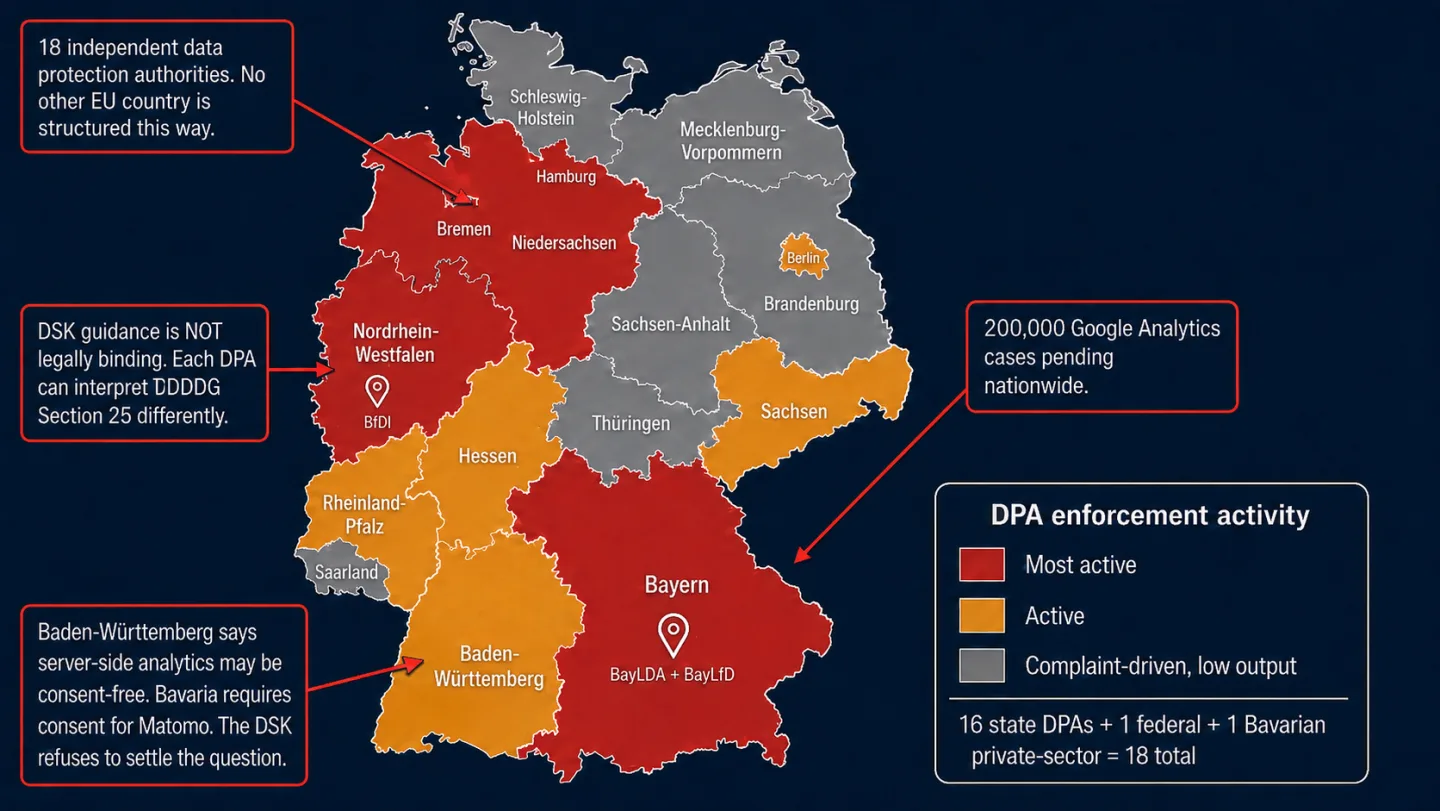
Germany is the only EU country where privacy enforcement isn't centralized. There are 18 independent data protection authorities: the federal BfDI plus 17 state-level authorities (Bavaria uniquely has two, one for the public sector and one for the private sector). They coordinate through the DSK (Datenschutzkonferenz), a conference body that issues joint guidance. But here's the critical point: DSK decisions aren't legally binding. Each state DPA can technically interpret the law differently, and some do.
The BfDI, headed by Prof. Dr. Louisa Specht-Riemenschneider since September 2024 (she announced her resignation in March 2026 and stays until a successor is appointed), has around 400 staff and supervises federal agencies and telecom companies. It doesn't supervise private websites. If your German e-commerce store violates cookie law, the state DPA where your company is registered investigates.
The practical result: a company operating across Germany could face different interpretations from different DPAs. Baden-Wurttemberg's DPA suggests server-side analytics may be consent-free. The BfDI says Matomo requires consent. The DSK deliberately refuses to state whether analytics cookies can ever qualify as "strictly necessary." Even Germany's own government websites use different approaches: Hamburg uses etracker without consent, Bavaria requires consent for Matomo, and Hesse uses no analytics at all.
The TDDDG: Germany's cookie law
The TDDDG (Telekommunikation-Digitale-Dienste-Datenschutz-Gesetz) is Germany's implementation of the ePrivacy Directive. Originally enacted as the TTDSG in December 2021, it was renamed in May 2024 to align with the EU Digital Services Act. The substance didn't change.
Section 25 is the core provision. It requires consent for storing information on or accessing information from a user's device. Not just cookies. Any device access: localStorage, sessionStorage, browser fingerprinting, even reading screen resolution via JavaScript. The scope is broader than most EU transpositions.
There are exactly two exemptions. First: carrying out a communication over a public network. Second: "strictly necessary" to provide a service the user explicitly requested. Analytics doesn't qualify for either.
This isn't an oversight. During the Bundestag legislative process, ARD, ZDF, Deutschlandradio, every major publisher association, and Bitkom all lobbied for a consent-free audience measurement exemption. The legislature kept Section 25 aligned with the ePrivacy Directive and adopted none of them. Germany saw the exemption debate happen and deliberately shipped the law without one.
The TDDDG has its own penalty regime. Violations of Section 25 carry fines up to EUR 300,000. If the data collected constitutes personal data (it almost always does with analytics), GDPR fines up to EUR 20 million or 4% of global turnover apply on top. That means 2 penalty regimes stack on 1 mistake.
Germany's DSK Orientierungshilfe (guidance for digital service providers, updated November 2024) spells out the requirements: "strictly necessary" means technically necessary, not economically useful. Shopping cart cookies qualify. Login session cookies qualify. Analytics cookies never do. The DSK says generic descriptions like "improve user experience" are unacceptable as justification.
Google Analytics in Germany: not banned, not safe
Unlike Austria and France, no German DPA has issued a formal ruling declaring Google Analytics illegal. But the cumulative pressure from court rulings, DSK positions, and pending complaints amounts to the same thing. The Netherlands sits in a similar position: no outright ban, but the AP has excluded GA from its first-party analytics exemption.
In May 2020, the DSK adopted a joint resolution on Google Analytics. Key positions: only consent can justify GA use (not legitimate interest), Google and the website operator are joint controllers under Article 26 GDPR (not a processor relationship), and IP anonymization alone is insufficient because data reaches US servers before anonymization occurs. (The transfer half of that reasoning is suspended while the DPF stands; the consent half is what still bites.)
In March 2023, the Cologne District Court ruled that Deutsche Telekom's use of Google Analytics was unlawful. The Verbraucherzentrale NRW (consumer protection organization) sued, and the court found that a generic "Accept All" cookie banner doesn't constitute valid consent for GA because users weren't specifically informed about data transfer to Google's US servers.
Then came 2025. In March, the Hannover Administrative Court ruled that even Google Tag Manager requires consent before loading, because it transmits IP addresses to Google servers on page load.
The EU-US Data Privacy Framework provides a legal basis for GA4's US data transfers, but it doesn't solve the consent problem. You still need consent under TDDDG Section 25 before setting any analytics cookies or accessing device information. And the DPF itself is contested: the EU General Court upheld it in September 2025, but Latombe's appeal to the CJEU (C-703/25 P) is pending, FISA Section 702 lapsed in June 2026 with existing certifications running to March 2027, Trump fired three PCLOB members in January 2025, Germany's Federal Ministry of the Interior warned the DPF's legal basis is at risk, and German DPAs are split on its reliability. For a deeper look at how GA rulings played out across Europe, see our EU-wide overview.
The Abmahnung: Germany's private enforcement weapon
This is the angle I think makes Germany fundamentally different from every other EU country. In France, you worry about CNIL. In Italy, you worry about the Garante. In Germany, you worry about everyone.
An Abmahnung is a cease-and-desist letter. Under German law, competitors, consumer protection organizations, and affected individuals can demand that someone stop a specific behavior, backed by the threat of court action. The recipient pays the sender's attorney fees. As jurist Ulf Buermeyer explained to netzpolitik.org: "In practically all other legal systems, either nothing would happen or a friendly email would be sent to correct the error." Germany's unique twist is that the sender can demand reimbursement of their attorney's fees from the recipient.
On March 27, 2025, the Bundesgerichtshof (BGH) confirmed that DSGVO violations are actionable under the UWG (Unfair Competition Act). The cases concerned health data, but German legal commentators read the principle straight onto cookie consent: competitors can send Abmahnungen for non-compliant banners. Legal commentators across Germany are predicting a neue Abmahnwelle (new warning wave).
Germany already experienced what happens when Abmahnungen meet privacy violations. After a Munich court awarded EUR 100 in damages for a website loading Google Fonts without consent (January 2022), one individual sent an estimated 100,000+ cease-and-desist letters demanding EUR 170 each; prosecutors later pursued 2,418 documented cases. That means an estimated EUR 17 million shakedown built on 1 court ruling. The scheme was eventually ruled abusive, but the underlying legal principle still stands. The Verbraucherzentrale Bundesverband investigated 949 websites, found 10% clearly unlawful, sent approximately 100 Abmahnungen, and obtained 66 binding declarations. In plain English: 2 of every 3 letters ended in a signed promise. A separate Verbraucherzentrale NRW action even pushed Google itself to redesign its cookie banner for the German market, alongside CNIL's pressure from France.
How much traffic are you losing?
Germany has the worst compound data loss for cookie-based analytics in Europe. Three layers stack against you.
First, cookie consent. With a legally compliant banner (equal-prominence Accept and Reject buttons), 60% of visit data is lost according to etracker's benchmark of German websites. SealMetrics estimates that 50-60% of German visitors ignore the banner entirely (ghosting) and only 8-12% accept everything. Fewer than 25% of German users accept cookies when given a fair choice. That means 3 in 4 say no when the buttons are honest.
Second, ad blockers. Germany sits among Europe's highest ad blocker adoption at roughly 44%. In plain English: nearly every 2nd German browser never even loads your tag. Many ad blockers specifically block Google Analytics.
Third, browser tracking prevention. Safari holds 18.5% of German traffic (30.7% on mobile) with ITP blocking third-party cookies and capping JavaScript cookies to 7 days. Firefox holds 10.4% with Enhanced Tracking Protection enabled by default. Combined: approximately 30% of German traffic uses browsers with built-in tracking protection.
Bitkom's latest survey found that 97% of German companies describe GDPR compliance effort as high and 77% say data protection hinders digitalization. Susanne Dehmel, Bitkom's executive board member, calls data protection "the number one barrier to innovation in the German economy." The consent problem isn't theoretical. It costs real traffic, real revenue, and real decisions made on incomplete data.
What Germany's DPAs require for consent
The DSK's Orientierungshilfe (updated November 2024) sets the standard. An "Accept All" button must be paired with an equally prominent "Reject All" button on the same layer, equivalent in communicative effect. German courts have spelled that out as size, color, contrast, and typography. Nudging users toward acceptance invalidates consent.
German courts have been enforcing this aggressively. The OLG Koln ruled (January 2024) that WetterOnline's cookie banner was unlawful because "Accept" was prominently displayed in blue while rejection required a second click through a grey "Settings" button. The court specifically flagged the "Accept & close X" button, noting that users interpret the X as closing the window, not as consent.
The LG Munchen found (November 2022) that BurdaForward's focus.de banner was manipulative: 140+ pages of settings for 100+ third-party providers, with "Accept All" highlighted and "Reject All" in faint text. A netzpolitik.org investigation of the top 100 German websites found 77 using dark patterns. Only 4 offered an equally visible reject option. Which means 96 of the top 100 made rejecting harder than accepting. The worst offenders in the study required double-digit clicks and a path through more than a hundred vendor toggles to reject.
Germany's BfDI has acknowledged the problem. Prof. Specht-Riemenschneider stated in November 2025: "Cookie banners lead to confusion rather than transparency. Users are increasingly frustrated. This leads to consent fatigue." Former Baden-Wurttemberg commissioner Stefan Brink put it more bluntly in his official FAQ: "Annoying cookie banners are used by tracking companies. Privacy-friendly websites and apps get by entirely without banners."
The Digital Omnibus and the Einwilligungsverordnung
Germany has attempted two fixes for cookie banner fatigue. Neither solves the problem.
The Einwilligungsverwaltungsverordnung (EinwV), effective April 1, 2025, creates a framework for certified consent management services. The idea: set your cookie preferences once through a recognized service, and those preferences apply across all participating websites. The BfDI recognized the first service ("Consenter") in October 2025. But participation is voluntary for websites. No major publisher has adopted it. Privacy lawyer Thomas Schwenke called the regulation "well-intentioned but poorly executed." Cookie banners remain everywhere.
The Digital Omnibus is more significant. It would override Germany's TDDDG and give German websites their first analytics exemption. But the timeline is uncertain (adoption unlikely before 2027), and Germany's DSK may interpret it restrictively.
The cookieless path: analytics without consent in Germany
TDDDG Section 25 triggers when information is stored on or accessed from a user's device. The key question for analytics is whether the device access is "strictly necessary" to provide the service the user requested.
Pure server-side processing of HTTP request data (IP address, user agent, referrer URL, requested path) doesn't constitute device access under Section 25 at all, because this data is sent automatically by the browser as part of the request. Privacy-first analytics tools that avoid cookies, fingerprinting, and cross-site tracking minimize their TDDDG footprint. Where minimal sessionStorage is used for session continuity (tab-lifetime, auto-clears on close), the ePrivacy Directive explicitly contemplates exempting storage strictly necessary for the requested service. You still need a GDPR legal basis for processing the data, but legitimate interest under Article 6(1)(f) is defensible when data is aggregated and not cross-referenced.
Stefan Brink said it plainly in Baden-Wurttemberg's official cookies FAQ: "Privacy-friendly websites and apps get by entirely without banners." The BfDI's Prof. Specht-Riemenschneider described her vision as a "corridor of the possible": clear red lines, but constructive solutions below them.
Cookieless analytics take that corridor. No cookies, no fingerprinting, no cross-site tracking. Tab-scoped sessionStorage that auto-clears on close qualifies as strictly necessary. No consent banner needed. No Abmahnung surface for cookie violations. For German website owners navigating 18 DPAs, the Abmahnung system, and courts that keep expanding liability, the simplest compliance strategy is minimizing the compliance surface entirely. For a broader look at how this model works across the EU, see our privacy-friendly analytics guide.
What this means for your German website
Germany is the largest web market in Europe. 17.66 million .de domains (the largest country-code TLD in Europe), 78.5 million internet users, and an e-commerce market near EUR 90 billion. The stakes for getting analytics right are high.
Here's what you need to know:
If you use cookie-based analytics (GA4, Matomo with cookies, etc.): You need TDDDG-compliant consent before setting any cookies. That means an equal-prominence reject button, specific disclosure about each service, and documentation of consent. Our cookie banner decision flowchart walks through those checks, and our GDPR checker scans your site for scripts that fire before consent. Expect to lose 60-80% of your traffic data. Your competitor can now Abmahn you if your banner is non-compliant. Your analytics provider may be directly liable under the December 2025 Frankfurt ruling.
If you use Matomo self-hosted in cookieless mode: You avoid TDDDG Section 25 but still need a GDPR legal basis. Matomo's own documentation recommends asking for consent in Germany. The legal situation is unclear because the DSK refuses to take a definitive position.
If you use cookieless, privacy-first analytics: No cookies, no fingerprinting, no cross-site tracking. No consent banner needed. No Abmahnung surface. No data loss from consent rejection. See how it works, or compare the field of Google Analytics alternatives that meet Germany's TDDDG requirements.
Germany's federal data protection commissioner says cookie banners create confusion. Bitkom says data protection is the number one innovation barrier. German courts keep expanding who is liable for non-compliant cookies. And the Bundestag deliberately chose not to exempt analytics from consent. The system is telling you something, and I'd listen.
Frequently asked questions
Is Google Analytics legal in Germany?
No German DPA has formally banned it, but the DSK's 2020 resolution requires consent, the Cologne District Court ruled its use by Deutsche Telekom unlawful, the Hannover court ruled even Google Tag Manager needs consent, and a 2019 mass-complaint wave put roughly 200,000 GA reports before German DPAs. GA4 requires valid consent under TDDDG Section 25. Using it without consent carries real legal risk.
Do I need a cookie banner for my German website?
Only if your website stores information on or accesses information from the user's device beyond what is "strictly necessary" to provide the service the user requested. If you use analytics cookies, marketing pixels, embedded YouTube videos, or Google Fonts loaded from Google's servers, you need consent. If your analytics tool uses no cookies, no fingerprinting, and no cross-site tracking, you may not need a banner.
Can I use analytics without consent in Germany?
Yes, if your analytics tool operates without storing anything on or reading anything from the user's device. Server-side processing of HTTP request data (IP, user agent, referrer) with immediate anonymization falls outside TDDDG Section 25. The DSK hasn't explicitly approved this approach, but Baden-Wurttemberg's DPA acknowledges that local, data-minimized server-side analytics may be consent-free.
What is the TDDDG?
The Telekommunikation-Digitale-Dienste-Datenschutz-Gesetz is Germany's national implementation of the ePrivacy Directive. Originally enacted as the TTDSG in December 2021, it was renamed in May 2024. Section 25 requires consent for all device access except strictly necessary cookies. Fines go up to EUR 300,000.
What is an Abmahnung and can I get one for cookie violations?
An Abmahnung is a German cease-and-desist letter. The recipient pays the sender's attorney fees. Since the BGH's March 2025 ruling, competitors can send Abmahnungen for DSGVO and TDDDG violations including non-compliant cookie banners. Typical cost to the recipient: several thousand euros in attorney fees and contractual penalties. Consumer organizations like the vzbv also actively enforce cookie compliance.
How many German visitors reject cookies?
With a legally compliant banner design, 60% of visit data is lost (etracker 2025 benchmark). Fewer than 25% of German users accept cookies when given a fair choice. Combined with Germany's roughly 44% ad blocker rate, cookie-based analytics capture roughly 10-20% of actual traffic.
Does the CNIL analytics exemption apply in Germany?
No. The CNIL exemption is a French regulatory decision that only applies in France. Germany's DSK has refrained from creating a similar exemption. The TTDSG as enacted includes no analytics exemption, despite heavy industry lobbying during the legislative process. No German DPA has granted any analytics tool a consent exemption.
Will cookie banners disappear in Germany?
Not soon. The Einwilligungsverordnung (April 2025) aimed to reduce banner fatigue but is voluntary and barely adopted. The EU Digital Omnibus proposes an analytics exemption that would override TDDDG, but adoption is unlikely before 2027 at the earliest. For now, the only way to avoid a cookie banner in Germany is to use analytics that don't require consent.
A closing note, because this is a legal topic: I'm not a lawyer and this article isn't legal advice. It's a founder's map of the terrain, with every claim linked to the ruling or source it came from. If your setup is complicated, show this to your DPO or lawyer.
And if you're staring down a German cookie-banner decision, or an Abmahnung, and something here doesn't match what you're seeing, email me.

Comments
Loading comments...
Leave a comment