Which Topics Do AI Assistants Think You Own?
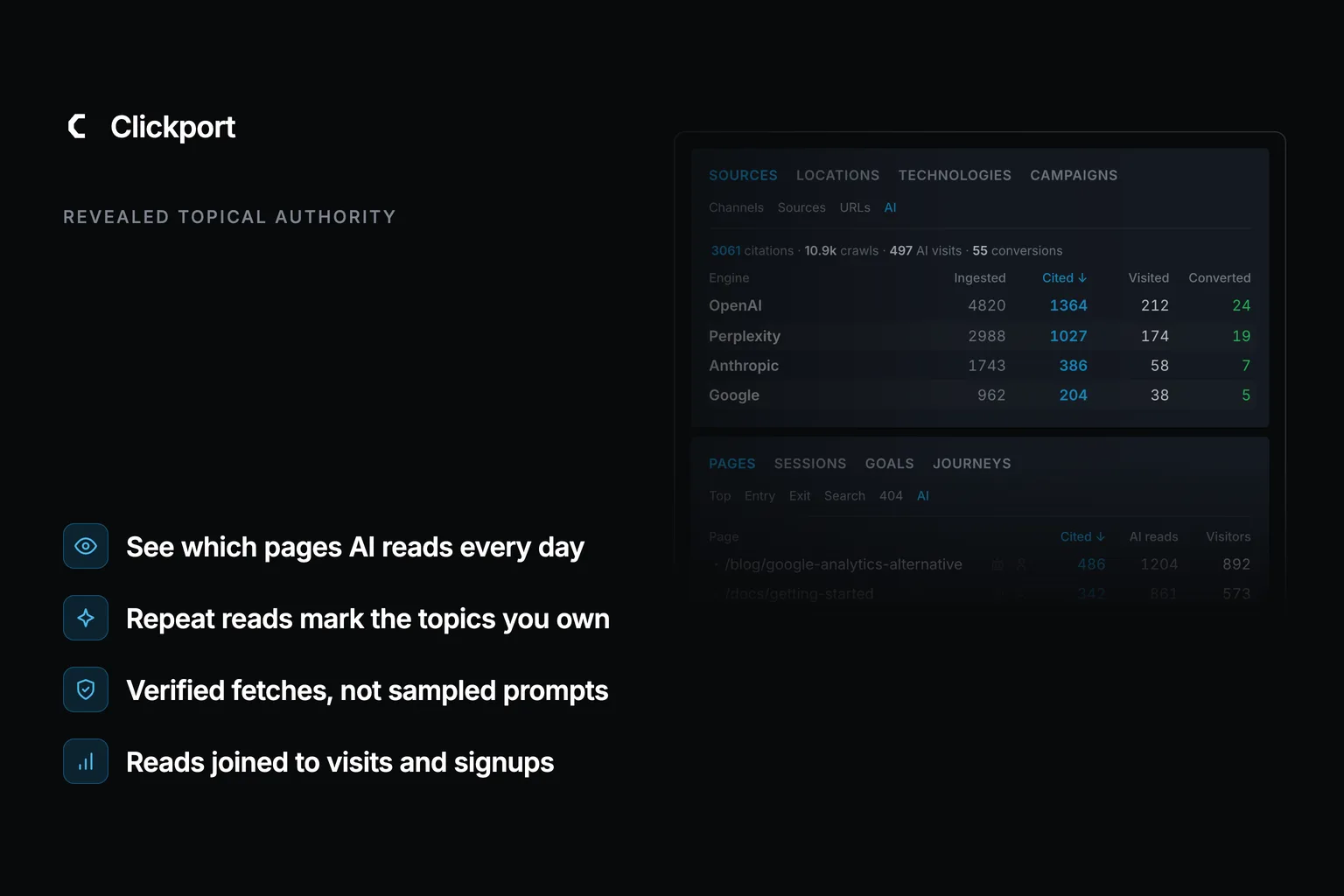
Which topics do AI assistants think you own? Your server logs already answer that question. Every time ChatGPT, Claude, or Perplexity pulls one of your pages to answer a real person, it leaves a log line behind. Add those lines up and a map appears: a few topics the machines come back to every day, and a long tail they touched once and abandoned.
Kevin Indig just published a study of ChatGPT answers across 1,094 categories that found brands get cited as sources almost anywhere, but only get recommended by name in topics close to their core expertise. His data comes from sampling answers. Ours comes from the other side: what the assistants actually read. The two agree, and his newer data on AI favoring products over publishers matches our landing-page numbers too.
Quick disclosure: I run Clickport, and our AI panel shows this reading data per page. But the method below works with plain server logs too. You don't need us to check your own map.
- The top 10% of pages get 59% of all live AI reads.
- 27% of pages get read once and never fetched again.
- AI cites almost anyone but recommends brands only in their deepest topics.
- Repeat reads reveal your authority anchors. Your server sees them for free.
- Homepages barely matter to AI: 2.5% of live fetches on our site.
AI reads with strong preferences
Across the sites we measure with meaningful AI traffic, we counted every verified live-retrieval fetch over the last 60 days. Not training crawls, not index building. Only the fetches that fire mid-conversation because a real person asked a question.
The reading is heavily concentrated. On every site, the top 10% of pages carried more than half of all AI reads:
Put another way: the machines have already decided which tenth of your site matters. The rest of your pages split what's left, and a big chunk of them get one courtesy read and no second visit. On our own site, 39 of the 144 pages AI read in those 60 days were fetched exactly once. That's 27% of the read pages, one and done.
Your authority anchors are visible in raw reads
Here's our own map. These are the pages AI assistants fetched most on clickport.io, with the number of separate days each was read:
Two clusters jump out: EU privacy analytics and GA4 mechanics. Those are exactly the two topics we've covered deepest, article after article, for over a year. The assistants noticed. They come back to those pages almost every day, because when someone asks about French analytics law or GA4 scroll tracking, our pages are what they trust enough to re-read.
And look at the homepage. 133 reads out of 5,361. The machines don't care about your front door. They care about the specific page that answers the specific question.
Reads, citations, mentions, visits: what can you actually measure?
There's a ladder here, and each rung is measured differently:
- Reads. An assistant fetches your page mid-conversation. Your server sees every one, exactly. Three kinds of AI bots exist; only live retrieval counts here.
- Citations. Your page appears as a source in the answer. Reads are the closest countable thing to these.
- Mentions. The answer names your brand as the recommendation. Nobody can observe these directly. Tools estimate them by asking thousands of sampled prompts.
- Visits. The person clicks through. Your analytics sees these. Expect about a hundred reads per visit.
Indig's sampled data shows how rungs two and three split: in categories far from a brand's expertise, half of appearances are citations and only a quarter are mentions. Close to core expertise, mentions nearly double. And ownership is rare and sticky: only 15.2% of categories have a clear owner, and owners keep their lead in 90.4% of month-to-month checks. Depth wins recommendations, and most categories are still unclaimed.
You can't see mentions. But rung one is free, exact, and updates daily.
How to find your own anchors
- Pull 30 to 60 days of live-retrieval fetches per page. In Clickport that's the AI tab; in raw logs, count hits from ChatGPT-User, Claude-User, and Perplexity-User.
- Group pages by topic. Ignore totals for a moment and look at days-read: a page fetched on 30 separate days is an anchor. A page fetched once is not.
- Deepen the anchor topics first. That's where the reading demand already is, and per Indig's data, depth is what turns citations into recommendations.
- When you expand into a new topic, watch for repeat reads in the first weeks. It's the earliest success signal that exists, months before rankings move.
A short note on method: 60 days to August 4, 2026, live-retrieval fetches only, verified against the AI companies' published IP ranges, across the four measured sites with at least 200 fetches. The counting approach is documented in the citation gap study.
The machines are already telling you which topics you own. They tell you every day, in your own logs. Most sites just never look.
If you'd rather not grep for it, Clickport shows the reading map per page, next to the visits and signups those reads eventually send.

Comments
Loading comments...
Leave a comment