AI Citations vs. Mentions: What Google and Bing Count
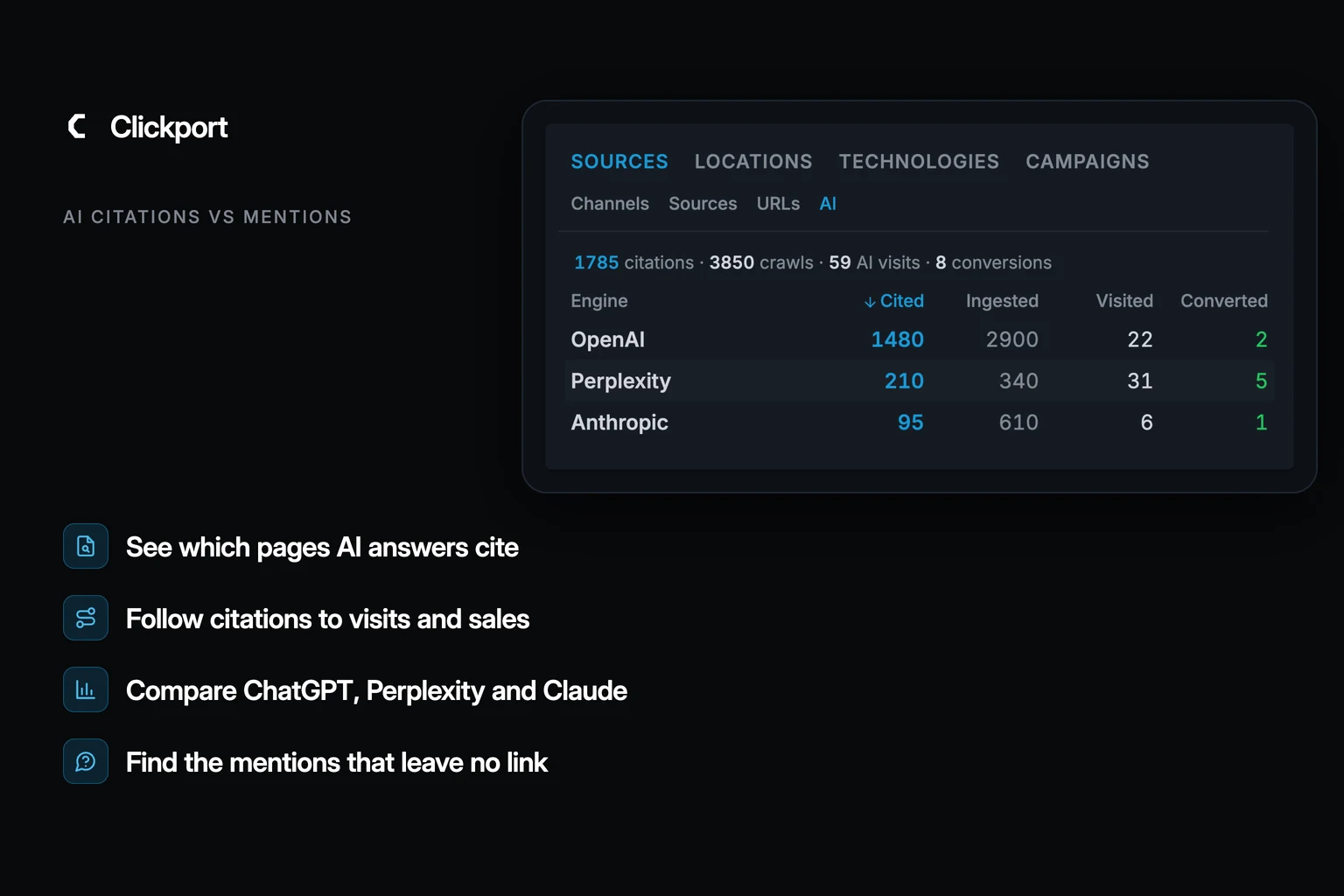
Ask ChatGPT for a good family lawyer in your town and it may name a firm without linking to it. Ask Google whether you need travel insurance for a Schengen visa and the AI Overview answers with a small link to the page it took the answer from. The first is a mention, the second a citation, and only the citation can send someone to your site.
Google and Bing both started reporting citations this year. Search Console now shows how often AI Overviews and AI Mode showed links to your pages, and Bing shows how often Copilot used them as a source. What neither tells you is whether anyone clicked, or whether all that exposure brought a single customer.
I'll walk through what each report counts and how four example businesses would read them next to their visits and sales. The businesses are made up; the dashboard panels are real Clickport reports with the example numbers filled in.
- A mention names your brand in an AI answer; a citation links your page.
- Search Console's AI report counts link impressions in AI Overviews and AI Mode, not clicks.
- Bing's AI Performance counts a sample of citations and retrieval phrases, also without clicks.
- No Google or Bing report counts mentions; brand searches and survey answers show them.
- Put each report next to visits and goals for the same pages.
What's the difference between an AI mention and an AI citation?
In short, a mention is a name and a citation is a source. A citation can bring a click; a mention without a link can only bring a later search for your name. Google's and Bing's reports count citations, so they show your reach in AI answers, not what that reach brought.
Here is what each report counts, as checked in October 2026:
| Report | What it counts | Clicks |
|---|---|---|
| Search Console AI report | Link impressions in AI Overviews and AI Mode, combined | No |
| Bing AI Performance | A sample of citations in Copilot, Bing's AI summaries and some partners | No |
| Clickport, Sources → AI | Pages that ChatGPT, Perplexity, Claude and other AIs fetch for answers, then visits and conversions | Visits, yes |
| AI visibility tools | Mentions and citations in answers to prompts you choose | No |
Three things in that table change how you read the numbers.
Google's AI impressions are already in your Web numbers. The report "includes data from the Web search type", and a click on a link in an AI Overview counts as a normal Web click in the Performance report. Don't add the two reports. In your analytics, that click arrives as an ordinary Google visit. Google sends nothing that marks it, so no tool can split it out reliably today. In the UK, the competition authority has required Google to report clicks from its AI features and to mark those visits for publishers' own analytics, by 3 December 2026.
Bing says it plainly. Its help page asks "Do citations represent clicks or traffic?" and answers "No." The citation count is a sample, and the retrieval phrases ("grounding queries") are "not full user questions or prompts". They're the phrases the AI used to look for content.
Nobody counts mentions for you. Google counts "links to your site", and Bing counts content "shown as a source". A brand named without a link appears in neither. Prompt-tracking tools sample mentions in answers to prompts you choose, which is why I call their scores vanity metrics. The traces a mention leaves in your own data are searches for your name and what customers tell you when you ask. SEO reporting when traffic is down and How did you hear about us? cover both.
ChatGPT and Claude give site owners no citation report, and Perplexity offers one only to its publisher partners. That's the gap Clickport's AI Agents connector fills: it records the pages an AI fetches while answering a real person, labels them Cited, and follows it to visits and conversions in the same view.
Quillon Travel Cover: Google shows the guide, but who asks for a quote?
Quillon compares travel insurance. Its guide "Do you need travel insurance for Schengen?" leads Search Console's AI report: 48,000 impressions in September, more than any other page on the site.
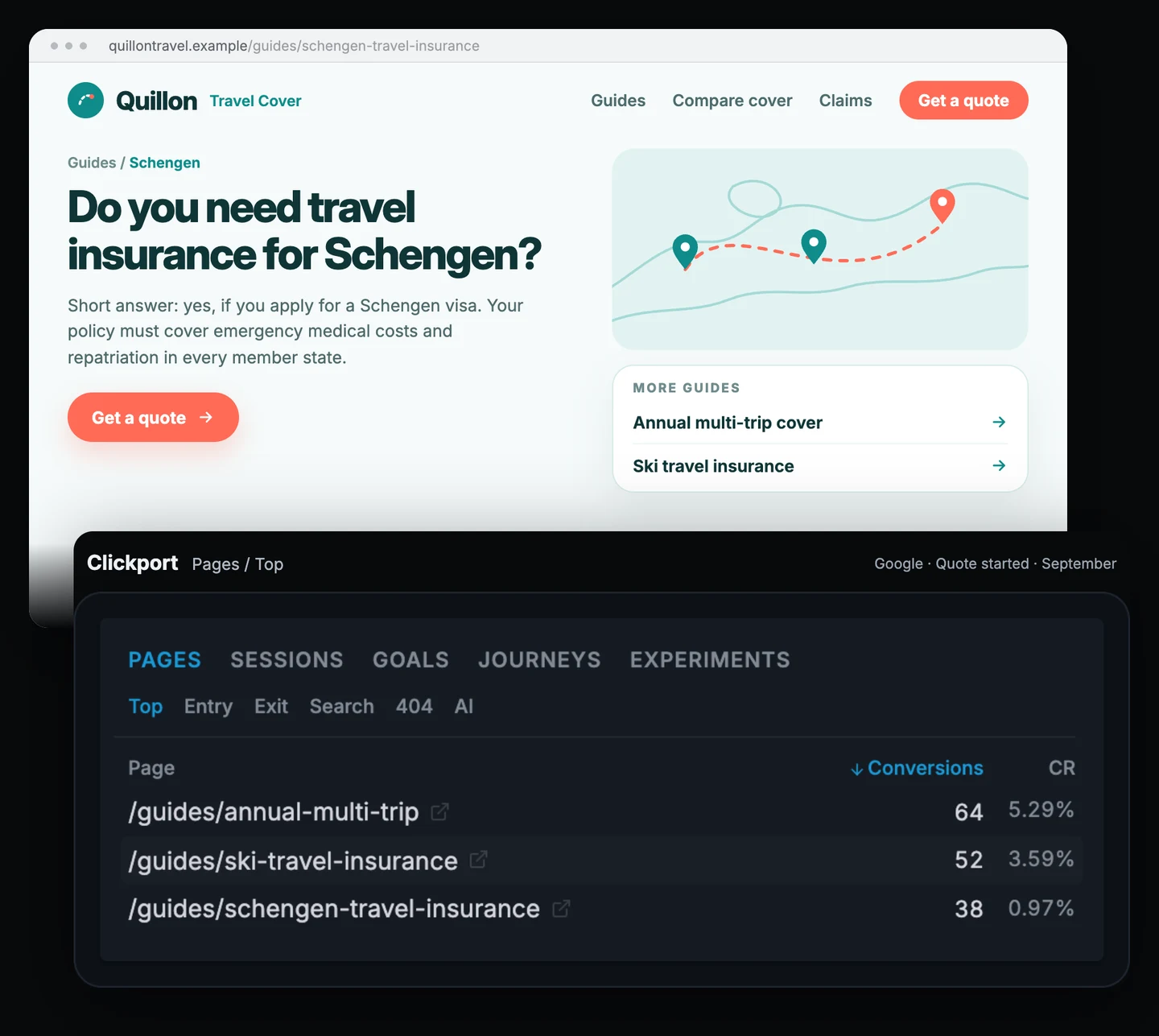
| Guide | Google visitors | Quotes started | Rate |
|---|---|---|---|
| Annual multi-trip | 1,210 | 64 | 5.29% |
| Ski travel insurance | 1,450 | 52 | 3.59% |
| Schengen travel insurance | 3,900 | 38 | 0.97% |
Quillon's guides in September, as in the figure.
The Schengen guide brought 3,900 Google visitors, about one for every twelve AI impressions, and 38 of them started a quote. The annual multi-trip guide brought a third of the visitors and 64 quotes.
I'd read that as a guide that answers the question too well. The AI Overview already tells people whether they need cover, and the ones who click want a detail, not a policy. Quillon could put a short price example and a quote button next to the answer, where the reader stops. The AI report shows the reach. The quote rate shows whether that reach turns into business.
Keep the comparison page by page and month by month. Google doesn't say which of those 3,900 visits came from an AI Overview, so the guide's visits mix both kinds of click.
Kessmoor Pumps: what Copilot reads, and who asks for a price
Kessmoor makes industrial pumps. Bing's AI Performance shows two of its pages as the most cited in the last 30 days: the KP-400 datasheet with 1,240 citations and a guide to pump head calculation with 860. The retrieval phrases read like an engineer's notes: "submersible pump flow rate", "pump head calculation".
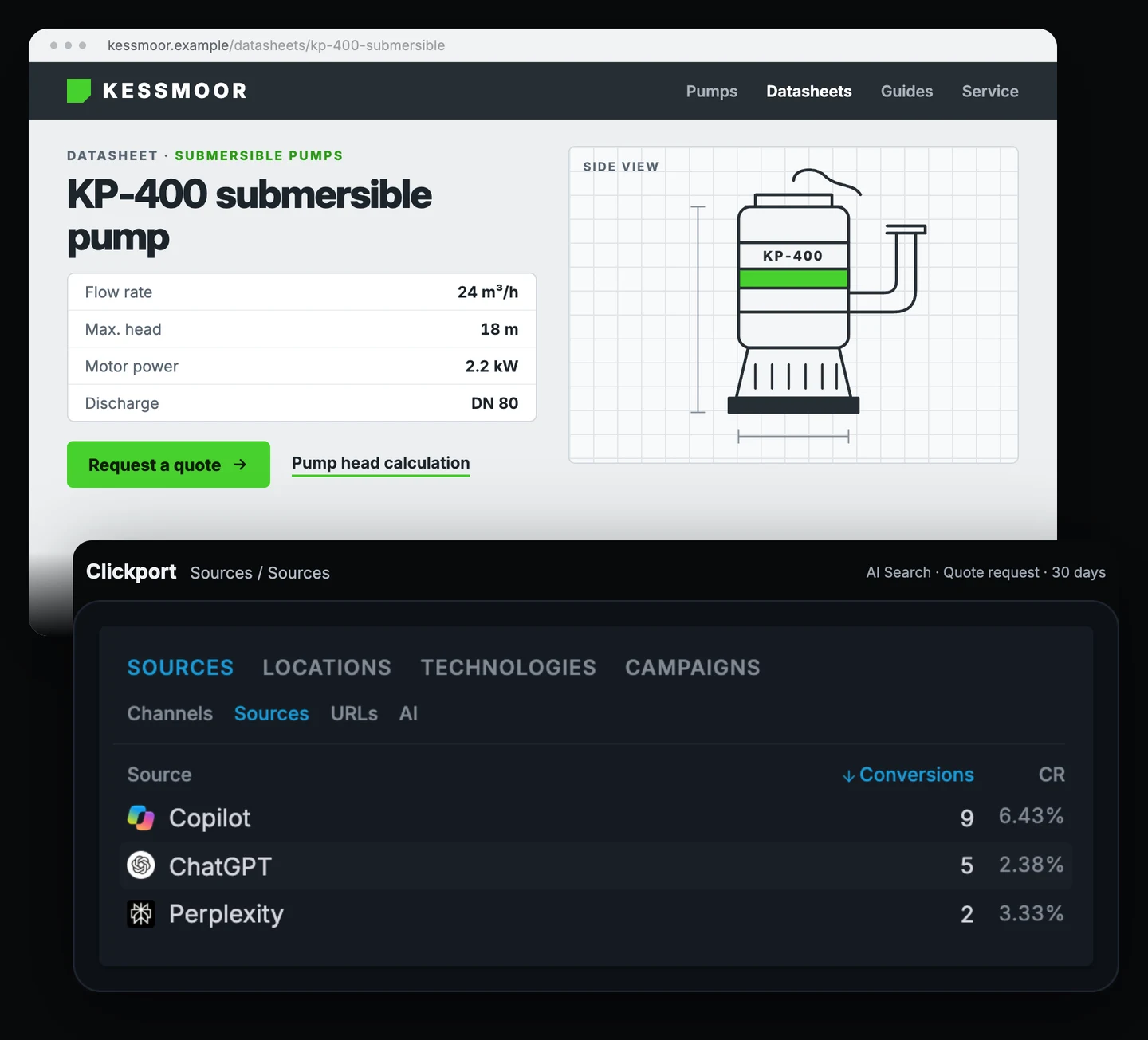
| AI source | Visitors | Quote requests | Rate |
|---|---|---|---|
| Copilot | 140 | 9 | 6.43% |
| ChatGPT | 210 | 5 | 2.38% |
| Perplexity | 60 | 2 | 3.33% |
Kessmoor's AI Search visitors over 30 days, as in the figure.
Bing counted 2,100 citations for those two pages, and Copilot sent 140 visitors in the same 30 days. Few clicks per citation is normal for AI answers: Pew Research found that people clicked a link in Google's AI summary in 1% of visits that showed one. The people who do click arrive ready: 9 of the 140 asked for a price.
The retrieval phrases tell Kessmoor what the AI looked up on its pages. I'd put the head calculation and the KP-400's flow figures right next to the request form, so an engineer who checks the AI's numbers can ask for a price on the same screen.
Bing's counts are a sample and its phrases aren't what the buyer typed. Use them to choose pages, not to count buyers.
Oatlace Skincare: ChatGPT reads a lot, Perplexity sends the buyers
Oatlace sells skincare for dry skin. It runs the AI Agents connector, so Clickport sees each time an AI fetches one of its pages while answering someone, and follows it to visits and orders.
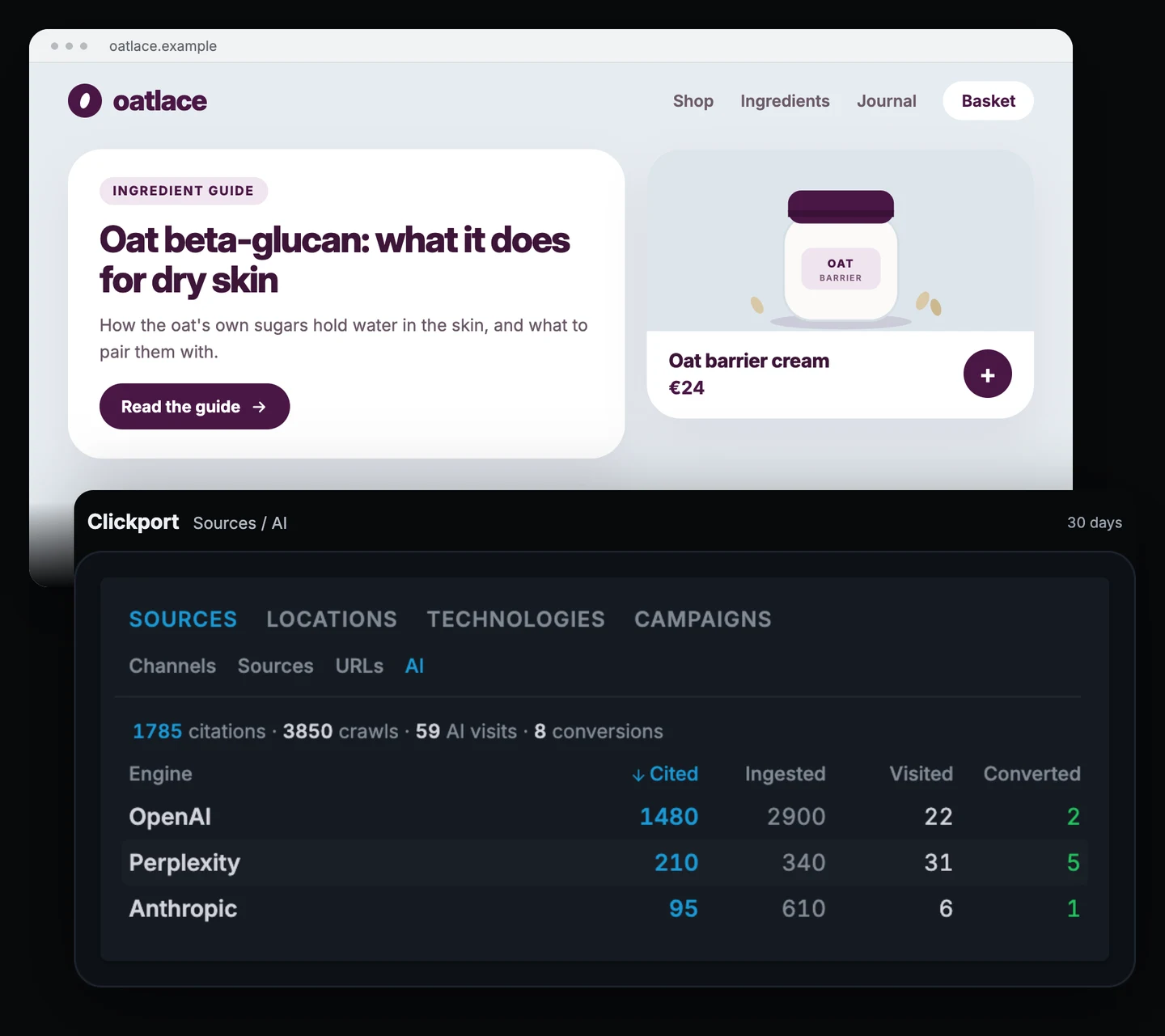
| AI | Cited | Visited | Converted |
|---|---|---|---|
| OpenAI (ChatGPT) | 1,480 | 22 | 2 |
| Perplexity | 210 | 31 | 5 |
| Anthropic (Claude) | 95 | 6 | 1 |
Oatlace's AI activity over 30 days, as in the figure. The Ingested column counts crawls for search indexes and training: 2,900 by OpenAI, 340 by Perplexity and 610 by Anthropic. The panel's top line adds it all up: 1,785 citations, 3,850 crawls, 59 AI visits and 8 conversions. Clickport groups the rows by company, so ChatGPT shows as OpenAI and Claude as Anthropic.
ChatGPT read Oatlace's pages 1,480 times for answers and brought 22 visits, about one for every 67 citations. Perplexity cited the shop far less and brought more visits: 31, and 5 of them converted. For Oatlace, the one goal is an order. Perplexity shows its sources as numbered links next to the answer. We saw the same pattern across real sites in our AI citation gap study.
In Pages → AI, Oatlace sees that most of ChatGPT's citations go to the ingredient guides, not the product pages. I'd add the key ingredient facts to each product page, so an answer that cites the shop can cite the page that sells.
One thing to keep in mind, in the words of our docs: a citation is a fetch, not a guaranteed appearance. An AI can fetch a page and use only part of it.
Penhallow Family Law: named in answers, never cited
Penhallow is a family law firm. New clients keep saying ChatGPT recommended it. Clickport's AI view shows 3 citations and 2 visits from ChatGPT in the last 90 days. The firm is mentioned and almost never cited.
Its agency added one question to the enquiry form, "How did you hear about us?", and sends the answer with the enquiry goal.
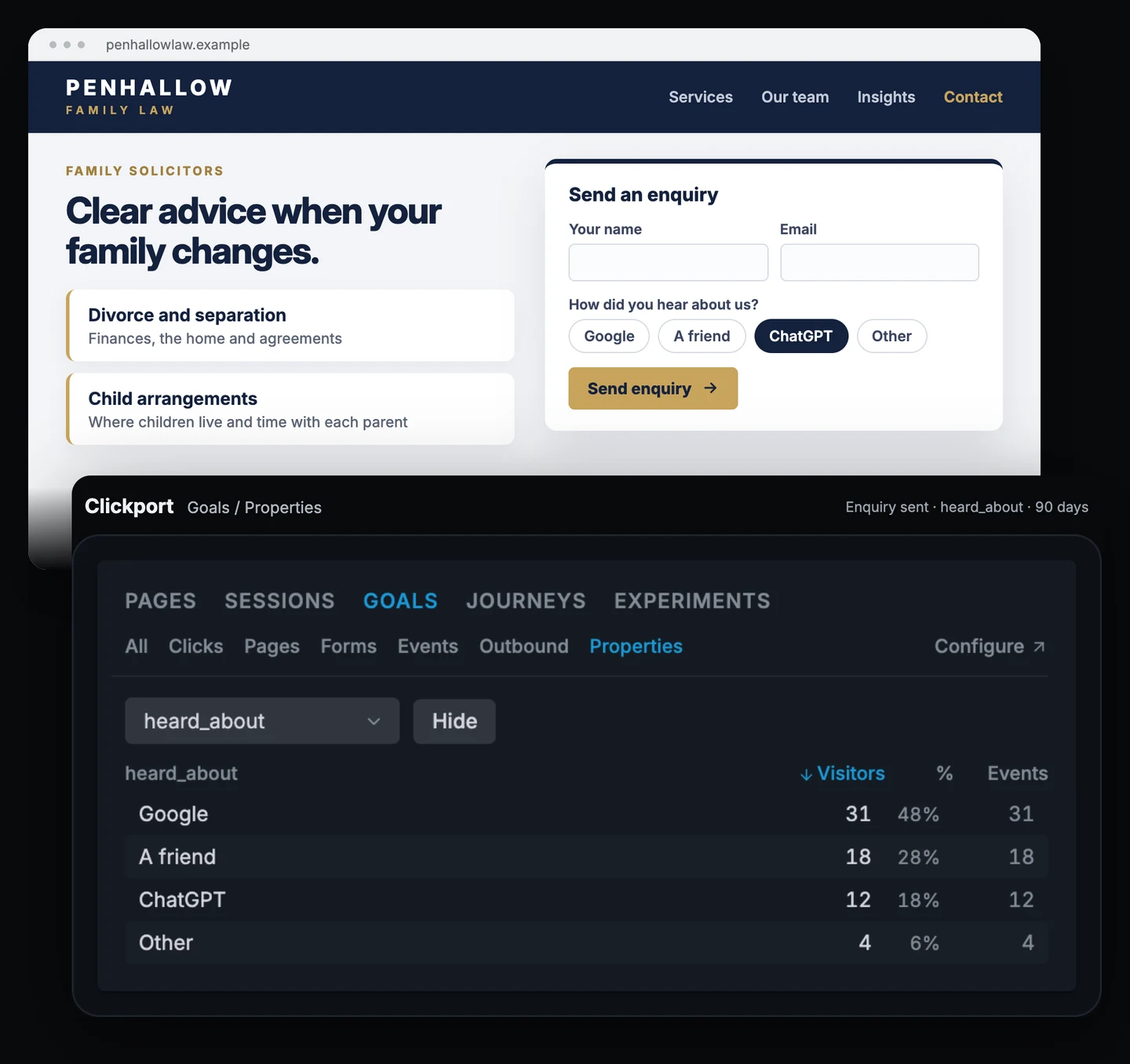
| How did you hear about us? | Visitors |
|---|---|
| 31 | |
| A friend | 18 |
| ChatGPT | 12 |
| Other | 4 |
Visitors who sent an enquiry over 90 days, by their answer, as in the figure. Each sent one enquiry.
12 of the 65 people who sent an enquiry named ChatGPT, while ChatGPT sent 2 visits. The mention works without a link. People hear the name and search for it, or type the address. Those visits look like Google or Direct in any analytics tool.
For the agency's report, I'd show both: the answers as the measure of mentions, and the citation count as the reason to act. A family law firm gets mentioned because people trust a recommendation. It gets cited when a page answers the question someone asked, such as what a divorce costs. Penhallow has no fees page, so there's nothing for ChatGPT to link. I'd write that page first.
The answers are self-reported. People forget, or pick the first option. Read them as a direction, next to the brand searches in Search Console.
Start with the pages AI already cites
Work back from the report you already have:
- Take the top five pages from Search Console's AI report, Bing's AI Performance or Clickport's Cited column.
- Filter your analytics to those pages and the source that matches: Google, Copilot, ChatGPT or Perplexity.
- Pick one goal that matters for those pages: a quote, an order, an enquiry.
- Compare the pages on that goal, not on impressions or citations.
- For mentions, add the "How did you hear about us?" question and watch the brand searches.
In Clickport, the Pages and Sources panels take the same filters and goals, and the AI Agents connector adds the Cited column for the engines Google and Bing don't cover. If your current reports already put citations next to goals for the same pages, keep them.
You can try Clickport free for 30 days, no credit card required. If you're moving from GA4, the switching guide shows how to set it up. For the visits themselves, How to Track AI Search Traffic goes deeper.
Frequently asked questions
How can I view the generative AI performance report in Search Console?
Open Search Console and find the generative AI performance report under Performance. It shows how often links to your pages appeared in AI Overviews and AI Mode, by page, country, date and device. Google finished the rollout to all sites on 31 August 2026. Sites with few impressions in AI features see no report.
Does Search Console show clicks from AI Overviews?
Not separately. Clicks on links in AI Overviews and AI Mode count as ordinary Web clicks in the Performance report, and the AI report shows impressions only. In your analytics, those clicks arrive as normal Google visits.
What are grounding queries in Bing Webmaster Tools?
Grounding queries are the phrases Bing's AI used to look up content for an answer. Bing says they are "not full user questions or prompts". Use them to see which topics pull your pages into answers.
What is AI citation tracking?
AI citation tracking counts how often AI answers use your pages as a source. Google and Bing report it for their own AI features. For ChatGPT, Perplexity and Claude, you can record the pages they fetch while answering, as Clickport's AI Agents connector does, or sample answers with a prompt-tracking tool.
How do you measure performance in AI search?
Count three things for the same pages: how often AI answers cite them, how many visitors arrive from AI sources, and how many of those visitors complete a goal. The citation count shows reach. The goals show whether the reach pays.

Comments
Loading comments...
Leave a comment