Why Is My GA4 Direct Traffic So High? The Real Answer
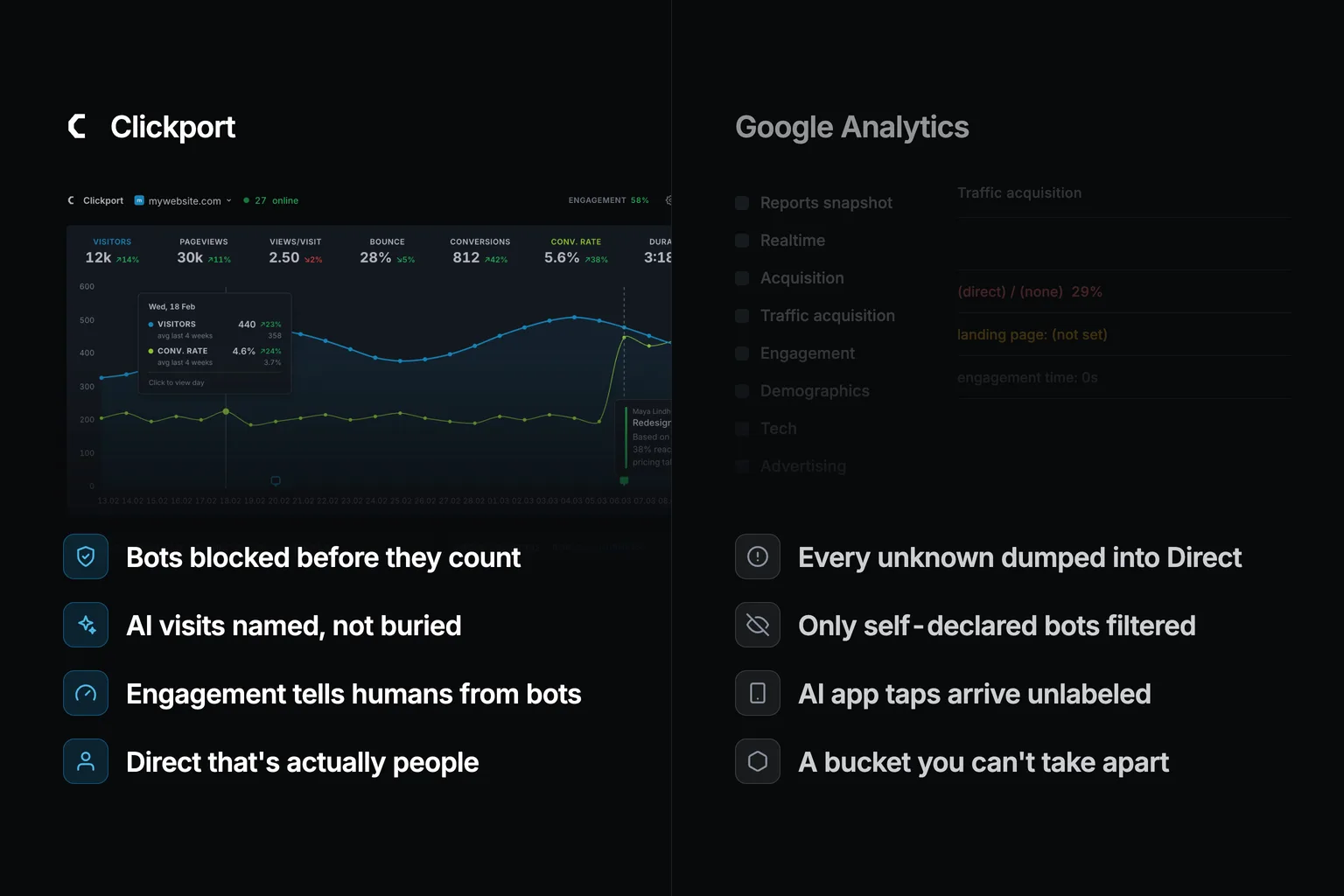
Across the sites we measure, the median site sees 29% of its sessions land in Direct. Nobody believes 29% of their visitors typed the URL, and they're right not to. Direct isn't a channel like the others: it's where GA4 puts every visit it can't explain. Here's what's inside that bucket, how much of it you can win back, and a 10-second test I use to separate real humans from junk.
- Across the sites we measure, the median site sees 29% of sessions land in Direct.
- GA4 marks a session Direct when no referrer, UTM, or stored source survives the visit.
- Direct sessions bounce 2.1x more than organic search and hold 11 vs 49 engaged seconds.
- Bots GA4 never filters land in Direct. One scraped site we measure runs 94% Direct.
- Only untagged campaigns and broken redirects are fixable. The rest of Direct is structural.
What GA4 counts as direct traffic
GA4 marks a session Direct when it has no referrer, no UTM parameters, and no stored source from an earlier visit. The channel rule is literal: source is "(direct)" and medium is "(none)" or "(not set)". It's not a measurement of people typing your URL. It's the label GA4 applies when it found no evidence at all.
That's also what separates Direct from Unassigned. Unassigned means GA4 found source data that doesn't match any channel definition. Direct means it found nothing. One is confusion. The other is absence.
A Reddit user put it better than Google's own docs: "GA4 tends to dump uncertainty into Direct instead of saying unknown." That's the honest definition. Direct is the unknown column, renamed.
How much direct traffic is normal?
Across the sites we measure, over the 30 days ending August 2, 2026, the median site saw 29% of its sessions land in Direct. The middle half of sites sat between 16% and 46%. Which means: if you're near 30%, you're normal. If you're above 50%, something specific is usually wrong, and it's usually not fame.
You'll find guides claiming 10 to 20 percent is the healthy range. I went looking for the data behind that number and found none. It's folklore, copied from article to article. Nobody measured it. Somebody just said it.
One caveat I should flag, and it makes our figures conservative: they come from cookieless tracking with bots blocked at ingestion, so most junk never becomes a session in the first place. GA4 filters far less. That means your GA4 Direct share likely runs higher than these numbers, not lower.
What's inside the Direct bucket
Five things, mostly. Only one of them is yours to fix.
The stripped-referrer share is bigger than most people expect, and it's growing. Modern browsers default to a strict referrer policy, and 28.0% of the top million sites now set an explicit Referrer-Policy header, up threefold since 2022 (Scott Helme's June 2026 crawl). In practice, the name tag gets torn off before the visitor ever reaches you. This isn't new, either. Back in 2014, Groupon deindexed its own site for six hours and watched what happened: 60% of its "direct" traffic vanished along with organic search. That means the biggest "direct" audience on record was search traffic the whole time.
The AI share is newer. GA4 added an AI Assistant channel on May 13, 2026, but it only reclassifies AI visits that arrive with a referrer. App taps don't. In April 2026 I measured 35.7% of AI-attributed sessions arriving with no referrer at all. In plain English: a third of your AI visitors look like they came from nowhere. Perplexity isn't in Google's recognized list either, so it lands in Referral. The traffic your best answers earn gets split three ways: some named, some mislabeled, some invisible in Direct.
And the bots. GA4's built-in filter excludes only bots that identify themselves, using Google's own research plus the IAB spiders list. A scraper that fakes Chrome passes. In 2025, automated traffic crossed the halfway mark: 53% of all web traffic was bots, per Imperva. Put another way: half the internet doesn't read. It fetches.
The 10-second test: humans or junk
Open Traffic acquisition, add average engagement time, and look hard at the Direct row. Real visitors read. Junk doesn't. Across the sites we measure, organic search visitors hold a median 49 seconds of engaged time. Direct holds 11. And on that scraped site from the chart above, the median Direct session engages for exactly 0 seconds.
23.5% leave within 10s
47.5% leave within 10s
84.6% leave within 10s
In plain English: nearly half of Direct sessions are gone within ten seconds. For search traffic, it's under a quarter. Real interest doesn't leave that fast.
Now the twist, and it's my favorite number in this study. The Direct sessions that do stay view more pages per visit than organic search does, 2.39 against 1.88. That means Direct isn't one crowd. It's your most loyal readers standing in the same bucket as traffic that was never human, and the average of the two tells you nothing. Split them by engagement and each half becomes legible.
The bot half has a signature I've learned to spot on sight: a sudden spike, landing page "(not set)", engagement near zero, and often a schedule. One site owner watched Direct spikes arrive every 12 hours, from Linux machines all claiming to be in the US. If your spike looks like that, no marketing happened. You got scraped.
What you can fix, and what you can't
The fixable share is the traffic you send yourself. Tag every link you place in emails, ads, QR codes, and social bios with UTM parameters. Make sure redirects and shorteners preserve query strings. Set up cross-domain tracking properly if you span domains. It's real work, but it genuinely shrinks Direct, and it's the one lever that's fully yours.
The rest is structural. No GA4 setting makes WhatsApp send a referrer. None makes the ChatGPT app announce itself. None blocks the scraper that fakes a browser, because GA4 doesn't meet the traffic until it's already happened. That's the floor, and on a typical site the floor is most of the bucket.
What you can change is the counting. Clickport blocks bots at ingestion, before they ever become sessions, and classifies AI assistant visits into their own channel instead of burying them. No cookies and no consent banner also means no consent-refusal hole for attribution to fall into. The Direct that remains is much closer to what the label promises: people who know your URL.
Direct is a question, not an answer
A high Direct number isn't telling you your brand is beloved. It's telling you how much of your traffic your analytics couldn't explain. Fix the part you control, learn the fingerprint of the part you don't, and stop reading the bucket as brand strength. The number worth watching isn't how big Direct is. It's how much of it behaves like a person.
FAQ
Is direct traffic good or bad?
Some of it's the best traffic you have: people who know your URL and come back on purpose. The rest is missing evidence, misattributed campaigns, and bots. It isn't one thing, so it isn't one verdict. The label alone can't tell you which, so judge it by behavior: engaged time and pages per visit separate the fans from the noise.
How do I reduce direct traffic in GA4?
Tag every link you control with UTM parameters, make redirects preserve query strings, and configure cross-domain tracking. That reclaims the fixable share. The structural share (dark social, AI app clicks, referrer-stripping browsers, bots) can't be reduced by any GA4 setting; it can only be measured more honestly by tools that filter and classify at collection time.
What's the difference between Direct and Unassigned in GA4?
Direct means GA4 found no source information at all: no referrer, no UTM, nothing stored. Unassigned means it found source data that doesn't match any channel definition, like a UTM medium it doesn't recognize. Absence goes to Direct, contradiction goes to Unassigned.
You can try Clickport free for 30 days and see your Direct bucket with the bots already gone and AI visits named. If it's still high after that, those are probably your fans. When you're ready, switching from Google Analytics takes one snippet.

Comments
Loading comments...
Leave a comment