Facebook Ads Bot Traffic: Why Your Conversion Rate Is a Lie
652 link clicks. 47 real sessions. Zero sales. That Reddit post got 125+ upvotes in hours, because hundreds of advertisers recognized the exact same pattern. Meta reported the clicks. The advertiser's analytics counted who showed up. The gap between those two numbers is where your ad budget disappears.
Quick disclosure before the numbers: I build Clickport, an analytics tool with bot detection, so I profit when you stop trusting platform-reported clicks. Every claim below is sourced, so you can check me instead.
- Juniper Research estimates $84 billion was lost to ad fraud in 2023, projected to reach $172 billion by 2028. Meta's own terms say they're 'not responsible for click fraud.'
- Meta's Andromeda algorithm rollout and the removal of targeting exclusions in mid-2024 shifted ad delivery toward broader audiences. Advertisers report a sharp bot traffic spike since September 2024.
- Every click fraud detection tool on Meta works post-click only. Meta doesn't support IP blocking. The first fake click always costs you money.
- The gap between Meta-reported clicks and real analytics sessions reveals your true invalid traffic rate. If Meta says 500 clicks and your analytics shows 200 sessions, 60% of your budget went to non-human visitors.
- Independent analytics with engagement tracking (scroll depth, interaction events, behavior scoring) catches bot patterns that Meta's reporting hides and GA4's known-bot list misses entirely.
The scale of the problem
Ad fraud isn't a rounding error. Juniper Research analyzed 78,700 data points across 45 countries and found that $84 billion was lost to ad fraud in 2023, roughly 22% of all online ad spend. In plain English: more than a fifth of every ad dollar, gone. By 2028, they project $172 billion.
Meta sits at the center of it, and I don't say that lightly. A Reuters investigation published in November 2025, based on internal Meta documents spanning 2021 to 2025, revealed that Meta projected approximately 10.1% of its 2024 revenue, roughly $16 billion, came from ads tied to scams, illegal gambling, and banned products. Internal documents showed Meta served an estimated 15 billion "higher risk" scam ads per day. In other words, that isn't a leak in the system. That's the system.
The third-party numbers I trust say the same. Lunio's 2026 Invalid Traffic Report, analyzing 2.7 billion clicks between August 2024 and July 2025, found an overall invalid traffic rate of 8.51% across paid channels. Meta specifically: 8.2%. That means roughly one paid click in twelve never had a person behind it.
That's the global picture. The numbers I care about are yours. If Meta reports 500 clicks on your campaign and your analytics shows 200 real sessions, 60% of your budget reached non-human visitors. Your reported conversion rate is built on 500 clicks. Your real one is built on 200 sessions. Which means every decision you make off the inflated number pushes more budget toward bots, and the inflated number gets worse.
Meta isn't hiding its position on this. Their Self-Serve Ad Terms state: "We cannot control how clicks are generated on your ads... we are not responsible for click fraud, technological issues, or other potentially invalid click activity that may affect the cost of running ads."
You agreed to that when you created your ad account. Most people never read it.
Where fake clicks come from
Fake clicks aren't one thing. I'll take them one at a time: three separate operations, each with its own economics and its own way of hiding.
Click farms hire low-paid workers in Bangladesh, the Philippines, India, Vietnam, and Indonesia. The workers sit in rooms with racks of 50 to 3,000 real smartphones. Each phone runs several accounts with rotating SIM cards. They tap through ads by hand for $1 to $3 a day. The traffic comes from real humans on real devices with real IP addresses, so it's the hardest kind to catch by machine. In practice, the sessions last 3 to 15 seconds, the engagement is thin, and nobody ever buys.
Bot networks use automated browsers or malware-infected devices. Basic bots run headless Chrome on cloud servers. The smarter ones use residential proxy networks (Bright Data, Oxylabs) that send traffic through real consumer ISP addresses, which makes detection by geography or IP close to impossible. The best bots of 2025 scroll like a person, sit on a page for 20 to 60 seconds, and some even drop items into a cart before walking away. They never buy anything. But they teach Meta's algorithm to think "users are interested, keep finding more like them."
Audience Network publisher fraud is the third one. Meta's Audience Network puts your ads inside other people's mobile apps. Those app developers get paid per click. Some apps exist for no reason other than to manufacture clicks. Power Digital Marketing ran a controlled $5 test that targeted only Audience Network placements. The result: 100% bounce rate, 100% exit rate, 0:00:00 time on site. Their session recordings on LuckyOrange showed no mouse movement at all. "Visitor is idle for 1 second. Visitor has left the site." Every single session.
Jon Loomer ran a split test with three identical ad sets that differed in one thing only: the event he optimized for. Link clicks, landing page views, or a custom "quality visitor" event, defined as 2+ minutes on the page and 70%+ scroll depth. Optimize for link clicks and 99% of the traffic came from Audience Network. Optimize for the quality visitor and 0% came from Audience Network. The cost per quality visitor fell from over $50 to around $1.
In plain English: the algorithm isn't broken. It's doing exactly what you told it to do. Ask it for clicks and it finds the cheapest clicks. The cheapest clicks come from bots and Audience Network apps.
What happened in September 2024
I kept seeing advertisers land on the same date without talking to each other. Campaigns that had run a steady 2%+ conversion rate fell to near zero. Click-through rates climbed while sales sank. No new landing pages, no new offers, no new targeting. Same campaign, different planet.
So what changed? Not one thing. Several Meta changes piled up at once.
On July 29, 2024, Meta removed the ability to use detailed targeting exclusions. You could no longer tell it to keep your ads away from low-quality segments. Meta pointed to its own testing, which showed a 22.6% lower median cost per conversion without exclusions. In practice, what advertisers lost was their main line of defense against the audiences that bots had always lived in.
Through Q2 and Q3 2024, Meta rolled out Andromeda, a completely new ad retrieval and ranking engine. Andromeda swapped audience-based targeting for creative-based targeting. Meta's AI now picks who sees your ad from the creative, not from the audience you defined. So your ads went to far bigger pools than before, tuned for engagement signals instead of real sales.
Through 2024, Advantage+ became the default for new campaigns. Advantage+ placements switch Audience Network on unless you turn it off by hand. Then in October 2025 Meta added a setting, on by default, that spends up to 5% of your budget on placements you explicitly excluded. In plain English: you turned off Audience Network, you never saw the toggle, and Meta spent 5% of your money there anyway.
September 2024 is when, as far as I can tell, all of it tipped over at once. Enough accounts had moved to Andromeda, the exclusions were gone, and the algorithm was chasing engagement signals instead of conversions. The bots had been learning the new system the whole time. By September they were good enough to fool it on command.
What bot traffic looks like in your analytics
Here's what I look for. Once you know it, a bot session is hard to miss. The trouble is that most analytics tools either bury the evidence or never gather it. The broader question of whether your traffic is real or bots hangs over every channel. Paid ads are where the wrong answer costs you the most.
The first signal is the click-to-session gap. Meta Ads Manager says 500 link clicks. Your analytics says 200 sessions. A healthy gap is 10 to 20%, because some clicks do bounce before the page loads. A gap over 40% is a red flag. Past 60%, that means most of your ad money reached something that isn't a person.
The sessions that do land have a tell. Engagement time of zero seconds. Scroll depth of zero. No mouse movement, no key presses, no clicks on anything. One pageview, then gone. In the session recording the cursor never moves. The visitor sits idle for one second and leaves.
Scroll depth: 68%
Pages viewed: 3
Had interaction: Yes
Behavior score: 72/100
Converted: Added to cart
Scroll depth: 0%
Pages viewed: 1
Had interaction: No
Behavior score: 0/100
Converted: No
The clever bots take more work to find. They scroll, they sit on the page for 20 to 60 seconds, some poke at product pages. But they leave a fingerprint anyway: session durations that cluster at exact intervals instead of varying the way people do, zero return visits, and no conversions down the line. Real people are messy. Bots are tidy.
Geography helps too. If you target the US and a wave of sessions shows up from countries you never targeted, those are usually proxy exit nodes or click farm towns leaking through. You see the same shape in a sudden spike of direct traffic that turns out to be bots: one country, a flat 24-hour spread, almost no engagement.
GA4 won't show you most of this. It doesn't report scroll depth per session. It doesn't track mouse or keyboard activity. It doesn't give you a behavior score. And it filters bots using a known-bot list, the IAB/ABC list plus Google's own research. If a bot doesn't announce itself as a known crawler, GA4 logs it as a person. In our controlled test, GA4 caught zero out of 1,000 bot sessions. That includes bots wearing obvious bot user-agent strings.
Why Meta doesn't fix this
Follow the money and the whole thing makes sense.
Meta charges you for every click. Real or fake, a click is revenue. The Reuters investigation found that Meta's own anti-fraud managers were told they could not take any action that cost more than 0.15% of total revenue, about $135 million. The fraud-adjacent ads those managers wanted to stop brought in $16 billion. In other words: the cure was capped at $135 million, and the disease was worth $16 billion.
Meta's systems only ban an advertiser when the internal models hit 95% certainty of fraud. Below that line, Meta doesn't remove the suspected fraudster. It charges them a higher ad rate instead. In plain English: the penalty is Meta's profit.
Marketing professor Mark Ritson wrote in The Drum: "Meta isn't just too big to fail. It's too big to fault."
Now look at Google Ads. It gives you automatic invalid click credits you can see in your billing, a dedicated Click Quality Form to open an investigation, a team of PhDs and data scientists on click quality, and a plain "Invalid Clicks" number in your dashboard. Google's version isn't perfect. But it's a system, which is more than I can say for Meta's.
Meta has no invalid click number in Ads Manager. No automatic credits. No investigation form. No click quality team you can reach. And their Sequential Invoicing Terms come with a 60-day clock: "You waive all claims against Facebook related to charges... unless claimed within 60 days after the charge." Miss the window and the money is theirs to keep.
| Fraud protection feature | Meta | Google Ads |
|---|---|---|
| Invalid click metric in dashboard | No | Yes |
| Automatic billing credits | No | Yes |
| Formal investigation form | No | Yes |
| IP-level blocking | No | Yes |
| Refund for invalid clicks | Rare, ad credits only | Automatic |
| Liability per ToS | "Not responsible" | Partial |
Rob Leathern ran Meta's business integrity operations until 2019. He read the Reuters findings and told Fortune: "If people don't trust advertisers, advertising, it reduces the effectiveness of that channel for all advertisers. There's a lot of risk to their business, directly and indirectly, from not doing a good enough job on stopping scams."
A $7 billion class action lawsuit, DZ Reserve v. Meta, says Meta puffed up its "Potential Reach" number by as much as 400% by counting fake and duplicate accounts as real people. The US Supreme Court declined Meta's appeal in January 2025. The case is still going.
The $1 billion industry that can't solve it
The problem got so big that a whole industry grew up to fight it. More than 30 click fraud detection companies have raised over $300 million in venture money. CHEQ on its own is worth $1 billion after a $150 million Series C led by Tiger Global. It has bought three companies along the way: ClickCease in 2020, Ensighten in 2022, and Deduce in 2025.
The enterprise end is bigger still. DoubleVerify (NYSE: DV) booked $657 million in 2024 revenue. IAS (NASDAQ: IAS) booked $530 million. Two public companies, $1.19 billion a year, all of it from fighting ad fraud.
And the fraud keeps growing anyway. $84 billion lost in 2023. $172 billion coming by 2028. Put another way: an industry that big, against a problem that big, and it catches less than 1% of it.
On Meta the tools all hit the same wall: Meta doesn't let you block by IP. On Google Ads, a fraud tool drops a bad IP onto an exclusion list and that IP never sees your ads again. Real-time, before the impression is ever served.
Meta has no equal to that. Here's all a click fraud tool can do on Meta:
- A user clicks your ad. You pay for the click.
- The user lands on your site. The fraud tool's JavaScript reads the visit.
- If it looks fraudulent, the user's Meta Audience ID goes onto a Custom Audience exclusion list.
- That list gets applied to your ad sets so the user, in theory, won't see your ads again.
The first fake click always costs you money. The exclusion lists are batched, not real-time. They're a guess, not a certainty. And any bot that rotates its identity walks straight past them. A click farm running hundreds of devices, each with its own profile, is more or less untouchable.
These tools aren't useless, and I won't pretend they are. Knowing your fraud rate beats not knowing it. But "protect your ad spend" is a strange promise when the platform gives them nothing to protect with. Blocking isn't the thing that matters here. Measuring is, and measuring is the part I can help with. Know your real numbers and you can make a real decision.
How your analytics should catch this
The question was never "can you stop bots from clicking your ads?" Nobody can. The real question is whether your analytics will tell you which clicks were real.
I built Clickport to run 11 detection checks across 7 layers on every event that comes in, before any of it touches the database. Four of those checks speak straight to Meta ad fraud.
Datacenter IP detection catches bots running out of cloud hosting. Every visitor's IP gets checked against 3,434 known datacenter ranges, plus hardcoded ranges for the big cloud providers. That covers Audience Network bots running on server infrastructure. It doesn't cover residential proxy traffic, which I flag as an acknowledged limitation.
JavaScript environment checks catch headless browsers. Four signals do the work: navigator.webdriver (Selenium, Playwright, Puppeteer), the languages count (a real browser always reports at least one), the WebGL renderer (a software renderer like SwiftShader is a headless Chrome giveaway), and execution timing (zero milliseconds from script start to first event means a machine, not a person).
Fingerprint velocity catches botnets. When 100+ events show up inside a 10-minute window from the same browser version, operating system, country, and screen size, every later event from that fingerprint gets blocked. That's how you catch a coordinated campaign, because the bots in it all wear the same outfit.
Behavioral scoring uses Welford's online variance algorithm to score every session from 0 to 100 on mouse velocity variance, scroll velocity variance, and how the timing falls into buckets. The research backs this up. The BeCAPTCHA-Mouse study in Pattern Recognition (2022) hit 93% bot detection accuracy from a single mouse trajectory, reading the same neuromotor signals.
| Detection method | Audience Network bots | Click farms | Residential proxy bots |
|---|---|---|---|
| Datacenter IP blocklist | Catches many | Misses | Misses |
| JS environment checks | Catches basic | Misses | Catches some |
| Fingerprint velocity | Catches coordinated | Misses | Catches uniform |
| Behavioral scoring | Strong signal | Weak signal | Strong signal |
| Engagement metrics (scroll, time, interaction) | Reveals all | Reveals most | Reveals most |
The last row is the one I count on. Even when the automated checks miss a bot or a click farm worker, the engagement numbers give it away. Zero scroll depth, zero interaction, zero return visits, zero conversions. Filter your Sources panel by Facebook or Instagram, open the Sessions panel, and you'll see at a glance which sessions were real people and which were ghosts. That's the check I'd run first.
No other analytics tool in the privacy-focused space has written about this problem. I went looking. The topic belongs entirely to the click fraud vendors charging $69 to $20,000 a month. An analytics tool that just shows you the truth is a different kind of fix, and it costs a sliver of what those tools do.
The real conversion rate behind your Meta Ads
Here's the math I want you to run on your own campaigns.
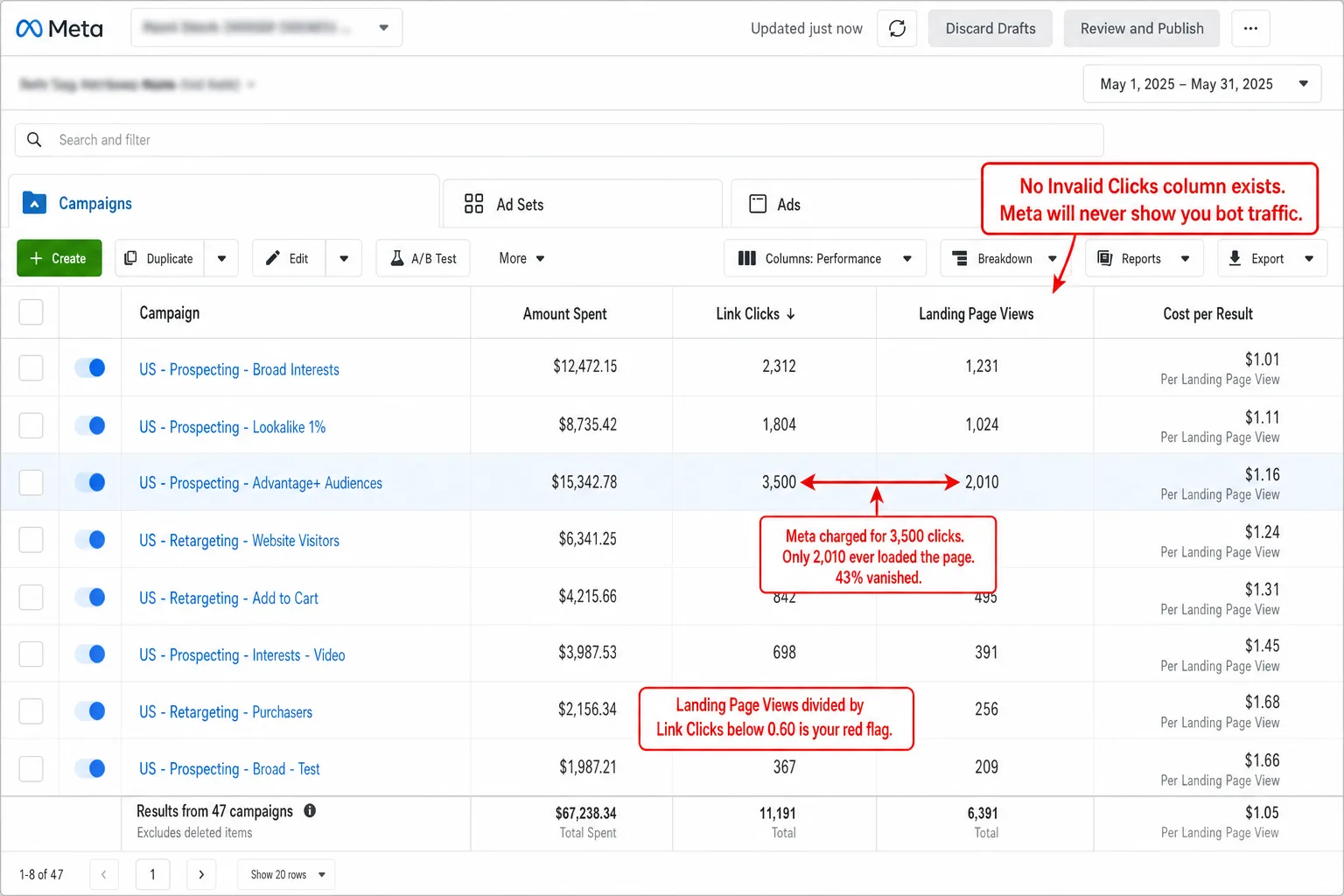
Meta works out your conversion rate as conversions divided by clicks. Say 3,500 clicks and 50 conversions. Meta shows you 1.43%. Your CPA reads $100 on a $5,000 spend. Looks fine.
But your analytics counted only 2,000 real sessions. The other 1,500 "clicks" never turned into a real page load with a real person behind it. So your true conversion rate is 50 from 2,000, which is 2.5%, not 1.43%. Your CPA is still $100, because you did pay for all of it. What is new is that you now know 43% of your budget reached nobody. In practice, cut that waste and the CPA falls to $57.
That distortion bleeds into every call you make. You pause a campaign because Meta says 0.8%, when the rate among real humans is 2.1%. You pour more budget into a campaign that looks cheap and efficient, when all the algorithm found was a pocket of cheap bot clicks. You aren't optimizing. You're following bots around.
If you run Meta Ads without an independent analytics tool showing you real session counts and real engagement, you're optimizing blind. See what your real numbers look like.
A practical defense playbook
You can't stop Meta from charging you for fake clicks. But you can cut the damage, and here's the playbook I'd run.
1. Exclude Audience Network from every campaign. Open ad set settings, pick manual placements, and uncheck Audience Network. Then hunt down the "limited spending on excluded placements" toggle and turn it off too. That one move drops the highest-fraud placement you have. Jon Loomer's tests found 0% quality visitors from Audience Network. While you're there, think about excluding In-Stream Video and Instant Articles too.
2. Optimize for conversions, not clicks. Never run Traffic or Engagement objectives for acquisition. Link clicks cost $0.05 to $0.10 for a reason. In plain English: that's the bot price. Optimize for the deepest funnel event you have data on. Purchase is safest, because bots don't carry credit cards. Then Add to Cart, then Landing Page View. A Landing Page View at least needs the page and the pixel to fire, which already strips out some of the bots.
3. Use independent analytics. Line up Meta's reported clicks against your analytics sessions every week. A healthy gap is 10 to 20%. Over 40%, go digging. The Sources panel in Clickport lets you filter to Facebook or Instagram and read the engagement for just that slice. If your Meta sessions show zero scroll, zero interaction, and zero conversions while your organic traffic converts as usual, you have a bot problem.
4. Watch your diagnostic ratios. In Meta Ads Manager, add the Landing Page Views column. Divide Landing Page Views by Link Clicks. Under 0.60 is a red flag. Then check Unique Link Clicks against Link Clicks. Under 0.70? That means the same handful of entities is clicking over and over.
5. Validate conversions server-side. If you run Meta's Conversions API (CAPI), put a gate in front of your conversion events. Only fire Lead or Purchase after the visitor has spent 5+ seconds on the page, scrolled past 25%, or touched a form. That teaches Meta's algorithm to chase real humans, not bots that fire an event the second the page loads. (For the wider question of what server-side tracking actually fixes versus what it can't touch, our 27-store audit walks the architecture honestly.)
6. Put honeypot fields on lead forms. Add a hidden field that only a bot would fill in. Any submission that fills it's a bot. No false positives, nothing to pay. And never run Meta's native Lead Forms for B2B. They pre-fill from profile data and submit on a single tap, which makes them a gift to bots and click farms.
7. Set up goals for real engagement. Track scroll depth milestones at 50% and 75%, time-on-page thresholds at 30 and 60 seconds, and form interactions. Those goals give you a baseline of genuine engagement to hold up against Meta's puffed-up click count. If Meta says 1,000 visitors and only 200 of them hit any engagement goal, you don't need me to finish the sentence.
Start with clean data
Every number I've shown you lands on the same spot: you can't run ad spend off platform-reported metrics. Meta reports clicks. Your analytics should report what really happened.
Clickport tracks scroll depth, engagement time, and interaction events on every session. It runs 11 detection checks to filter bots before they reach your dashboard. It shows you what it blocked in the Bot Center. And a month of it costs less than one day of the budget Meta is feeding to bots.
Start your free 30-day trial. You can see your real traffic in 60 seconds. No credit card required.
Frequently asked questions
How do I know if my Facebook ads are getting bot clicks?
Hold Meta's reported link clicks up against your analytics sessions for the same dates. A gap over 40% means a lot of invalid traffic. Then look for sessions with zero scroll depth, zero engagement time, and no interaction. If your Meta traffic bounces at 90%+ while your other channels convert as normal, bots are eating your budget.
Why don't my Facebook ad clicks match my analytics sessions?
Some gap is normal, 10 to 20%, because a person can click an ad and close the tab before the page finishes loading. A gap over 40% points to invalid clicks: bots, click farms, or Audience Network fraud. Meta counts the click up at the ad platform. Your analytics only logs a session once the page loads and the script runs. The bots that click but never load the page are the gap.
What percentage of Facebook ad clicks are bots?
It depends on the campaign and the placement. Lunio's 2025 report put Meta at an 8.2% invalid traffic rate across 2.7 billion clicks. Audience Network placements run far dirtier than the Facebook or Instagram feed. And campaigns built around link clicks pull in more bots than ones built around conversions.
Does Meta refund for bot clicks on ads?
Rarely. There's no automatic invalid click credit on Meta. A refund request goes through general billing support and Meta decides on its own terms. If it says yes, you get ad credits, not cash. Meta's terms say flatly that they're "not responsible for click fraud." Google Ads, by contrast, hands out automatic invalid click credits and runs a formal investigation process.
Should I disable Meta Audience Network?
Yes, for most advertisers. Power Digital Marketing's controlled test clocked a 100% bounce rate and 0:00:00 time on site from Audience Network traffic. Jon Loomer's split test found 99% of link clicks came from Audience Network and 0% of quality visitors did. Open ad set settings, pick manual placements, uncheck Audience Network, and switch off the 5% excluded placement override.
Does optimizing for conversions instead of clicks reduce bot traffic?
A lot. Ask for link clicks and Meta's algorithm finds the cheapest ones going, which often means bots and Audience Network inventory. Ask for purchases or add-to-cart and it goes after people who complete those actions instead. Bots can't make a real purchase. Jon Loomer's test saw cost per quality visitor fall from over $50 on link click optimization to around $1 on quality visitor optimization.
How much of my Facebook ad budget is wasted on bots?
Run the calculator above with your own figures. Put in Meta's reported clicks, your analytics session count, your conversions, and your monthly spend. Take the gap between Meta clicks and real sessions, multiply by your spend, and that's the wasted amount. In plain English: for a typical advertiser sitting at a 40 to 60% click-to-session gap, that's 40 to 60% of the budget going to something that isn't a person.
Are click fraud protection tools worth it for Meta ads?
They give you visibility, but they run into a wall on Meta. On Google Ads these tools can block an IP in real time. Meta doesn't allow IP blocking at all. So every fraud tool on Meta works after the click: you pay for the first fraudulent one, then the tool drops the user into an exclusion audience. Those audiences are batched, they're a guess, and any bot that rotates its identity slips past them. For most advertisers, independent analytics with bot detection and engagement tracking gives you similar visibility at a sliver of the price, €9 to 199 a month against $69 to $20,000+ a month for the dedicated fraud tools.

Comments
Loading comments...
Leave a comment