The Hidden Cost of Free Google Analytics
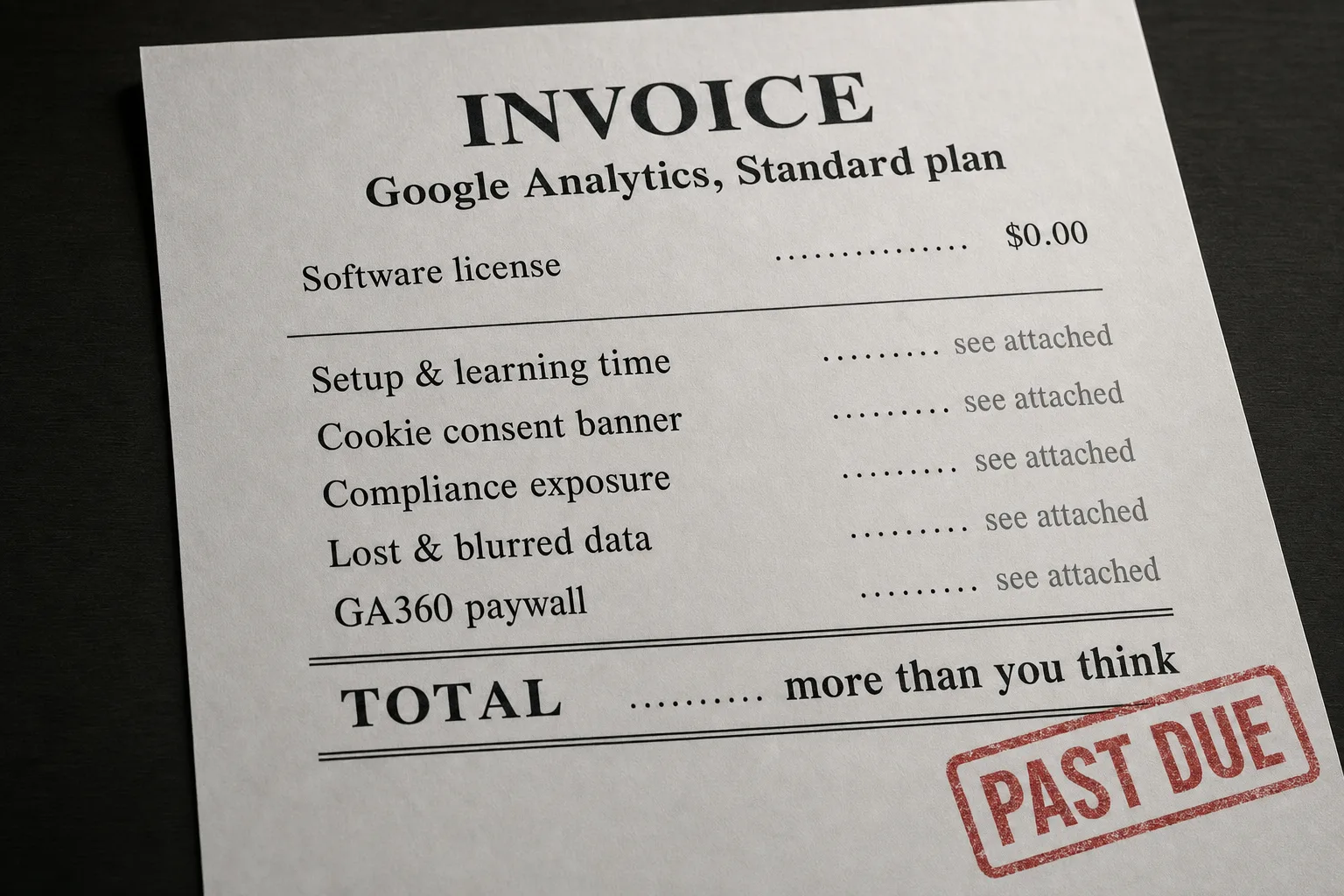
You installed Google Analytics because it was free. Everyone said to, the price was zero, and the box got ticked.
The cost shows up later, and it shows up everywhere except the price.
I build a competing analytics tool, so read me with that in mind. That's also why I pinned every figure below to Google's own documentation, EU law, named studies, and Alphabet's own filings, so you can check me rather than trust me.
Is Google Analytics really free? GA4 costs nothing to install. But "free" is its price tag, not its bill. A normal site still pays in five hidden line items: the time to set it up and learn it, a cookie-consent banner that then deletes the visitors who decline, compliance exposure on a legal framework already struck down twice, data that is blocked and sampled and hidden and expired on a timer, and the GA360 paywall, reportedly around $50,000 a year, because there is nothing in between. Here is the itemized invoice, then the same invoice zeroed.
- Google Analytics costs $0 to install, but free is its price tag, not its bill. A normal website still pays in time, a cookie banner, compliance exposure, lost data, and a paywall ceiling.
- The data degrades exactly where it matters. Free GA4 starts sampling explorations above 10 million events (GA360 allows 1 billion, a 100x gap), keeps your history for only 14 months, and new properties start at just 2.
- The cookie banner is a double cost. You pay a consent platform around 7 to 90 euro a month per domain for a banner whose entire job is to make your free analytics collect less, and just over a quarter of visitors accept.
- There is no middle tier. The only way to lift any free limit is Google Analytics 360, reportedly around $50,000 a year, sold by quote with no public price. You go from $0 straight to a five-figure contract.
- GA is free because you are the input, not the customer. Advertising was $294.7 billion of Alphabet's $402.8 billion 2025 revenue, and Google Analytics feeds that machine with your visitors' behavior.
Free is the price tag, not the bill
Let me be fair to GA before I take it apart. For a rough visitor count on a small site, the free tier works, and one honest commenter on Hacker News put it as bluntly as you can: "for 99% of websites there is no better alternative, paid or free to GA4." If all you ever need is a number on a screen, you can stop reading.
The trouble starts when you need a little more than that, because GA is built on a structure most people never notice. It has no middle tier. The free product, then a wall, then Google Analytics 360 at a price you have to call a salesperson to hear. There's no $20 plan. There's no $200 plan. Every limit you're about to read about lifts only when you cross from $0 to a five-figure annual contract.
So the question was never "free versus paid." It's "which invoice do you want." Free GA hands you one with the amounts left blank. Let me fill them in.
Line item one: the time
The biggest cost on the invoice is the one no competitor prices, because it doesn't arrive as a charge. It arrives as your hours.
Start with setup. Google's own "set up Analytics" guide is a seven-step sequence, and each step has its own sub-steps: a Google account, a property, a data stream, the tag on every page through Tag Manager, consent mode wired in, conversions defined. Then the work that never ends. One agency "puts a single custom conversion at 30 minutes to four or five hours" to build correctly in Tag Manager. One event.
Then there is the learning. GA4 is hard enough that Google sells a "certification" for it, and the certification expires every twelve months. Sit with that. The tool to read your own website needs a credential, and the credential lapses. It isn't just you finding it hard, either: after the forced move to GA4, a Search Engine Land poll found "only 23.1% of marketers had it fully set up and in use." That means three in four were still wrestling with it. Even the calm experts agree the thing is "built for analysts more than marketers."
Put a number on your own hours. Then look at what a "free" tool just cost you. I counted the everyday version of this struggle, click by click, in why GA4 feels too complicated, so I won't re-run it here.
Line item two: the cookie banner you buy, and the visitors it deletes
Here's a cost that's somehow worse than a flat fee. You pay for a tool whose job is to make your free analytics collect less.
Google Analytics sets cookies, and in the EU and UK, cookies like these need opt-in consent before they fire. That comes from the "ePrivacy Directive, Article 5(3)", a separate law from GDPR, which means you can't wave it away with "legitimate interest." You need a banner. On top of that, Google now requires "Consent Mode v2" for EEA traffic, commonly documented as live since March 2024, or you lose remarketing and audiences in Ads.
A banner means a Consent Management Platform, and that's a real subscription. Cookiebot, one of the common certified ones, runs from roughly 7 to 90 euro a month, "billed per domain", and it raised its base price in 2025. In practice, run three sites and you're paying three times.
Now the cruel part. The banner you just paid for suppresses the very data you installed GA to collect. Just over "a quarter of visitors accept all cookies" on the first level of the banner. The rest decline or ignore it, and for them GA collects nothing real. So you pay a monthly fee for a tool that throws away most of your visitors. I made the full case for skipping the banner entirely in the cookie banner is optional.
Line item three: the compliance exposure you can't buy out of
This one you can't fix with a budget line, and that's what makes it a cost.
Google Analytics sends data about your EU visitors to the United States, and three European regulators have ruled that unlawful. Austria's DSB went first, in "January 2022". France's CNIL "followed in February". Italy's Garante "banned a site's use of GA in June". They were acting on "101 model complaints" filed across the EU after the Schrems II ruling.
What put GA back on the right side of the line is the "EU-US Data Privacy Framework," adopted in July 2023. Here's the part that should make you nervous. It's the third deal of its kind. The first two, Safe Harbor and Privacy Shield, were both struck down by Europe's top court. And the third is already on appeal: a challenge "reached the Court of Justice in late 2025."
I'm not telling you GA is illegal today. I'm telling you its legality rests on a bet that's already lost twice. That is a strange foundation to build your measurement on, and I went deeper into it in is Google Analytics legal.
Line item four: the data you never see, and the data you can't trust
You'd forgive all of the above if the numbers were at least complete and correct. They're neither. Some of your traffic never reaches GA at all, and some of what does reach it gets blurred before you see it.
First, the traffic GA never sees. Three separate things take a bite, and they stack, because they're different mechanisms, not one fuzzy percentage. Ad blockers strip the GA request in the browser before it sends, and ad-block usage is no longer a fringe habit: "around 29.5% of internet users" run one, and Google Analytics sits on the standard "blocklists" by name. That means nearly 3 in 10 browsers send GA nothing. Independent measurements put the share of a normal audience that blocks GA in the low teens, and well over half on technical audiences. On top of the blockers, consent rejection drops most of the visitors who see your banner. And Safari's "tracking prevention" deletes the browser storage GA leans on, capping it to days.
Now the data that does arrive, degraded. GA's free tier "samples" your explorations once a query passes 10 million events, estimating from a slice instead of counting. GA360 raises that to 1 billion. Which means there's a 100x accuracy gap that kicks in exactly as your site grows into needing accuracy. On top of sampling, GA "thresholds" data to protect privacy, hiding numbers you collected (on a normal site, most of your report rows), and in Google's own words, "you can't adjust" it. And on a content-heavy site, your less-common pages get swept into a single "(other) row" once the table passes its limit, so your real pages quietly vanish into a bucket you can't open.
Blocked, declined, deleted, sampled, hidden, bucketed. The free report you are reading is a partial, blurred picture, and nothing in the interface tells you by how much. I took apart the accuracy side in full in how accurate is GA4.
And your history evaporates on a timer. Free GA4 keeps your event and user data for "14 months at most," and new properties start at just 2. In plain English: your history is on a 14-month timer. The deletion is automatic and not retroactive, so if you didn't flip the toggle on day one, your year-over-year comparison is permanently capped. The usual escape hatch, exporting to BigQuery, is itself "capped at 1 million events a day" on the free tier, and once you exceed it the export pauses and doesn't backfill. In other words, the free workaround has a limit too. I wrote about the memory cliff on its own in the GA4 data retention limit.
Line item five: the paywall, and why there is no middle tier
Every limit above has exactly one fix, and it's not a setting. It's a contract.
Google Analytics 360 is the only way to lift the sampling cap, the retention window, and the rest. It has no public price, because Google doesn't sell it from a page. You talk to a reseller, and the figure that comes back, by every third-party estimate, "starts around $50,000 a year" and climbs from there. Treat that number as reported, not official, because Google publishes nothing. Even the free tier's data freshness comes with Google's own disclaimer that it is "not a guarantee, nor an SLA or an SLO."
So picture the ladder. The bottom rung is $0. The next rung is a five-figure annual check. There is nothing between them. One Hacker News commenter described the jump as going "from totally free to $150,000 a year overnight" once your volume crosses the line. That's not a pricing model with options. It's a cliff, and the moment your site matters enough to need real depth, you're standing at the edge of it.
You are the input, not the customer
Step back and ask the obvious question. If all of this costs Google money to run, why is it free?
Because you're not the customer. Your visitors' behavior is the product, and it feeds the machine that pays Google's bills. In 2025, advertising was "$294.7 billion of Alphabet's $402.8 billion in revenue." In plain English: 73 cents of every dollar Alphabet makes is ad money. Google is an advertising company that happens to give away an analytics tool, and the tool is free because the data it collects on your visitors makes the ads worth more.
It's not subtle, either. Turn on "Google Signals" and GA associates your visits with signed-in Google accounts for cross-device remarketing. The data-sharing setting lets Google use your Analytics data "to improve its Ads system." That is the real transaction behind "free." One Shopify store owner put the feeling plainly: Google is "sucking all the valuable data off my website." Free analytics is the bait. Your audience is the catch.
The same invoice, zeroed
Now the part that makes this worth writing. Almost every line on that invoice exists because of one thing: Google's business model, not the laws of analytics. Change the model and the bill mostly goes to zero.
A flat-price, cookieless tool that doesn't sell ads has no reason to set a tracking cookie, so there's no banner, no consent platform to pay for, and no quarter-of-visitors-only data. It keeps the data on EU servers and never ships it across the Atlantic, so the compliance line isn't a wager. It serves its tracker from your own domain and counts everyone, so the ad-blocked visitors come back, and it doesn't sample or expire your history. And there's one price that you can read on a page, not a cliff you fall off.
That is what I built Clickport to be. The pricing is flat and public: "from 9 euro a month for up to 10,000 pageviews to 199 euro a month for up to 10 million", with a 30-day trial and no credit card. Going over your tier never stops your tracking or drops your data. None of it's a stripped-down trade either. Goals, funnels with drop-off, auto-discovered journeys, session-level drill-down, saved segments, and cross-filtering are all there, on one screen, the moment you log in. I built it cookieless on purpose, and explained how it works without tracking anyone in privacy-first analytics.
Free was never the cheap option. It was the expensive one, billed in things that don't look like money until you add them up.
So when someone tells you Google Analytics is free, you can agree, and then ask the better question. Free to install, sure. But who is paying, and with what.
If you've been carrying that invoice without seeing it, you can try Clickport free and watch the lines go to zero: no banner, no consent platform, no data shipped overseas, no sampling, no cliff, and your top pages, real sources, and live visitors on the screen the moment you log in, with goals and funnels and journeys waiting underneath. And if you've already decided to leave, here is exactly how to switch from Google Analytics in an afternoon.

Comments
Loading comments...
Leave a comment